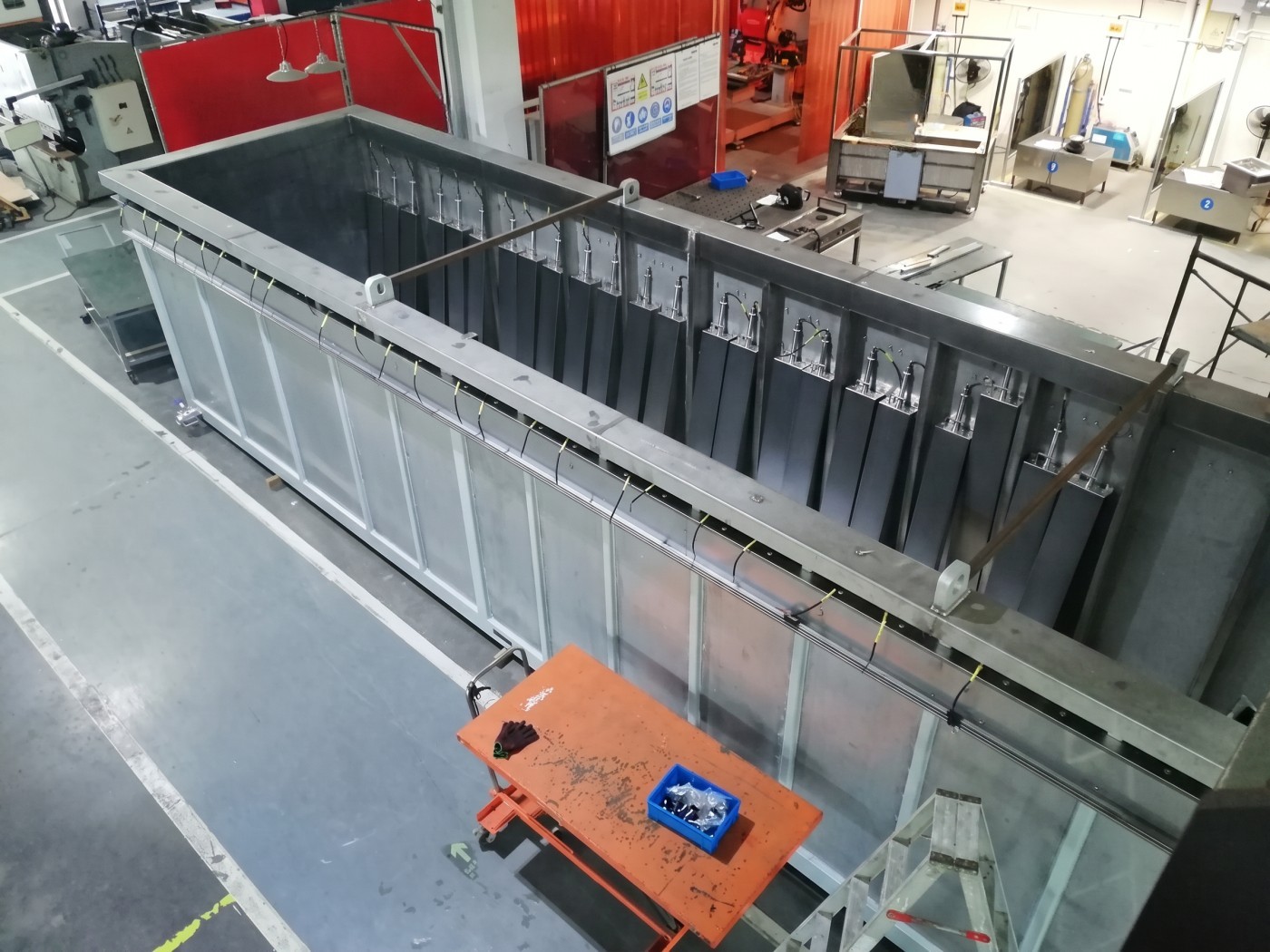
Click to enlargeHeat exchanger bundles are cleaned badly because they are cleaned in the wrong things — hydroblasted, chemically soaked, or cut down to fit the tank someone already owns. UltraMax HX is built the other way round: a tank sized to the bundle, with enough ultrasonic energy to reach the middle of it.
Four working lengths — 3, 6, 9 and 12 metres. 14,500 to 45,540 litres. Degreasing, decarbonising and passivation duty.
Every machine below is specified and priced from its own page — lid, heating, filtration and handling as priced options, with the drawing, the photos and the tank running on video.
≈11,880 L · 40 kHz · 43.2 kW. SS304 tank. The compact end of the range — condensers, coolers and shorter bundles.
Specify & price →≈23,760 L · 40 kHz · 86.4 kW. SS304 tank, deep section — the workhorse for most exchanger fleets.
Specify & price →≈29,160 L · 28 kHz · 156 kW nominal. SS316 bundle trough — confirmed in writing at quotation.
Specify & price →≈45,540 L · 28 kHz · 202.8 kW. SS316 bundle trough — the longest standard machine we build.
Specify & price →Enter the part; we calculate the tank, the volume and the ultrasonic power — and your selections become a complete RFQ.
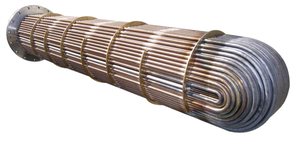
Start configuring →Hundreds of tubes, tight pitch, deposit on the inside and the outside, and no line of sight to most of it. Anything that relies on aim — jetting, lancing, spray — can only clean what it can point at.
It works wherever the liquid goes. In a bundle that means between tubes, into the pitch, and along the full length — the places a lance never reaches and a spray bar cannot see.
No media, no abrasive, no lance pressure against tube walls. Deposit comes off; wall thickness stays where it was. That matters when the bundle is going back into service and has to pass inspection.
Not every duty needs it, and the ones that do are split between sites with steam available and sites without. Electric clamp tubes with baffles and a fitted temperature sensor, or a steam pipeline where you already have the plant.
You are not paying for 120 kW of heating you will never switch on.
The connections are standard on every tank: dirty draw one side, filtered return the other. The skid itself is specified to your deposit — because filtering carbon off a rebuild bundle and filtering scale off an exchanger are not the same problem.
Retrofit later without touching the tank.
A tank this size is not something you take on trust. This is one running under test before it ships — the transducer banks driving the full volume.
The tank under test on the floor, transducers running.
Clip is silent and loads only when you press play.
All four share the same platform: submersible transducer arrays in SS316L housings, 415 V three-phase supply, and heating and filtration as specified options. Tank material is specified to the duty — SS304 on the 3 and 6, SS316 on the 9 and 12. Between sizes, or past them? Size your own tank.
| Model | Max bundle length | Volume | Effective tank (L×W×D) | Frequency | Ultrasonic power |
|---|---|---|---|---|---|
| UltraMax HX 3 | 3 m | ≈11,880 L | 3000 × 2200 × 1800 mm | 40 kHz | 43.2 kW |
| UltraMax HX 6 | 6 m | ≈23,760 L | 6000 × 2200 × 1800 mm | 40 kHz | 86.4 kW |
| UltraMax HX 9 | 9 m | ≈29,160 L | 9000 × 1800 × 1800 mm | 28 kHz | 156 kW |
| UltraMax HX 12 | 12 m | ≈45,540 L | 11000 × 1800 × 2300 mm | 28 kHz | 202.8 kW |
Click to enlargeA tank on the floor during build and test
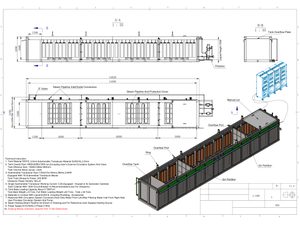
Photographed during build and test. The HX 12 general arrangement is dimensioned; drawings for HX 3 and HX 6 follow.
Lower frequency, larger cavitation bubbles, more energy per collapse. This is the setting for exchanger bundles carrying mineral scale, hard carbon and process deposit that has been baked on across a run. Standard on HX 12.
Frequency and temperature are separate decisions, and both are limited by the substrate. Aluminium, brass and coated assemblies need a gentler frequency and a lower bath temperature than carbon steel will happily take. Bath temperature — chemistry vs substrate →
SS304 on the 3 and 6 m tanks, SS316 on the 9 and 12 m bundle troughs — with SS316L transducer housings throughout. Confirmed with the chemistry at quotation.
2.5 mm SS316L housings. Arrays are positioned to the tank, not bolted on as an afterthought.
Generator cabinets sized per model. AS3100 certification for Australian installation.
Loaded from above by crane or gantry — the only sane way to place a bundle.
Design figure across the range. Confirm against your slab before siting.
Backed by Australian commissioning and support, not an offshore email address.
Bundles come in sizes, and so does the answer. Below the HX range the tank is a heavy industrial cleaner rather than a bundle tank; above the standard sizes, it is engineered from scratch.
4,433 L heavy industrial. Takes plate packs, headers and smaller bundles — and does heat-exchanger duty in its own right.
EVS 7000 →14,500 to 45,540 litres, 3 to 12 metres of working length. The bundle goes in whole.
Compare the sizes →A length no standard tank covers — size your own tank on the same platform. Or a staged sequence — degreasing, passivation and drying as separate stations.
Size your own → Custom builds →Every UltraMax tank ships with circulation connections as standard — dirty draw one side, filtered return the other. What goes between them is the option that decides how long the bath lasts. A bundle carries kilograms of scale, carbon and sludge; the first one loads the bath, and by the third you are re-depositing it.
The filtration skid is the answer: housings, pump, valves, instrumentation and pipework on one bunded frame, tested before it ships. Specified to your deposit — filtering carbon off a rebuild bundle and filtering scale off a water-side bundle are not the same duty, and the bag, the housing and the flow rate all change with it.
Weirs, coalescers and skimming, where the bundle brings oil with it.
Filtration overview →A heat exchanger rarely carries one deposit. Water-side scale, process-side carbon, oil, biofilm and corrosion product turn up in combination, and the chemistry has to suit the deposit and the tube metallurgy — copper, cupronickel, stainless and titanium do not all tolerate the same bath.
Where the deposit is mineral scale, or where sludge has to come out first.
Descale → · Desludge →Chemistry is selected against your deposit and your tube metal at trial, not chosen off a page. Send the bundle, or send a tube sample.
A bundle tank is a capital purchase, and the case for it is rarely the cleaning itself — it is what the cleaning replaces. These are the numbers worth putting side by side. They are yours, not ours: we will not quote a payback we cannot see your figures for.
| What to compare | The question to answer |
|---|---|
| Replacement avoided | What does a new bundle cost, and how many of the ones you scrapped were scrapped because cleaning could not recover them? |
| Downtime | What does an hour of that unit being down cost, and how many hours does the current method take against an unattended immersion cycle? |
| Labour | Hydroblasting and lancing are people standing there for the whole job. Immersion is loading and unloading. |
| Outsourcing | What do you pay per bundle now, including freight both ways and the time it is off site? |
| Heat transfer recovered | Fouling costs energy every day it is there. What is the fuel or power difference between a fouled and a clean unit on your duty? |
| Inspection pass rate | No media, no lance pressure, no metal removed — what is that worth where wall thickness is measured? |
| Water and disposal | Blast water volume against a filtered bath that is topped up rather than dumped. |
That single dimension decides the machine. Everything else follows from it.
Send bundle or component dimensions, the deposit you are removing and your throughput. Tanks this size are quoted to site — including installation, services and the options you actually need.