Home / Ultrasonic cleaning service
Contract ultrasonic cleaning · Australia

Send us the parts.
Get them back clean — and measured.

Contract ultrasonic cleaning for the work that does not justify buying a machine, and for the work that has to be proven before one is bought. Anywhere in Australia, freight in and freight out.

Work is accepted on application. Tell us what the parts are and what has to come off, and we will tell you whether we can take them — and where they go — before anything is freighted.

What makes this different

Anyone can wash a part. We hand you the evidence.

Every contract cleaner in the country will tell you the part came out clean. Almost none of them will tell you how clean, against a number, on a report you can put in front of your customer or your auditor. That is the whole service.

You get a result, not an opinion

Parts come back with the cycle recorded — chemistry, concentration, temperature, frequency, time — and with the cleanliness measured by whichever method your specification actually calls for. If you do not have a specification, we will tell you which one your customer is likely to use.

It is repeatable, because it is written down

The same recorded cycle can be run again next month and produce the same result. That matters when the parts are going into an audited process — and it is what makes the step from contract cleaning to owning a machine a small one rather than a leap.
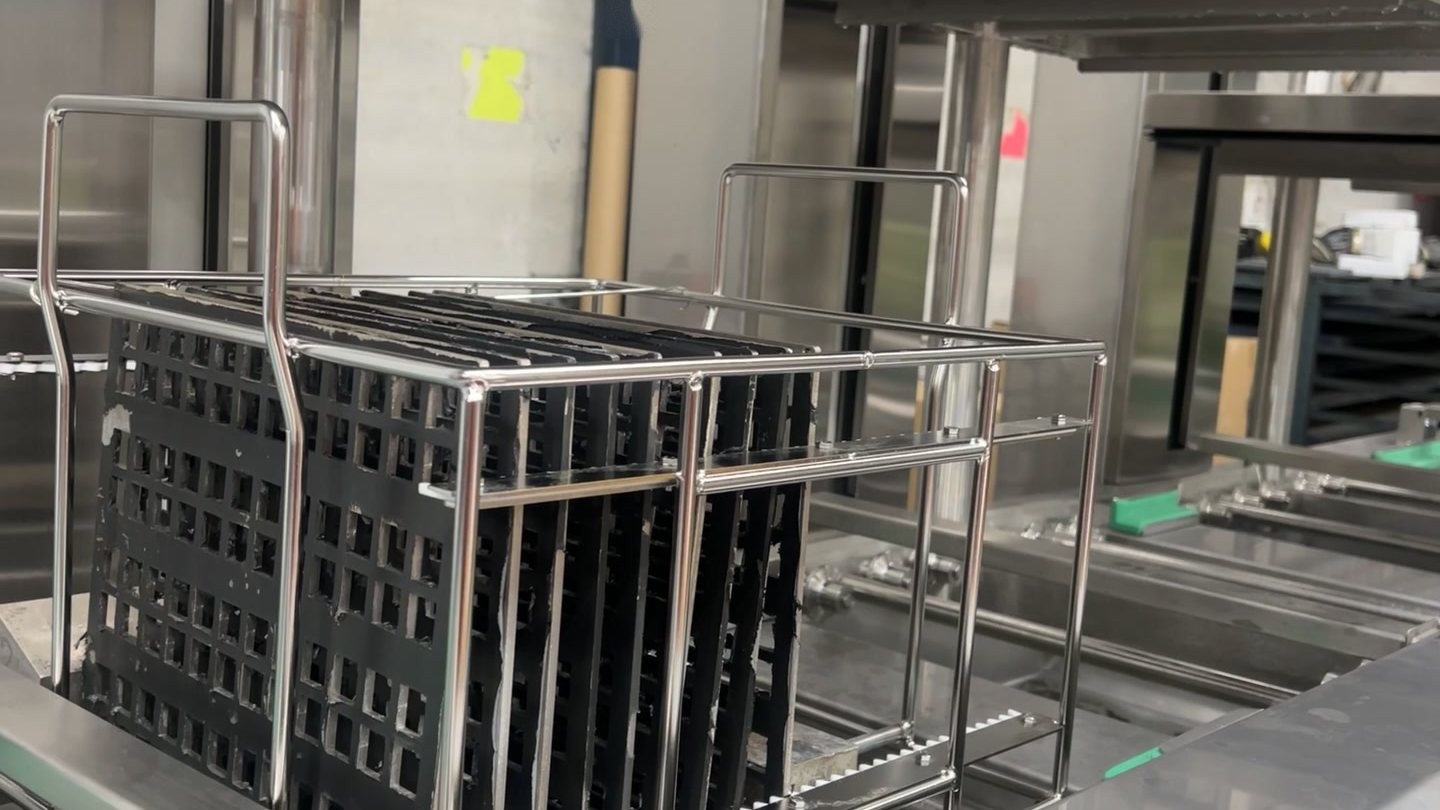
A rack of parts held above the ultrasonic wash tank of a Misonics Sonos L-130 line
Parts racked over the wash tank on our own three-stage line — held at drain position between stages.
The report

How we prove it

Which test we run depends on what you have to satisfy. Tell us the specification and we will match it; tell us you do not have one and we will start with the first two, because between them they answer most arguments.

MethodWhat it provesReference
Water break testNo hydrophobic film left — oil, grease, drawing compound, release agent, silicone. Pass/fail, instant, and the test most goods-inward departments will run on you anyway.ASTM F22
Gravimetric / Millipore patchMilligrams of residue per part or per 1000 cm², and a particle count sized off the same patch. The number you put in a purchase order.0.45 or 0.8 µm membrane
Component cleanliness codeParticle counts by size class, area-normalised — what an automotive, hydraulic or fuel-system drawing calls up.ISO 16232 / VDA 19.1
Non-volatile residue (NVR)Milligrams of residue by solvent rinse and evaporation. Aerospace, oxygen service, vacuum and optics.IEST-STD-CC1246 · CGA G-4.1
UV and white-light inspectionOil and organic film that white light alone will not show, plus the documented visual gate.CGA G-4.1
Surface energy — dyne or contact angleA number rather than a pass/fail on wettability — the test that predicts whether paint, adhesive or plating will hold.ASTM D2578

Methods available in-house versus referred to a laboratory are confirmed when we scope your job. Independent laboratory testing can be arranged where a third-party certificate is required.

How each of these tests actually works →

The work

What we clean, and what comes off

Parts and assemblies

Heat exchangers and cooler cores · engine components, heads and blocks · transmission and driveline parts · pumps, valves and manifolds · hydraulic assemblies · injection moulds and die tooling · extrusion and hot-melt filter elements · DPFs, EGR coolers and intercoolers · compressor screws · bearings and gearsets · instruments and precision components · filter baskets, screens and pall rings.

Contamination

Carbon and baked-on varnish · oil, grease and drawing compound · machining swarf and grinding paste · scale, rust and oxide · paint, ink and resin · polymer and hot-melt residue · soot and diesel particulate · casting sand and release agent · biological and process soil · flux and solder residue.

Where ultrasonics is the wrong answer, we will say so. Some soils come off faster and cheaper with a spray wash, a thermal process or blasting, and some substrates should never see a cavitating tank — soft alloys, thin foils, some coatings and anything already cracked. Part of what you are buying is being told that before you freight a pallet across the country.
How it runs

Six steps, and you see the result of each

1 · Assess

You send photos and a description, or a sample part. We identify the substrate, the soil and the acceptance criterion before anything is quoted.

2 · Select the chemistry

Chosen against the soil and the substrate from a 36-chemistry range, with the material cautions checked first — not discovered on your parts.

3 · Run the cycle

Frequency, temperature, concentration and time set for the job and recorded as it runs. Sweep and degas where the geometry needs them.

4 · Rinse and protect

Separate rinse stage so rinse water stays rinse water, then passivation or a temporary corrosion inhibitor where the substrate needs one.

5 · Dry

Heated dry, with blow-off for blind holes and galleries — because a part that flash-rusts on the way back to you was not cleaned, it was wetted.

6 · Verify and report

The test your specification calls for, with the result and the full cycle record returned alongside the parts.

Before anything is freighted

Work is taken on application

We do not accept everything, and we would rather say so before you pay a freight bill than after. Every job is scoped first — what the parts are, what is on them, what the substrate will tolerate and what you have to prove at the end. Where the work is processed is confirmed with you at that point, because it depends on the size of the parts, the chemistry required and the turnaround you need.

What we will usually take

Metal and most engineering plastics, in batches from a single instrument to a pallet of assemblies. Carbon, oil, grease, scale, swarf, polymer, soot and process residue. Parts with a defined cleanliness standard behind them, and parts where the standard has yet to be set.

What we will usually decline — and say why

Substrates that cavitation damages, anything already cracked or fatigued, sealed assemblies that will trap fluid, plated or coated surfaces at risk of lifting, and soils that a different process removes faster and cheaper. If ultrasonics is the wrong tool we will tell you what the right one is.

How a job startsPhotographs and a description, or a sample part — then a written scope before any freight moves
Batch sizeSingle items through to pallet quantities
FrequencyMatched to the job — lower for heavy soil on robust parts, higher for fine detail and delicate surfaces
Operating temperatureAmbient to 90 °C, set by the chemistry and the substrate
Chemistry available36 formulations — alkaline, neutral, acidic, passivation, oil-splitting and specialty see the range
Bath managementBag filtration and oil separation, so the last part in the batch is cleaned in the same bath condition as the first
Part size and turnaroundConfirmed at scoping, against your deadline
CoverageAustralia-wide. Freight arranged both ways
The honest version

Send it out, or buy a machine?

We sell both, so we have no reason to push you either way. This is roughly how the decision falls.

Send it out whenBuy a machine when
The work is occasional, seasonal or a one-off shutdownParts come through weekly or daily
You need it cleaned once, to a standard, to win the jobThe cleaning step is inside your own production takt
You are proving the process is even possibleThe process is proven and the volume justifies the capital
The parts are too large or too contaminated for your existing plantFreight, handling and downtime cost more than the machine amortised
You want a number before you spend capitalYou need control of the schedule and the parts never leave site
Most of our machine customers started here. A box of parts, a documented trial, a number they could show someone. The cleaning service and the cleaning trial are the same process — the only difference is whether you are buying the result or evaluating the machine that produced it.
Quoted per job

Price depends on the soil, the substrate, the part count, how much handling and masking is involved and which verification you need — so a real number needs a real look at the parts. Send photos and a description and you will have a quote, not a range. Standing arrangements and per-batch rates are available where the work repeats.

Start here

Tell us about the parts

The more of this you can answer, the more useful the first reply is. If you do not know something, leave it — but do send photos. We will come back with whether we can take the work, where it would be processed and what it will cost, before you send anything.

Photographs are the single most useful thing you can send — both sides of the part and a close-up of the worst area. Email them to sales@misonics.com.au and we will match them to this enquiry.

Related

If you are further along than this

You already know you need a machine

Nine machine groups from a 3.3 litre benchtop to a 45,540 litre immersion tank. See the range →

You want the test explained first

What each cleanliness test measures, what it misses, and which one your customer is likely to use. Read the guide →