The best industrial ultrasonic cleaner for your parts
The best industrial ultrasonic cleaner is the one that cleans your parts every shift at a running cost you can live with. Tank litres will not tell you that. These are the checks we run on every job, and the questions to put to any supplier.
All prices include GST.
What to look for at each size
The same checks apply to every machine, but what matters most changes with the size of the part. Find the row your biggest part sits in, then read down. Figures are from our published model specifications.
| Benchtop | Floor-standing workshop | Large and heavy industrial | Multi-stage and automated | |
|---|---|---|---|---|
| Typical jobs | Injectors, carburettors, firearm components, tooling, lab and clinic kit, circuit-board batches | Cylinder heads, manifolds, gearbox casings, pump housings, engine blocks, DPFs | Engine blocks and heads, radiator and heat-exchanger cores, power-station filter elements, mining final drives, heat exchanger bundles | Batches of production parts that must leave rinsed and dry, ready for coating, NDT or assembly |
| Biggest part | Baskets 240 to 490 mm long, 80 to 140 mm working depth | Baskets 500 to 900 mm long, 300 to 500 mm working depth | EvoSonic tanks to 2,495 mm long. UltraMax HX tanks for heat exchanger bundles of 3 to 12 m | Sized by basket and the number of stages |
| How often it runs | PowerSonic for occasional and light-commercial work. MSX 15 and MSX 30 for daily bench duty | Daily workshop duty, every shift | Heavy soils on a production or overhaul floor. Loaded by hoist, crane or an optional lifting platform | Production. One operator loads a basket and the machine runs the recipe, about 15 to 30 minutes a basket |
| Ultrasonics | 40 kHz swept. The MSX 30 runs dual 25/45 kHz | 25 kHz, 1,500 to 4,500 W, with load sensing | 25 kHz on EvoSonic, 28 kHz on UltraTecno ACM, 28 or 40 kHz on UltraMax HX | 25 kHz on UltraKleen Pro and UltraWash. Dual 25/45 kHz on SonoLine |
| Heating | To 80 °C | 2.4 to 4 kW, to 80 °C | EvoSonic 12 to 70 kW. UltraMax HX heating is a priced option, electric or steam | Heated wet stations, temperature held by the recipe |
| Oil and solids | No weir. Drain and replace the bath when it is spent | MSX 50, 70 and 150: drain valve, no weir. MSX 140 and 240: displacement weir and oil capture. MSX 240 adds a 150 µm triple interceptor and filtration | EvoSonic: displacement weir, oil capture and interceptor, with stainless filtration as an option. UltraTecno ACM: bag filtration option | Filtration on each wet stage and an oil skimmer on the wash. UltraWash filters to 5 µm through three collection tanks |
| Drying | None on the machine. Rinse and dry as a separate step | None on the machine. The MSX 150 pairs the wash with a rinse tank. Add a hot-air dryer alongside | Rinse tanks and drying stages quoted with the machine | Hot air on the last station. UltraWash adds a vacuum stage that dries blind holes and galleries |
| Power supply | 240 V, standard 10 A socket | 240 V single phase on MSX 50, 70 and 150. 415 V three phase on MSX 140 and 240 | 415 V three phase | 415 V three phase on UltraKleen Pro and UltraWash. SonoLine in 240 V single phase or 415 V three phase |
| Misonics range | PowerSonic, MSX 15, MSX 30 | MSX floor range: MSX 50, 70, 140, 150, 240 | EvoSonic EVS, UltraTecno ACM, UltraMax HX | UltraKleen Pro, SonoLine, UltraWash |
Basket sizes, power and heating for every model are on the model pages and in ultrasonic cleaner sizes. All specifications are confirmed at quotation.
The checks before you buy
1. Size the tank from your biggest part
Measure the biggest part you will ever clean, not the average one. The tank opening must clear it with room to lower it in and lift it out. The working depth must cover it completely, with the basket and any fixture under it. Then check the basket load limit. Buying on tank litres alone is the most common mistake we see.
2. Match the frequency to the soil
Low frequency, around 25 kHz, gives the heavy scrubbing action that shifts carbon, grease and scale from robust metal parts. Higher frequencies, around 40 to 45 kHz, give a finer action for detailed parts and softer surfaces. A dual-frequency tank covers both. Read more on choosing the frequency.
3. Compare power on the same basis
Watts per litre tells you how hard the tank works the bath. Suppliers quote power in different ways, nominal or peak, so ask which figure you are being given and compare like with like. Ask how many generators drive the tank and whether power can be adjusted.
4. Look at how the tank is built
Stainless grade and wall thickness decide how long the tank survives cavitation and chemistry. SS316 resists aggressive chemistry better than SS304. Ask what transducers and generators are fitted, and how the transducers are fixed to the tank. Many low-cost machines use mass-produced kits with transducers glued to the tank that cannot be replaced on their own. Ask how the transducers are fixed, what sustained power they are rated for, how one is replaced and what that costs. Look for transducers that can be replaced in the field, generators with modern wave modulation, and a remote connection so the generator can be diagnosed and updated on site. Cheap transducers fail in three ways: the piezo ceramic cracks and drifts off frequency, the clamp bolt loses tension, or the glue line to the tank lets go. Why we use rod resonators in large tanks. Ask what the warranty covers on them. Where cheaper machines save money.
5. Check the heating
Most aqueous cleaning chemistry is made to work hot. Check the heater size against the tank volume and ask how long the tank takes to reach temperature from cold. A small heater on a big tank costs you the first hour of every shift.
6. Ask how oil and soil leave the bath
Oil floats. Without a weir or overflow to skim it, parts are lifted out through an oil film and pick it back up. Filtration keeps solids out of the bath. Both decide how long a charge of chemistry lasts before it has to be dumped.
7. Decide how the part leaves the machine
A single tank washes. If parts must come out rinsed and dry, you need a rinse and a dryer: separate tanks in a line, or one sealed chamber that washes, rinses and dries behind one door.
8. Think about the operator
Baskets, lids and lifting decide whether the machine gets used properly. Heavy baskets need a lifting platform or a crane. A lid holds heat and keeps noise down. Stored recipes stop cycles being cut short.
9. Get the chemistry right
The chemical has to suit the soil and the metal. Ask for the safety data sheet and the technical data sheet, and follow the dose and temperature on the data sheet.
10. Check the support in Australia
Ask who commissions the machine, who trains the operators, where the spare parts are held, how faults are diagnosed, and what the warranty covers. A cheap import with no local support costs more the first time a generator fails.
11. Prove it on your parts
Ask for a documented result on parts like yours. Where the part is unproven, send the part, the soil and a photo, and talk it through with an engineer before you commit. The records to ask for.
The best industrial ultrasonic cleaner for each job
Ranked by the work, not by the brochure. These picks compare machines in the Misonics range, which we supply; they are not an independent market comparison. In every row the best machine is the smallest one that takes your biggest part and your production load in the cycle time you need, with the oil, heat and drying handled. Benchtop prices are listed. Floor machines and above are quoted to site. All prices include GST.
| The job | Best pick | Why it wins | Price |
|---|---|---|---|
| Small parts on a bench: lab, electronics, firearms | PowerSonic PS 603 to PS 620, 3 to 20 L | Heated digital benchtop tanks with basket and lid included, listed pricing, bought outright | From $1,622.50 inc GST |
| Trade bench: injectors, carburettors, small engine parts | MSX 15 and MSX 30, 15 and 30 L | SS316 tanks, stored recipes, 8 and 12 kg baskets; the MSX 30 runs dual 25/45 kHz so one cycle scrubs then finishes | $4,367 and $6,578 inc GST |
| Workshop floor machine: heads, manifolds, calipers, valve bodies | MSX 50 to MSX 240, 50 to 240 L | 1,500 W and up at 25 kHz with load sensing, 240 V single phase on the smaller tanks, factory oil management on the big ones | Quoted to site; rent from $140 a week |
| Parts that must come out rinsed and dry, every cycle | UltraWash, 70 to 300 L | One sealed chamber runs spray, flood, ultrasonics, rinse, hot-air and vacuum dry as a programmed sequence | Quoted to site |
| Batch production with wash, rinse and dry in a row | UltraKleen Pro, 100 to 320 L | Three stations with roller travel and a collection tank behind every wet tank | Quoted to site |
| Engine blocks, filter elements, fabricated assemblies | EvoSonic EVS, 180 to 10,000 L | An optional elevator platform does the lift, so nobody reaches into a hot bath and heavy baskets are not a crane job | Quoted to site |
| Heavy-duty tanks loaded at bench height | UltraTecno ACM, 405 to 5,881 L | Spanish-built 28 kHz tanks with a pneumatic platform lift, supplied and serviced here | Quoted to site |
| Heat exchanger bundles and the largest parts | UltraMax HX, 12,000 to 46,000 L | Immersion tanks built around the bundle, four working lengths to 12 metres | Quoted to site |
See every machine in the range
Not sure which row you are in? Compare ultrasonic cleaner sizes, or send the biggest part and we will tell you.
Every model and its figures
The published figures for every machine we build, so you can compare on the same basis rather than on a brochure claim. Ultrasonic power is the nominal continuous rating unless the row says peak. Heating is the installed heater rating. Every model page carries the full specification, dimensions and the general arrangement drawing.
Swipe the table sideways to see every column.
| Model | Tank volume | Frequency | Ultrasonic power | Heating | Tank steel |
|---|---|---|---|---|---|
| MSX benchtop — light industrial | |||||
| MSX 15 | 15 L · 17 L solution | 40 kHz | 300 W | 0.6 kW | SS316L, 1.5 mm |
| MSX 30 | 30 L | 25 / 45 kHz | 650 W | 1 kW | SS316, 1.5 mm |
| MSX floor-standing — industrial | |||||
| MSX 50 | 50 L · 86 L solution | 25 kHz | 1,500 W | 2.1 kW | SS316, 3 mm |
| MSX 70 | 70 L · 129 L solution | 25 kHz | 1,500 W | 2.1 kW | SS316, 3 mm |
| MSX 140 | 140 L · 235 L with weir | 25 kHz | 3,000 W | 4 kW | SS316, 3 mm |
| MSX 150 | 2 × 76 L · 152 L per tank | 25 kHz | 3,000 W | 3 kW | SS316, 3 mm |
| MSX 240 | 240 L · 353 L with weir | 25 kHz | 4,500 W | 5 kW | SS316, 3 mm |
| EvoSonic EVS — heavy industrial | |||||
| EVS 180 | 180 L | 25 kHz | 3,000 W | 12 kW | SS316, 3 mm |
| EVS 300 | 300 L | 25 kHz | 9,000 W peak | 12 kW | Confirmed at quotation |
| EVS 600 | 600 L | 25 kHz | 10,500 W | 21 kW | SS316, 3 mm |
| EVS 800 | 800 L | 25 kHz | 15,000 W peak | 21 kW | Confirmed at quotation |
| EVS 1200 | 1,200 L | 25 kHz | 18,000 W | 28 kW | SS316, 3 mm |
| EVS 1500-PL | 1,550 L | 25 kHz (40 opt.) | 18,000 W | 28 kW | SS316, 3 mm |
| EVS 7000-PL | 4,433 L | 25 kHz | 63,000 W | 70 kW | SS316, 5 mm |
| UltraMax HX — immersion tanks built around the bundle | |||||
| UltraMax HX 3 | 11,880 L · 3 m long | 40 kHz | 43.2 kW | 90 kW option | SS304, 3 mm |
| UltraMax HX 6 | 23,760 L · 6 m long | 40 kHz | 86.4 kW | 120 kW option | SS304, 3 mm |
| UltraMax HX 9 | 29,160 L · 9 m long | 28 kHz | 156 kW | Steam or electric | SS316, 3 mm |
| UltraMax HX 12 | 45,540 L · 12 m long | 28 kHz | 202.8 kW | Steam or electric | SS316, 3 mm |
Tank volume is the working volume, then the total solution the machine holds where that differs. UltraMax HX heating is a priced option, electric or steam. The MSX 30 runs dual frequency, 25 kHz to scrub and 45 kHz to finish. Benchtop machines are listed at a price including GST. Floor-standing machines and above are quoted to site, because the weir, filtration, platform and electrical supply change with the job. Rental starts at $63 a week on the benchtops and $140 a week on the floor range.
Where each one is built
Misonics is Australian owned. Every machine in the range is designed, engineered and specified here, and commissioned, trained and supported from Melbourne with a 12-month warranty. Who builds the steel differs by model, and we say which:
- MSX 50 to MSX 240 — assembled in Australia.
- MSX 15 and MSX 30 — built offshore to Misonics design, specification and test requirements. We write the specification, direct and pay for the testing, and hold the build to it.
- EvoSonic EVS and UltraMax HX — our own design, build and control software, including the PLC recipes and remote diagnostics.
Our machines at work
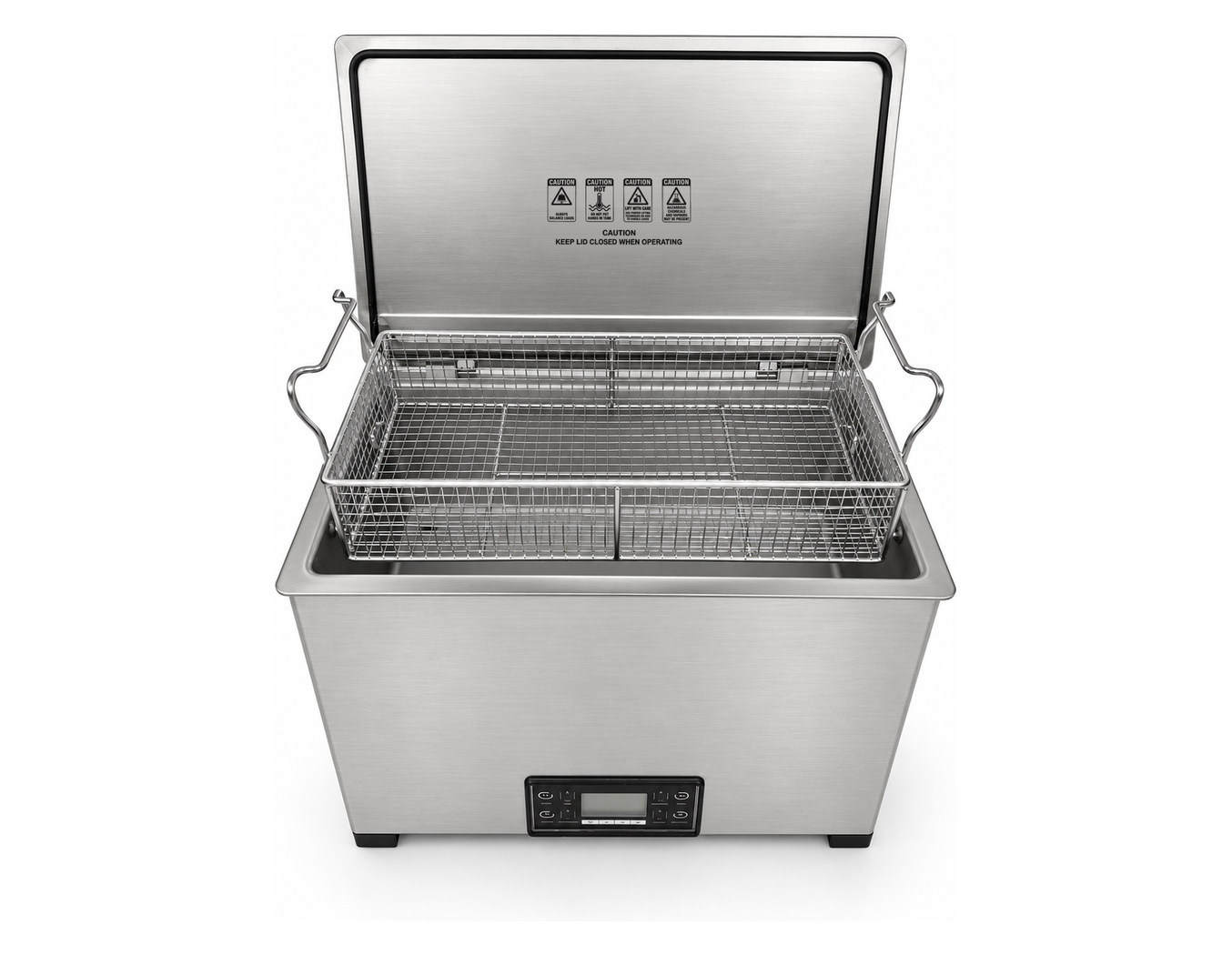
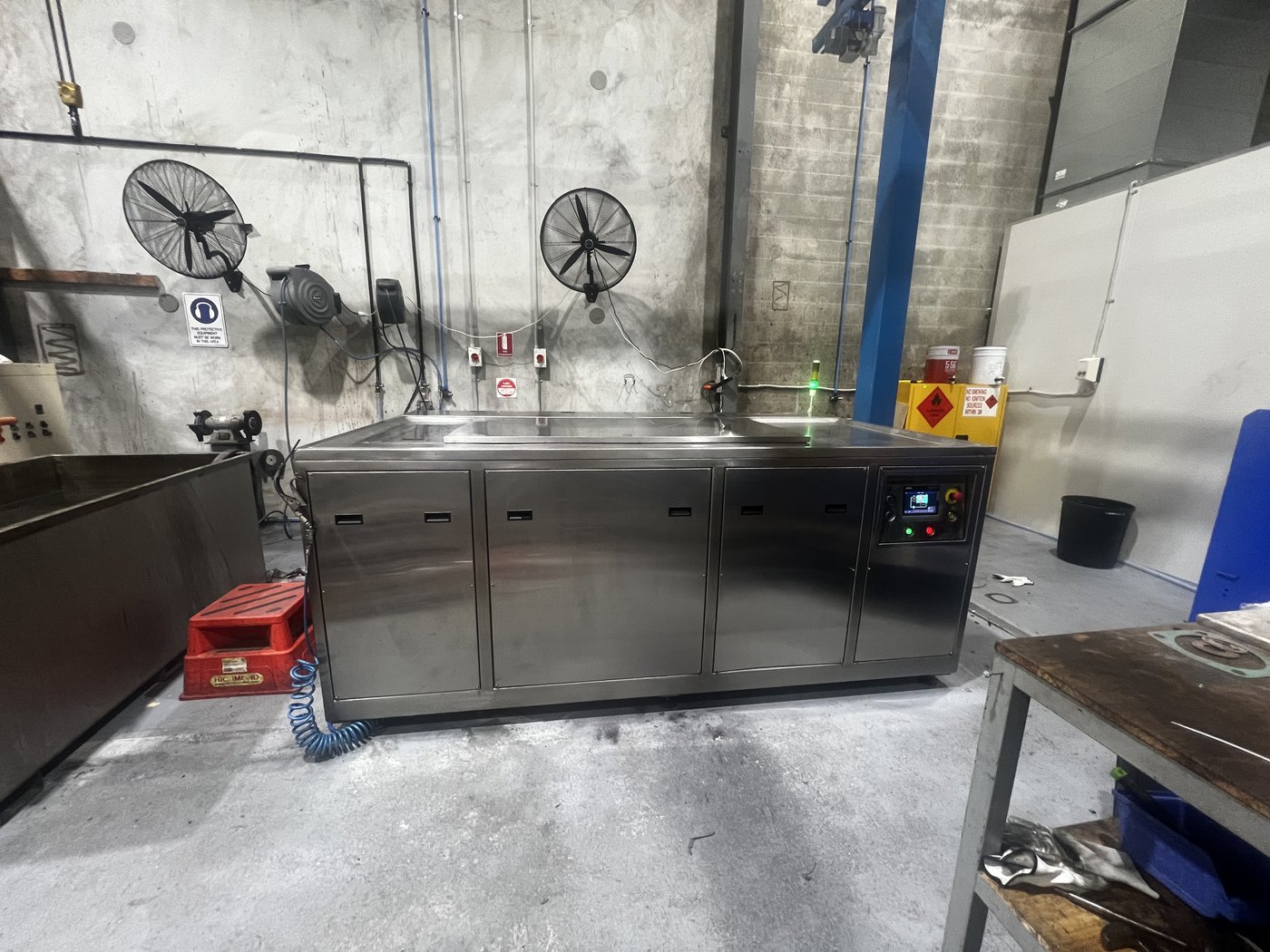
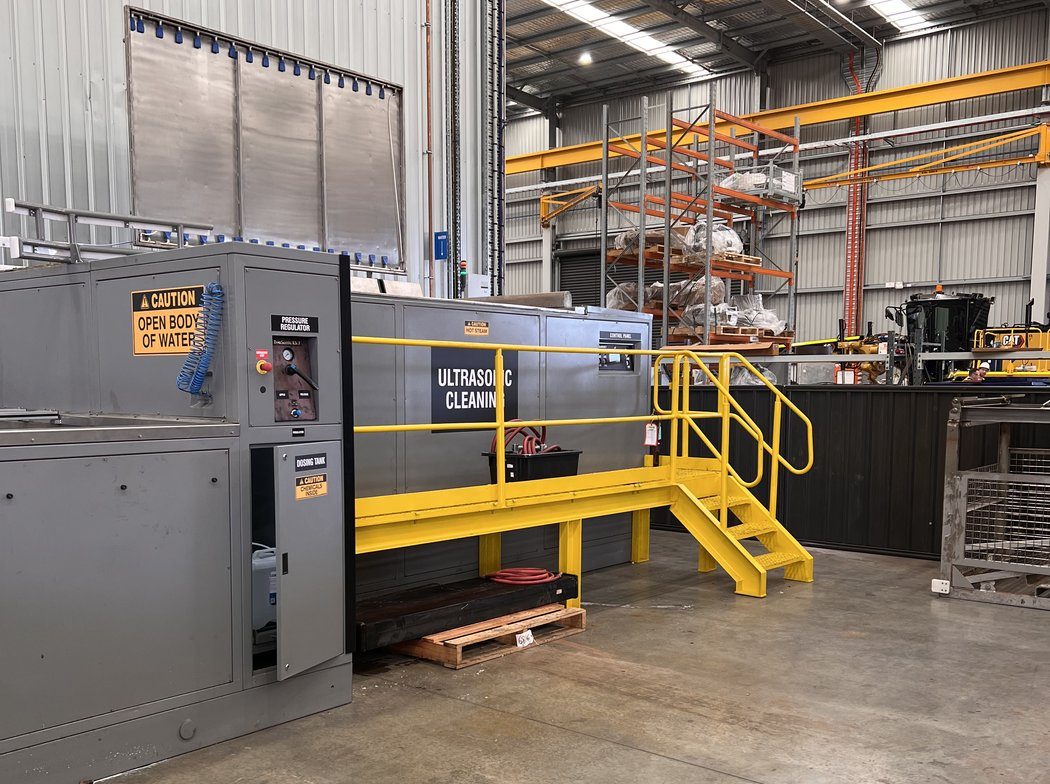
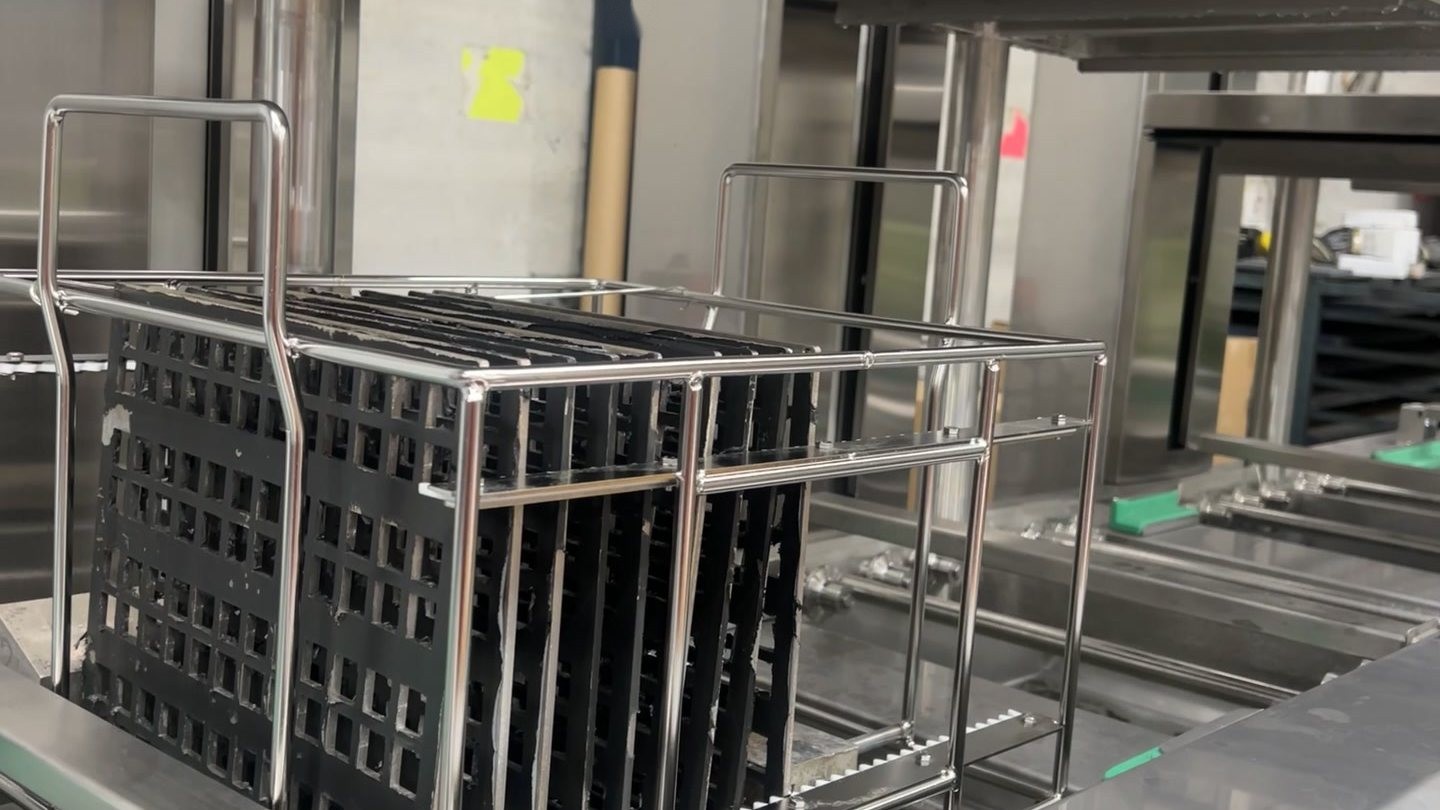
- Buying on tank litres instead of the size of the biggest part
- No way of removing oil, so clean parts come out with a film on them
- The wrong frequency for the soil
- A heater too small for the tank
- No rinse or dry, when the next process needs a dry part
- No local service or spare parts
Buyer's checklist
Take this to any supplier.
Where each Misonics range fits
See all our machines, or pick a range below.
Why buy your industrial ultrasonic cleaner from Misonics
We supply and support the whole span, from a PowerSonic on the bench to an UltraMax HX immersion tank built around a 12 metre heat exchanger bundle, with the chemistry, filtration, hot-air drying and automated lines that turn a tank into a working process. Between those ends sit the MSX benchtop and floor ranges, the Sono platform, UltraWash sealed chambers, UltraKleen Pro lines, EvoSonic EVS and UltraTecno ACM heavy-industrial tanks, and engineered one-off builds for the part nothing standard suits.
Our documented results run from PCB flux removal to engine block rebuilds, piston ring-groove carbon, DPF cores, power station filters, radiators and heat exchangers, firearms armouries and meat processing plant, across aerospace, mining, defence, rail, marine, oil and gas, energy, food and beverage, automotive, electronics and manufacturing. Each one is written up with the part, the soil, the chemistry and the result, and that is the standard every machine we sell is held to.
Search for the best ultrasonic cleaner and most of what comes back is a benchtop unit for jewellery, glasses or retainers. An industrial ultrasonic tank is a different object: 316 stainless thick enough to survive years of cavitation and hot chemistry, transducers fixed and rated to carry sustained power rather than a peak figure, a heater sized to the tank, and a weir or overflow so the oil you remove does not go back on the part. MSX 50 to MSX 240 are assembled in Australia; the MSX 15 and MSX 30 benchtops are built offshore to our design, specification and test requirements. Where each model is built. Every machine is commissioned, trained and supported from Melbourne, with a 12-month warranty.
For chemistry we run the Brulin AquaVantage range, with more than forty OEM approvals from Boeing to NASA oxygen service on 815 GD and Pratt & Whitney approval on 815 QR-NF, beside Misonics chemistry toll-manufactured for the application. Every product is Misonics Tank Approved: run in our own tanks at the published dilution and temperature. See the best ultrasonic cleaning solution for each job.
Questions buyers ask
What is the best frequency for an industrial ultrasonic cleaner?
For heavy soils on robust metal parts, around 25 kHz. For detailed parts and softer surfaces, around 40 to 45 kHz. A dual-frequency tank such as the MSX 30 covers both.
Is a bigger ultrasonic tank always better?
No. A bigger tank spreads its power through more liquid and costs more in heat and chemistry every day. Choose the smallest tank your biggest part fits in, fully under the liquid, with room to lift it in and out, that still handles your production load: baskets per hour, circulation and cycle time.
What does an industrial ultrasonic cleaner cost?
Our MSX 15 bench machine is $4,367 and the MSX 30 is $6,578, including GST. Floor machines and larger systems are quoted to site as a working system: machine, chemistry, baskets and commissioning in one price, including GST.
What is the best ultrasonic cleaner for a workshop?
For injectors, carburettors and small engine parts, the MSX 30: dual 25/45 kHz, a 490 × 235 mm basket rated to 12 kg, and it runs from a standard 10 A socket. For cylinder heads, manifolds and calipers, a floor-standing MSX 50 or MSX 70. Where heavy oil comes off every load, the MSX 140 or MSX 240, which carry a displacement weir and oil capture.
Do I need three-phase power for an industrial ultrasonic cleaner?
Not for the smaller machines. The PowerSonic, MSX 15 and MSX 30 run from a 10 A socket, and the MSX 50, MSX 70 and MSX 150 run on 240 V single phase. The MSX 140, MSX 240, EvoSonic tanks and most automated lines need 415 V three phase. We confirm the site supply on every quote.
Should I buy an ultrasonic cleaner or a parts washer?
A spray parts washer cleans the surfaces it can hit. Ultrasonics reach blind holes, threads and internal passages. Where parts must also come out rinsed and dry, a sealed ultrasonic parts washer such as UltraWash does both in one chamber.
Who makes the best industrial ultrasonic cleaner in Australia?
There is no single answer, because the best machine is the one that suits your part, your soil and your shift. Judge any supplier on five things you can check: the tank steel grade and wall thickness, whether transducers can be replaced on their own in the field, the heater rating against the tank volume, whether there is a weir or overflow to take the oil out of the bath, and who commissions, trains and holds spares in Australia. Misonics is Australian owned and builds the MSX, EvoSonic EVS and UltraMax HX ranges. MSX 50 to MSX 240 are assembled in Australia; MSX 15 and MSX 30 are built offshore to Misonics design, specification and test requirements; EvoSonic EVS and UltraMax HX are Misonics' own design, build and control software. Every machine is designed, engineered and specified in Australia, and commissioned, trained and supported from Melbourne with a 12-month warranty.
Are Misonics ultrasonic cleaners made in Australia?
In part, and we say which. Misonics is Australian owned, and every machine in the range is designed, engineered and specified in Australia. MSX 50 to MSX 240 floor-standing machines are assembled in Australia. The MSX 15 and MSX 30 benchtops are built offshore to Misonics design, specification and test requirements, with Misonics writing the specification and directing and paying for the testing. EvoSonic EVS and UltraMax HX are Misonics' own design, build and control software, including the PLC recipes and remote diagnostics. All of it is commissioned, trained and supported from Melbourne.
Is the best ultrasonic cleaner for parts the same as one for jewellery?
No. A jewellery or retainer cleaner is a small, lightly heated bath with a plastic basket. Parts cleaning needs a heated stainless tank, a basket rated for the load, a degreaser at the data-sheet dose, and a way to remove the oil that comes off.