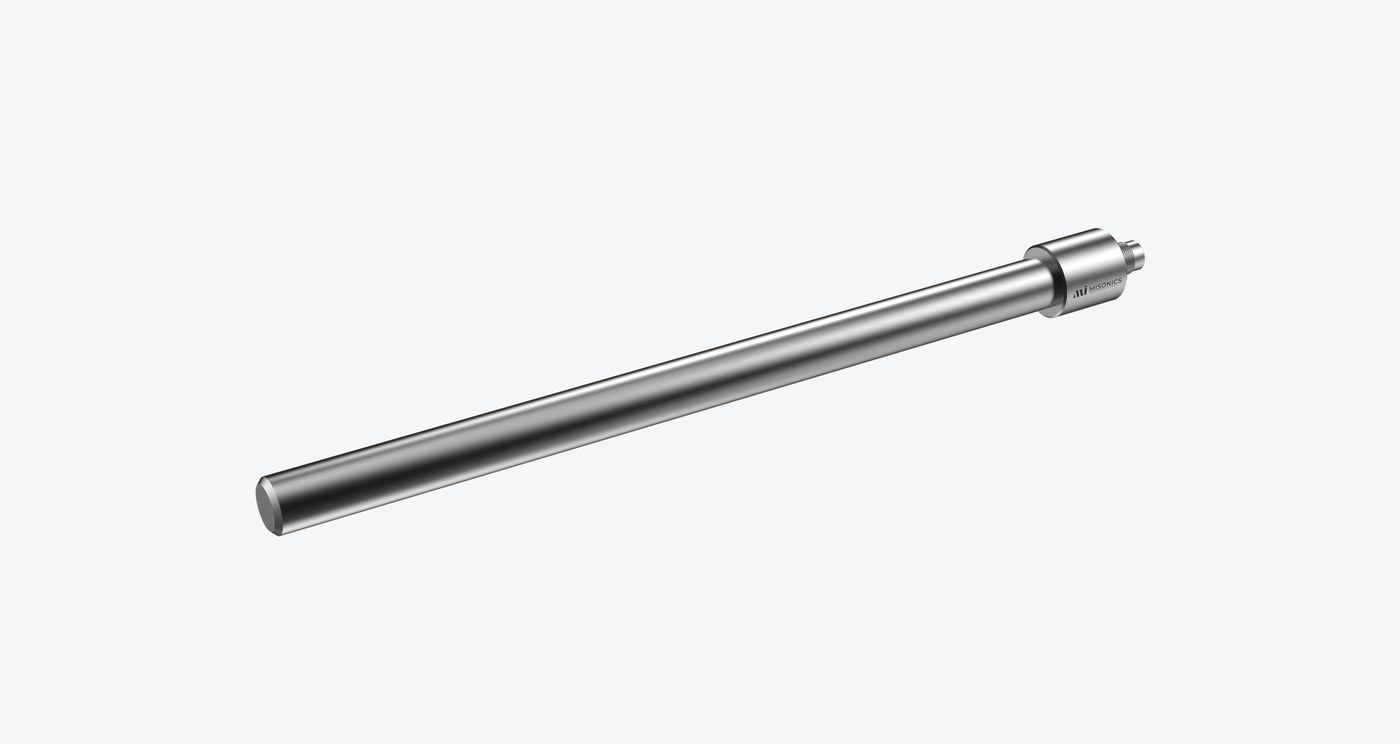
Most ultrasonic tanks radiate from one direction — transducers bonded to the base, energy firing upward, parts cleaned best on whatever faces the floor. The 360° rod resonator breaks that geometry: a cylindrical radiator that drives the sound field outward in every direction along its length. For deep tanks, retrofits and brutal environments, it changes what a tank can be.
A rod resonator is a solid titanium-alloy or stainless waveguide, driven from one end by a transducer stack outside the liquid. The rod itself resonates along its length, radiating ultrasonic energy from its whole cylindrical surface — an even, omnidirectional field, top to bottom of the immersed length. Because the drive sits outside the tank, the wetted component is a sealed solid with nothing to flood and nothing bonded to fail.
Deep and tall loads clean evenly. Base-mounted fields fade with depth; a vertical rod delivers the same intensity at every level. Tall baskets, hanging parts and deep tanks stop having a "good zone".
Retrofit without rebuilding. A rod drops into any existing vessel — a rinse tank, a process bath, a tank you already own — and turns it ultrasonic. This is the heart of our Naked Sonics retrofit line.
It survives what kills bonded plates. The classic base-transducer failure is contaminant settling on the radiating surface, insulating it until the bond cooks. A vertical rod has no horizontal face to bury — settled sludge falls past it, not onto it. In dirty, heavy-soil duty, that is the difference between a service item and a casualty.
Rod resonators are single-frequency devices — 20, 30 or 40 kHz — and their strength is robust, even, deep-field cleaning rather than fine high-frequency finesse. Precision multi-frequency work stays with bonded and immersible BLT platforms; the rod owns depth, retrofit and abuse.
Base-radiating tanks attenuate with distance: load shadowing and field spreading mean the top of a deep basket can see a fraction of the floor-level intensity — the classic "bottom layer perfect, top layer grubby" foil result. A vertical rod inverts the geometry: intensity tracks the rod's immersed length, so depth stops being a tax. For bundle tanks and hanging loads it is not an upgrade, it is the difference between cleaning the tank you have and pretending to.
Rod-set retrofit into an existing bundle vessel — before/after foil maps and cycle results.
Read the study: whole-core exchanger recovery →Heat-exchanger and bundle tanks where depth defeats base plates; anilox and roller tanks where the work is cylindrical like the field; mining and rebuild shops where the soil load would bury a bonded plate; and every workshop that owns a good tank and wishes it were ultrasonic. Driven by the same VarioSonic G5 generators as the rest of the range — frequency tracking, sweep and monitoring included.
Base-radiating tanks lose intensity with distance from the floor — attenuation, load shadowing and field spreading all conspire, and in deep tanks the top third can run at a fraction of floor-level intensity. The foil test makes it visible (№14); the rod makes it moot, radiating along its immersed length so intensity tracks the rod, not the distance from a floor that no longer matters.
A rod radiates from its entire cylindrical surface — the field follows the rod's length instead of fading from a distant floor.Rod resonator radiation geometry; verified per install by foil mapping.
The typical rod project starts with a vessel that already exists — a soak tank, a bundle pit, a wash vessel that some previous decade installed — and the question "can we make this ultrasonic?" The survey is short: liquid depth and working volume set how many rods and at what immersed length; the duty (bundles? baskets? hanging loads?) sets placement so the work sits in the field rather than beside it; and the vessel material and condition get a sanity check, because a rod set deserves a tank that will outlive it.
Placement is the craft. Rods radiate radially over their immersed length, so the pattern is designed the way you would light a room — overlapping coverage, no shadowed corners, spacing tightened where dense loads will sit. Each rod pairs to generator capacity, and the commissioning step is not a handshake but a foil map: strips hung at grid positions and depths, before and after, filed as the baseline the tank is measured against for the rest of its life. The before/after pair from a converted soak tank is usually the most persuasive document in the whole project — the "before" foils come out untouched.
Budget-wise, the retrofit conversation is a fraction of a new-tank conversation precisely because the vessel, the floorspace, the heating and often the pumping already exist. What is being purchased is the field — rods, generators, controls — and the engineering to put it where the work is.
If your current tank cleans the bottom layer beautifully and the top layer barely, you are living inside this article. A rod set fixes the physics; the trial proves it on your parts first.
Send dimensions, duty and a photo — we specify the rod set and generator, and trial the result on your parts.