From wash to dry — fully automated
PLC-driven basket transfer across two, three or four tanks — wash, rinse, dry — with automated lids, powered oscillation in every station and one logged recipe per part family. The operator loads and unloads; the line does everything between, cycle after identical cycle.
 Click to enlarge
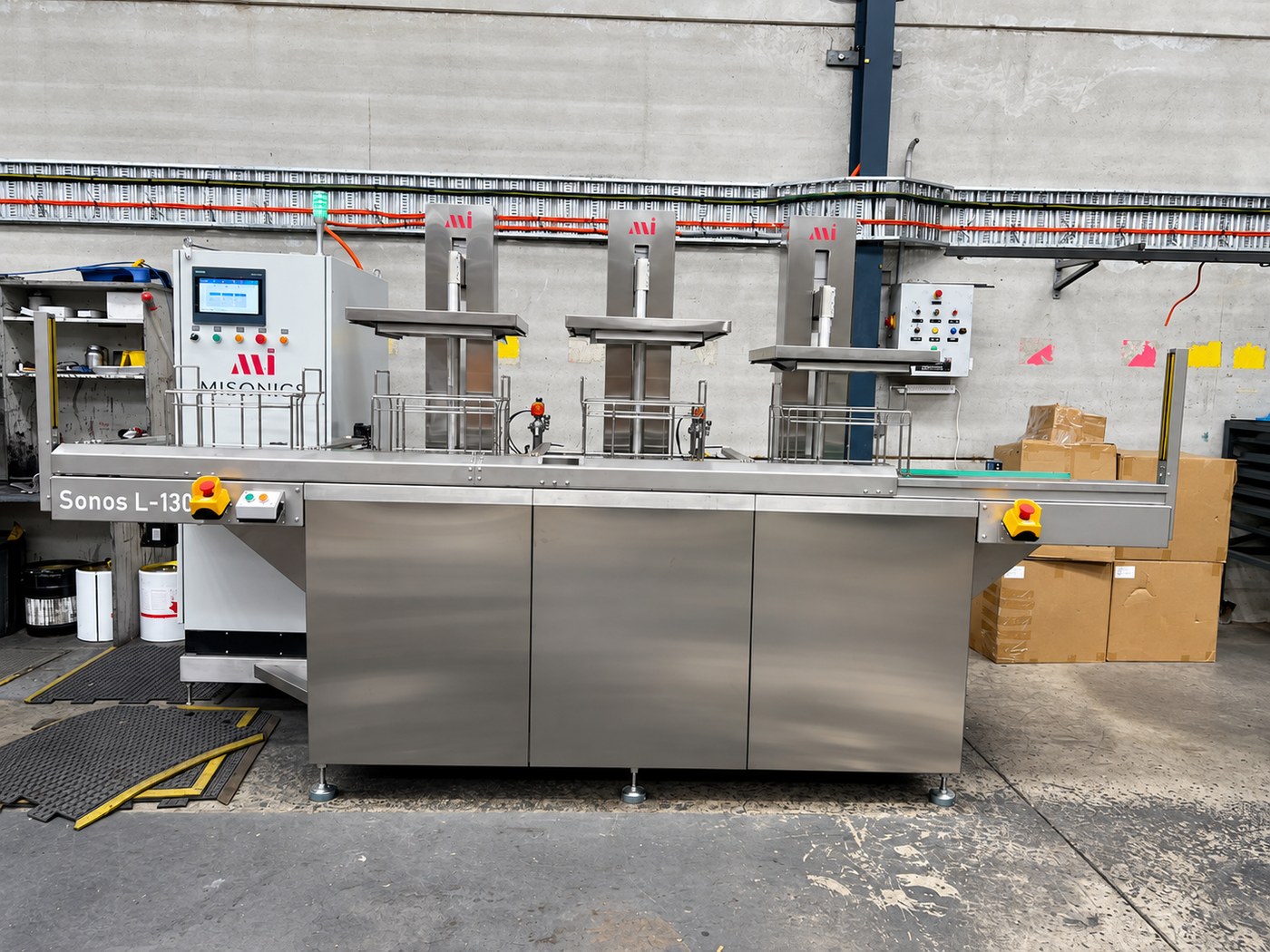
Sono L-130 — the full three-station line
Photographs of a delivered Sono L-130 three-tank line. Configuration renders and the general arrangement follow.
The process card runs itself
Everything our multistage guide teaches — wash, staged rinse, dry, in the right order with the right dwell — a SonoLine executes automatically: transfer on the clock, lids opening ahead of the basket, oscillation through every immersion, and a cycle log the auditor reads instead of the operator's memory. Throughput stops depending on whose shift it is. Our own three-station line — wash, rinse and hot-air dry in one pass — is the same idea at three stages. The aerospace four-tank line and the CM-800 food-plant installation in our case studies are this family delivered.
Line lengths and connected power
| Configuration | ST-85 | ST-120 | ST-160 | ST-220 |
|---|---|---|---|---|
| 2-tank line — length / power | ~2000 mm / 12.4 kW | ~2100 mm / 15.2 kW | ~2200 mm / 20.2 kW | ~2320 mm / 27.6 kW |
| 3-tank line — length / power | ~2760 mm / 19.2 kW | ~2910 mm / 23.2 kW | ~3060 mm / 30.8 kW | ~3240 mm / 43.2 kW |
| 4-tank line — length / power | ~3520 mm / 26.0 kW | ~3720 mm / 31.2 kW | ~3920 mm / 41.4 kW | ~4160 mm / 58.8 kW |
Same tank platform as the SonoWash and SonoLift series, dual 25/45 kHz, to 35 kg. Tank and basket sizes are confirmed at quotation. Every line engineered to site; add stages, drying and enclosure per the specification. Prices on application, ex GST.
Download the SonoLine general arrangement drawing (PDF, three-tank SL X3T)Specials under the SonoLine name
All specifications — incl. dimensions, ultrasonic power and volume — are confirmed at quotation.
Every part of it, named
Two views of the same three-tank line. The front is what the operator sees — load, three stations, unload. The back is the half that keeps the baths usable shift after shift: a pump and filter loop, an oil skimmer and a sub-tank on each wet stage, the blower that feeds the dryer, and the cabinet that runs all of it. Stage count and the plant fitted to each stage are set at quotation; this is the common three-tank arrangement.
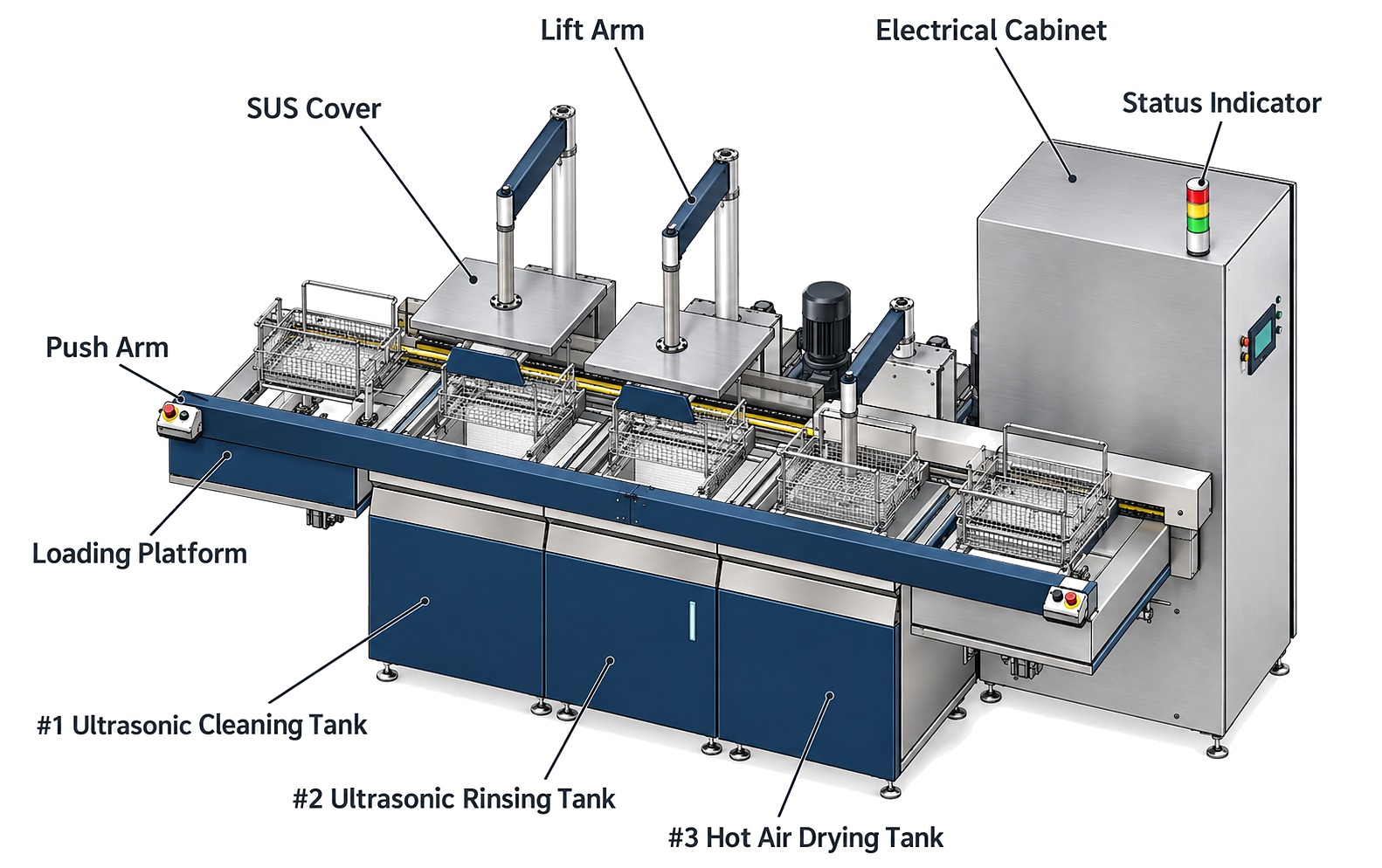
- Loading platform & push armWhere the operator sets the basket down. The push arm indexes it on to the transfer rail — the only manual step in the cycle, and the same at the unload end.
- #1 Ultrasonic cleaning tankThe wash stage: heated, ultrasonically driven and filtered, holding the bath at the recipe temperature for its own countdown.
- #2 Ultrasonic rinsing tankRinse under ultrasonics rather than a static dunk, so carry-over comes off the part instead of drying on to it.
- #3 Hot-air drying tankBlown hot air in the same footprint as a wet station. The part leaves the line dry and handleable, ready to pack or move to the next process.
- Lift arms and stainless lidsA powered lift over every station raises and lowers the basket; the lid opens ahead of it and closes behind, keeping heat and vapour in the tank. (Labelled SUS cover on the drawing — SUS is stainless.)
- Electrical cabinet & status indicatorGenerators, PLC and drives in one enclosure at the end of the line, with a stack light readable from across the floor.
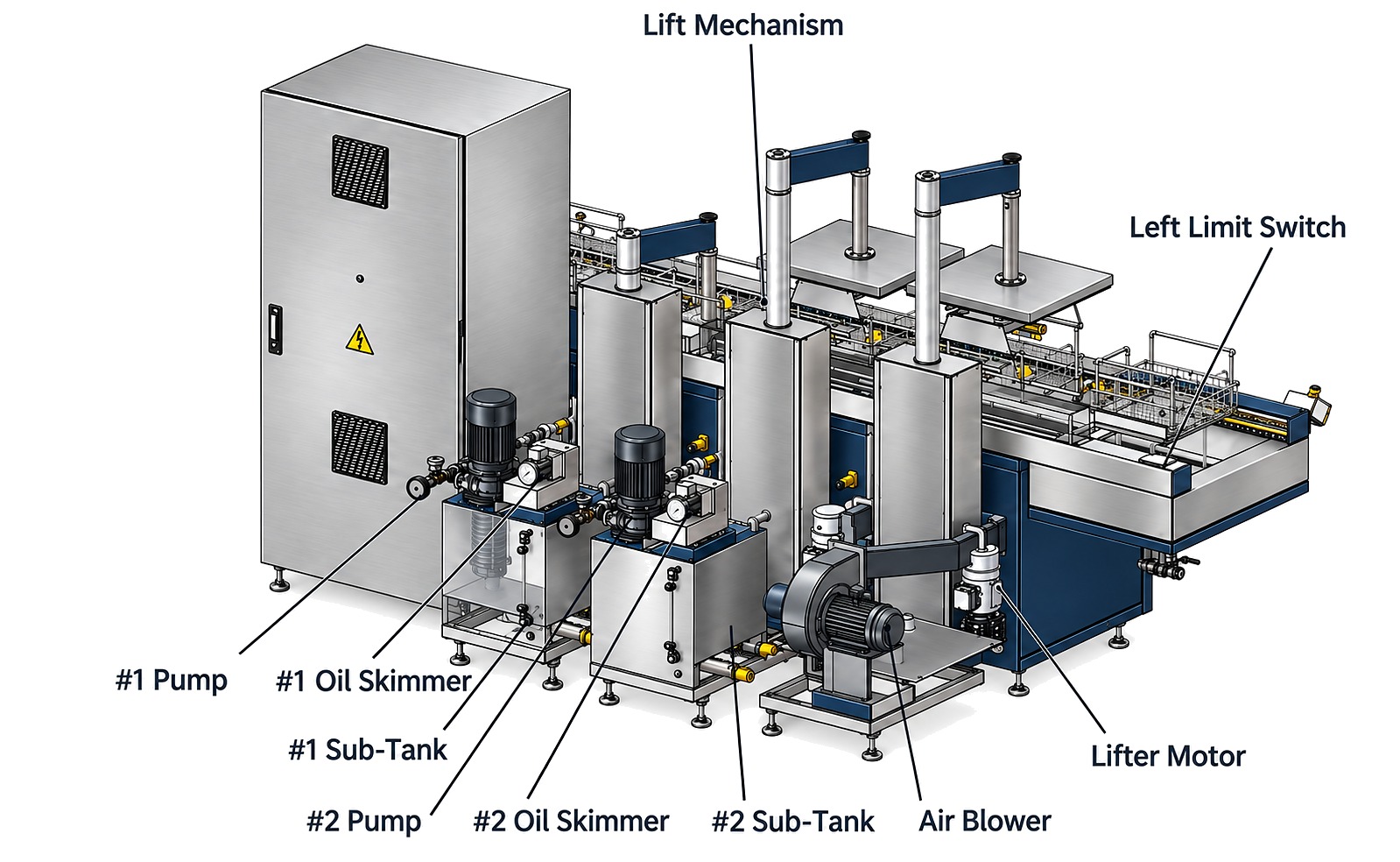
- #1 and #2 pumpsOne circulation pump per wet stage. Each drives its own filter loop, so the wash bath and the rinse bath are turned over independently and neither waits on the other.
- #1 and #2 oil skimmersTramp oil taken off the surface continuously instead of at a shutdown. This is what stops a wash bath going off early and re-depositing on the way out.
- #1 and #2 sub-tanksA reservoir per stage sitting outside the process tank. Solids settle and the pump draws from clean liquid, and the bath can be topped up or dumped without breaking into the line.
- Air blowerFeeds the drying station with heated air. Sited on the service side with the rest of the plant, off the operator’s walkway.
- Lift mechanism & lifter motorThe drive behind each powered lift. Motor and mechanism are on this side of the line, reachable for service without crossing the wet stations.
- Limit switchesEnd-of-travel switches on the transfer. The PLC knows where the basket is at all times — the line stops rather than guesses.
Illustrations of the standard three-tank arrangement. Tank sizes, connected power and the filtration fitted to each stage are confirmed at quotation — the dimensioned general arrangement is above.
A Sono L-130, running
Not a simulation and not a render — this is a three-tank SonoLine on the floor, cycling. The operator loads and unloads; everything between happens on the clock.
The line cycling — lids opening ahead of the basket, a powered lift at every station, and the basket held above the bath so drag-out runs back in. Open the video page →
Filmed on site at Misonics. Clips are silent and load only when you press play.
Approved chemistry
FX Degreaser
The daily bath for oils, grease and workshop soils — 5% in water, works from warm.
Product, SDS & TDS →Ferrous carbon & paintMetalTek 100
Grease, rust, scale, carbon and paint off steel and cast iron in one bath — the chemistry the 1.5 mm SS316 tank was built to hold. pH 14, so ferrous only.
Product, SDS & TDS →Precision & approvalsAquaVantage 815 GD
Aerospace-approved aqueous for new-manufacture and precision work; 815 QR-NF for MRO carbon.
Product, SDS & TDS →Tank count follows the parts and the takt time
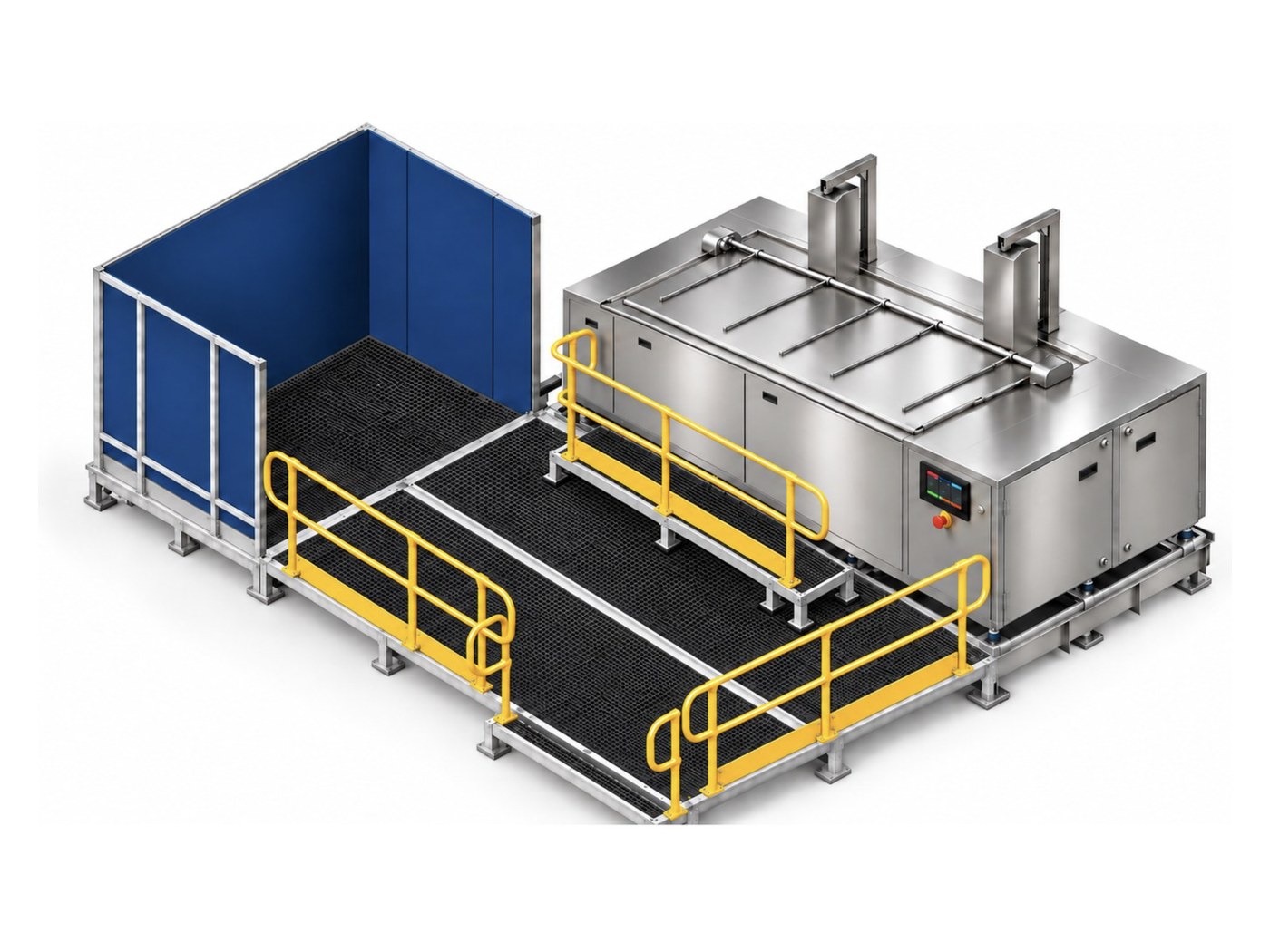
Integrated work areas
Bunding to catch what comes off the load, a raised grated deck so the work happens at working height, and a screened washbay for the wet work beside the bath.
Built into the machine from the start, or as a separate unit that drops in beside one already on the floor. Quoted as its own line, ex GST.
Bunding, raised platforms and washbays →