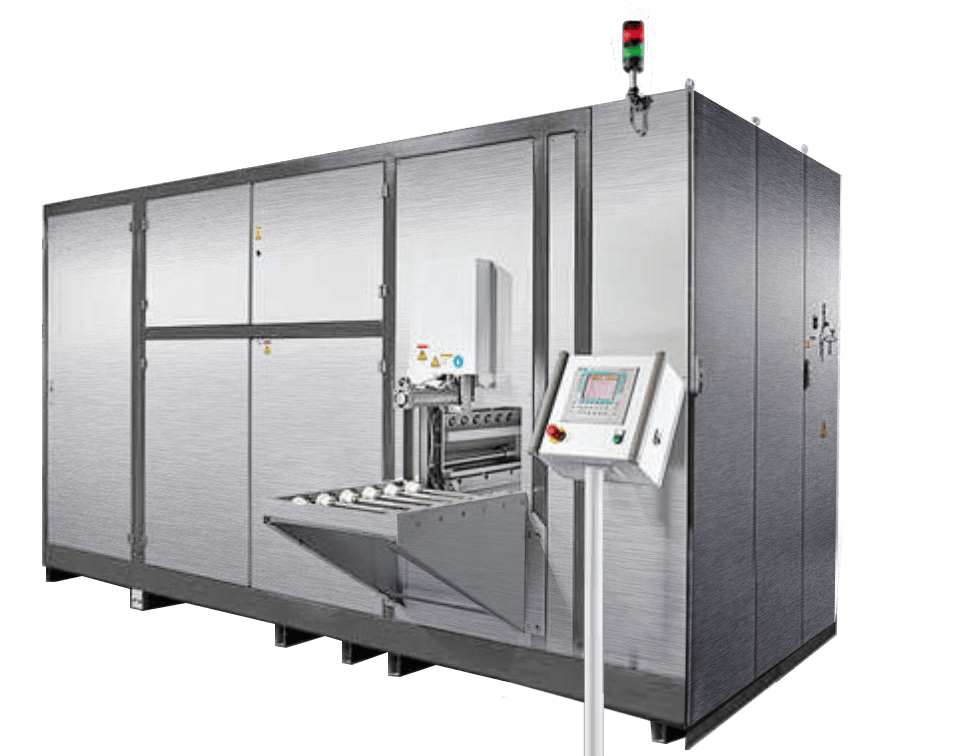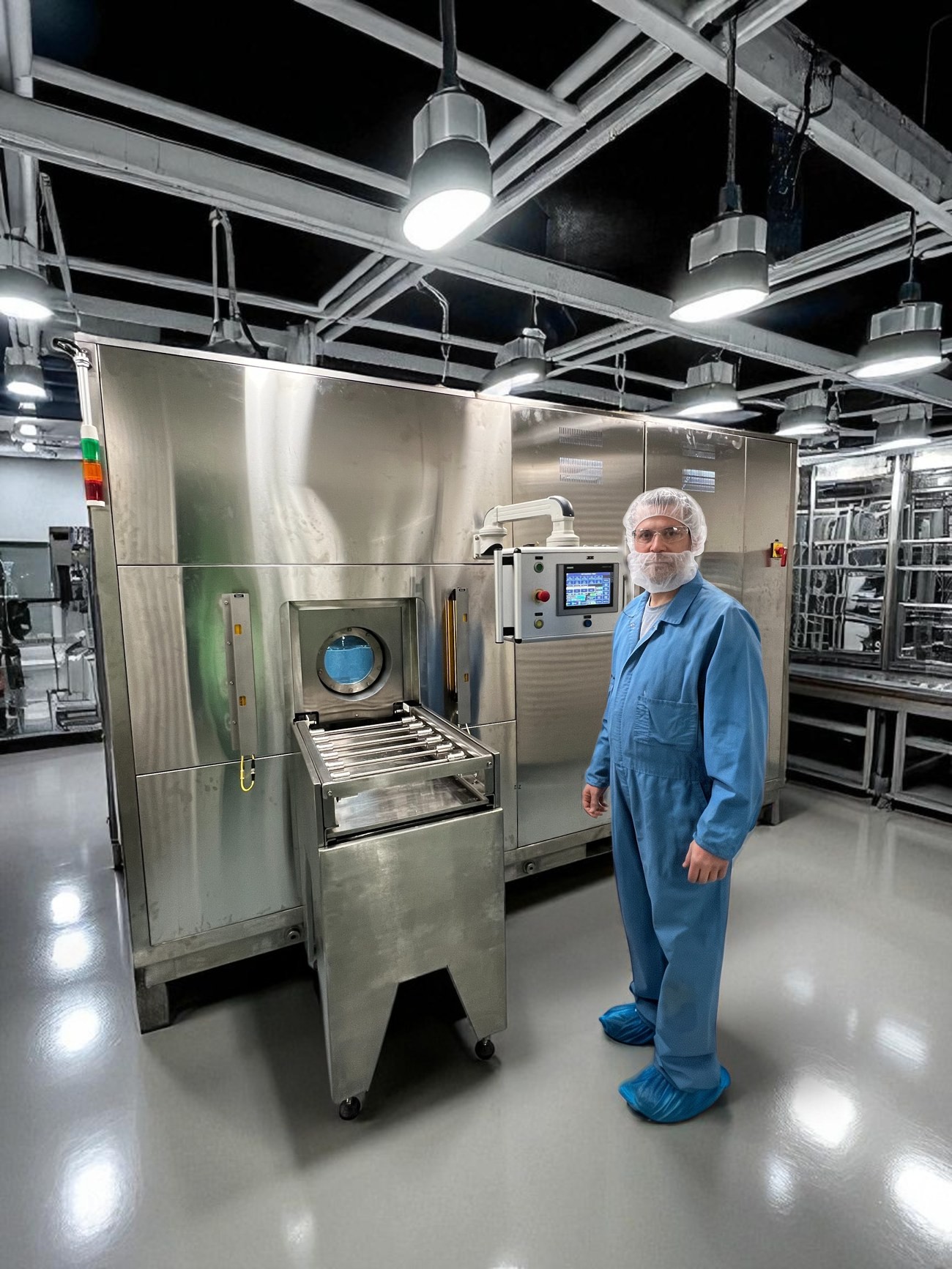

Install photography, engineering renders and July 2026 trial results — cleaned for a leading Australian vitamin & supplement manufacturer on an UltraWash trial. Model-specific photography of the UltraWash 70 to come; client naming pending permission.
Quoted as a working system: chamber, Collection Tanks, chemistry, recipes, commissioning and operator training — one number, ex GST.
Five clips from one customer trial, July 2026: the basket turning behind the sight glass, the chamber sealing, 25 kHz cavitation working the parts under the surface, the wash at full noise and the rinse jets that follow it. Filmed on an UltraWash trial — the same sealed-chamber process the UltraWash 70 runs at its own scale.
The parts and the before/after results are in the gallery above — production residue, stripped to base metal in a programmed cycle.
Clips are silent and load only when you press play. All filmed on the same customer trial.
The UltraWash 70 is the machine from our lock case study: a sealed chamber that takes a 470 × 320 mm basket through spray, injection flood wash, rotating ultrasonics, rinse, forced hot-air and vacuum drying — critically clean and assembly-dry in one cycle, roughly twenty minutes basket to basket.
Three heated Collection Tanks keep wash and rinse chemistry separate and filtered (10 µm cartridge + 50 µm bags), a belt skimmer takes the oil, auto-fill holds levels, and a Siemens S7-1200 runs five recipes behind an interlocked sliding door. For instrument makers, lock and hardware manufacturers, and any line where "clean" means gauged, not glanced.
This is the range the diagram was drawn for: spray, injection flood, rotation (the oscillation stage, motorised), ultrasonics, rinse, hot air and vacuum drying — sequenced by recipe inside one sealed chamber. Parts leave finished, not damp. The lock case study is this machine at work.
Every recipe below runs in this machine — same chamber, different sequence. Change the part family and the operator changes the recipe, not the machine. This is the UltraWash argument in one section: the processes are the product.
The delivered pharmaceutical cycle: product and machine oils off, Flush2Drain purges the sump so residual oils never touch the rinse stages, RO water finishes spot-free, vacuum empties the blind ports. Verifiable, logged, repeatable.
The daily workhorse recipe: turbulation and rotation carry the bulk load, ultrasonics finishes the geometry, forced hot-air drying finishes for handling. No RO stage — throughput first.
For soils that must dissolve before they can leave — congealed gelatin, crystallised slurries: a heated turbulation soak softens, cavitation strips, Flush2Drain takes the residue to drain before any rinse water is spent.
Instrument-grade chemistry at controlled power, RO finish, and drying complete before packaging — the cleaning step of the reprocessing workflow, parameterised and logged per basket.
Rotation keeps drillings changing aspect while injection flood evacuates chips; the ultrasonic burst clears what clings. Short, violent, effective.
ASTM A380 discipline: passivation only works on a genuinely clean surface. This recipe delivers it, RO-rinsed, ready for the citric line.
The recipe most machines never have: sump flushed to drain, Collection Tanks turned over through filtration, Monday starts clean. Initiated from the HMI like any other program.
Seven of the sequences we have delivered or specified — every stage time, temperature, rotation speed, spray pressure and ultrasonic power is an editable recipe value on the HMI.
| Stage | Time | What happens |
|---|---|---|
| Load | 15 s | Basket rolls in from the conveyor — single operator |
| Spray wash · 72 °C | 60 s | High-pressure spray as the basket rotates and the tank floods |
| Ultrasonic wash · 72 °C | 420 s | Rod-resonator cavitation with 360° basket rotation; drains to Collection Tank 1 |
| Rinse2Drain spray · 70 °C | 30 s | Flush2Drain purges sump and residues straight to drain — no cross-contamination into the rinses |
| Gross rinse · 70 °C | 120 s | Hot flooding rinse with ultrasonics and rotation |
| RO rinse · 70 °C | 45 s | Reverse-osmosis water finish — spot-free, residue-free |
| Forced hot-air dry · 120 °C | — | Regenerative blower drives forced hot air through the rotating basket — bulk moisture gone |
| Vacuum dry | — | Chamber vacuum evacuates blind ports and galleries — assembly-dry |
Mixed aluminium, stainless, brass, carbon steel and PTFE parts to 60 kg; soils from machine oils to congealed gelatin and crystallised slurries — 24-hour, three-shift duty. Client naming pending permission.
Product-contact parts — pumps, dies, wedges — cleaned of product and machine oils to RO-rinsed, vacuum-dried standard, logged per basket. Delivered and running in an Australian plant.
Life sciences sector →The parameterised cleaning step reprocessing audits want — instrument chemistry, controlled power, RO finish, dry before packaging.
The reprocessing guide →Blind bores, galleries and lattices cleaned and verified before NDT, coating or assembly — with the sealed chamber closing the between-stage contamination window.
Aerospace sector →Drawn from the UltraWash proposal engineering and delivered installations.
The daily bath for oils, grease and workshop soils — 5% in water, works from warm.
Product, SDS & TDS →Ferrous carbon & paintThe heavy-hitter for baked carbon on steel and iron — the chemistry the 1.5 mm SS316 tank was built to hold.
Product, SDS & TDS →Precision & approvalsAerospace-approved aqueous for new-manufacture and precision work; 815 QR-NF for MRO carbon.
Product, SDS & TDS →Items marked TBC are being confirmed; full engineering pack (GA, technical sheet, process diagram) available on request.