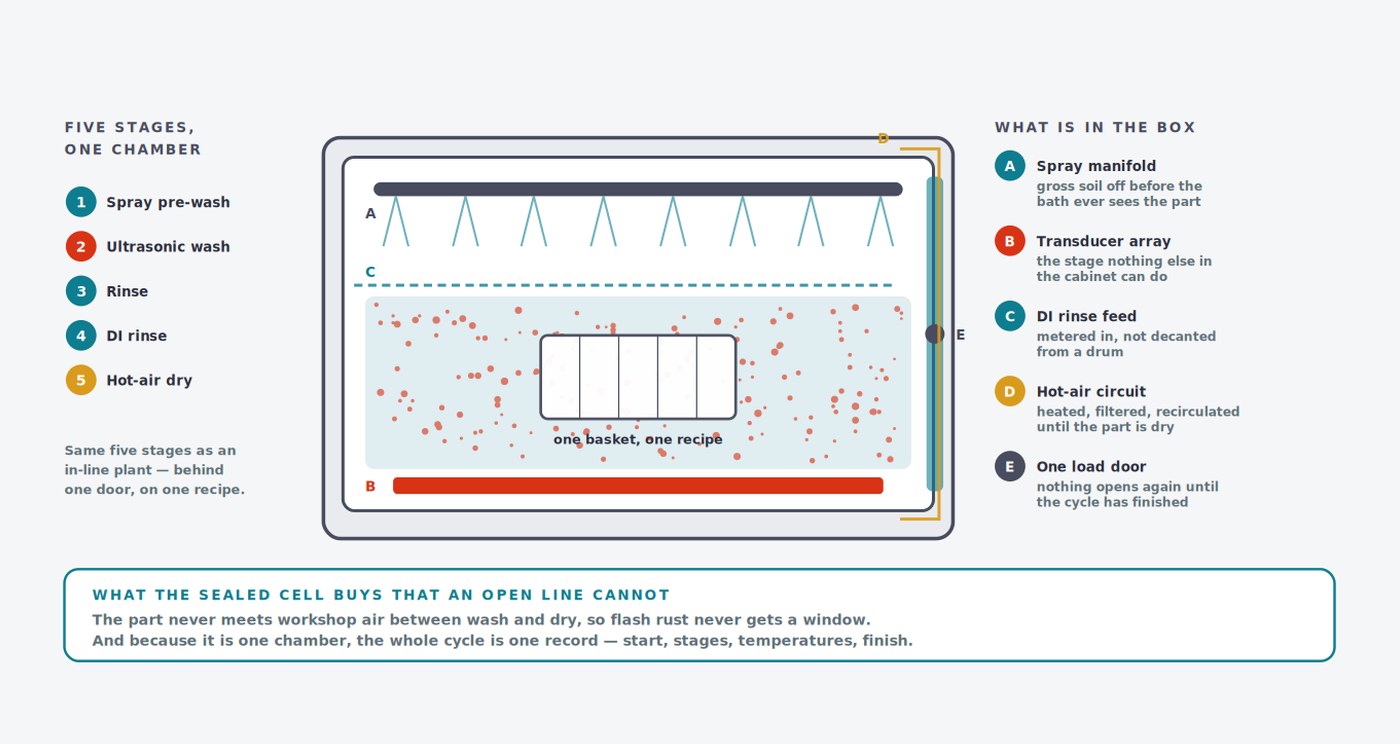
Article №3 made the argument that cleaning is a process — pre-clean, clean, rinse, protect, dry. This article is about what happens when that process stops being five places an operator walks between and becomes one machine: the multi-stage system, from open in-line stations to the sealed single-chamber cell that tier-one manufacturers specify.
Walked processes leak: drag-out drips between tanks, parts flash-rust in transit, cycle timing drifts with the operator's afternoon, and nothing is logged. Building the stages into stations — fixed positions, fixed transfer, fixed timing — closes every leak at once. Multi-stage design is process discipline cast in stainless.
Spray / pre-wash takes the bulk soil cheaply, so the ultrasonic stage spends its energy on precision work (№3's dumping-ground rule, automated).
Ultrasonic immersion — the heart: cavitation plus matched chemistry into every gallery and groove.
Rinse — often twice. Cascade rinsing (second rinse feeding the first) halves water use while improving final purity; DI final rinse where spotting or coating matters.
Protect — inhibitor dosed in the final rinse for ferrous work, so protection dries on with the part.
Hot-air dry — parts leave process-finished: dry, protected, ready for assembly, coating or box.
The in-line configuration — UltraKleen-class stations, SonoLine-class automated transfer — suits throughput: baskets progress station to station, several in process at once, capacity scaling with line length. The enclosed single-chamber cell — UltraWash-class — runs every stage sequentially in one sealed vessel: one door, one basket, spray, ultrasonics, rinse and dry without the part ever meeting workshop air. Between-stage flash rust becomes impossible; aerosols stay contained; the full cycle logs as one record. Throughput belongs to the line; process integrity and audit trail belong to the chamber; plenty of plants run both, for different parts.
The enclosed chamber adds the numbers nobody prices until asked: zero between-stage flash rust (no workshop air exposure), aerosol containment for WHS, and a single cycle record per basket that drops straight into a batch file. When the process itself is the deliverable — aerospace, defence, medical — the chamber is not the expensive option; the audit finding is.
CM-800 enclosed system at a meat processor — the chamber argument with photographs.
Read the study: the enclosed plant installation →When a customer, auditor or coating line asks you to prove the process — not the result, the process — you have left single-tank territory. Cycle records from a multi-stage machine are that proof, generated as a by-product of running.
Multi-stage design pays a quiet second dividend at the rinse tanks. Cascade counterflow — final rinse overflowing backward into the first — means the cleanest water always touches the cleanest parts, and one water feed serves two stages. Against two independent rinses, cascade typically halves water consumption while improving final-rinse purity — the rare upgrade that cuts a utility bill and a defect rate with the same plumbing.
Typical rinse-water saving from cascade counterflow versus independent rinse tanks — with final purity improved, not traded.Standard cascade rinse design practice; sized per line at quotation.
Sketch the line for a shop moving from one tired tank to a real process. Stage one, ultrasonic wash: the existing duty, properly specified — right frequency for the workload, splitting chemistry, weir, filtration. Stage two, rinse: heated water, ideally a cascade pair where the second, cleaner rinse overflows forward into the first so the dirtiest rinse water meets the dirtiest parts — the counterflow trick that halves water use while improving final rinse purity. Stage three, protection: for ferrous work in Australian workshop humidity, an inhibitor dip timed straight off the rinse, inside the minutes-wide flash-rust window rather than after the tea break. Stage four, drying: heated air or a drying stage sized so parts leave the line finished — a wet part on a shelf is stage three being undone in real time. Physically this is four tanks in a row with a transfer hoist at its simplest, a SonoLine transfer system as throughput grows, and an enclosed multi-chamber cell where the parts must never see workshop air between stages.
The design discipline is backwards from the part's final state: what must this part look like when it goes back on the shelf — clean to what test, protected for how long, dry to what standard? Each answer either exists as a stage or is being skipped, and the skipped ones are where warranty claims are manufactured. The trial defines all four answers on your actual parts before any steel is ordered.
The throughput study lays your parts across line and chamber options — capacity, footprint and audit trail, priced honestly.