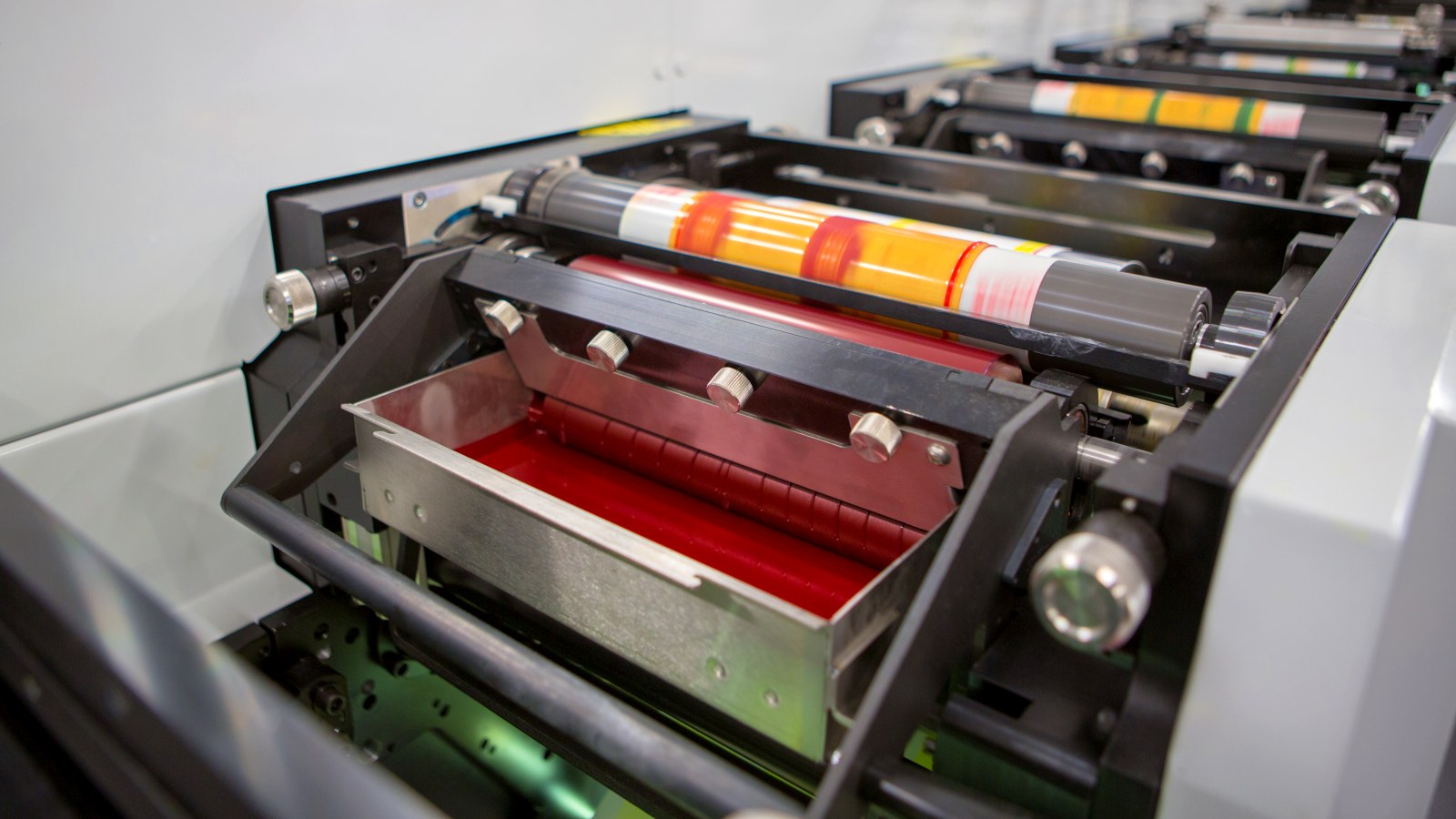
Printing press ink rollers in production
Industries / Manufacturing & Process / Printing
Industries · Manufacturing & Process

Ultrasonic Cleaning for Printing

An anilox roll is a precision metering instrument with millions of engraved cells — and every dried ink film in those cells changes the delivered volume. Blades and bicarb blasting shorten roll life; cavitation empties cells without touching the ceramic.

Misonics systems clean anilox rolls, sleeves, screens and press hardware back to volume, with cycle parameters set to engraving specification.

The Contamination Problem

What we remove in printing

Dried UV & water-based inks

Cured films in anilox cells, progressively starving delivered volume.

Coatings & varnishes

Bonded residues in high-LPI engravings.

Adhesives

Laminating and cold-seal residues through applicator hardware.

Plate & blanket residues

Processing chemistry and image debris.

Press oils & dust

General contamination through press components.

The endpoint is a defined, repeatable process condition — cycle time, chemistry, concentration, frequency and temperature are recorded parameters, not operator judgement.
Components We Clean

Real parts, real materials

Anilox rolls & sleeves

Ceramic and chrome anilox to 1500+ LPI — cell volume restored, verified by volume measurement.

To 1500+ LPICeramicChrome

Screens & plates

Rotary and flat screens, flexo plates — image areas open without mesh damage.

Rotary screensFlexo plates

Press hardware

Ink pumps, doctor blade holders, gluing and coating hardware.

PumpsHoldersApplicators
Why Ultrasonics — And Why These Machines

Cavitation cleans geometry it cannot see

Bubble collapse at the liquid–metal boundary lifts contamination from passages, galleries and cavities without anything touching the surface. Nothing abrades, nothing embeds, no metal is removed.

GeneratorResonance held all shift

The VarioSonic G5 tracks the transducer array as temperature and load shift — conversion efficiency up to 95%.

Sound fieldSweep modulation

Eliminates standing-wave hot and cold zones across a loaded basket.

Process controlLogged, recipe-driven cycles

Stored recipes and logged cycles — audit evidence produced as a by-product of running.

Bath conditionFiltration & oil separation

Multi-stage filtration and weir oil capture hold results steady as the bath loads.

SupportOver-the-air diagnostics

Most faults identified — many resolved — without a site visit.

ConstructionBuilt to work hard

Heavy 316 stainless tanks, tested before despatch, every wearing part replaceable.

Equipment Fit

The machine follows the process

From manually loaded single-tank units to automated lines — and engineered systems where the catalogue ends.

MSX

Roll-length tanks with rotation for anilox work.

Explore the range →

Powersonic

Bench units for plates and hardware.

Explore the range →
Chemistry

Matched to the soil and the substrate

Ink chemistry must dissolve the resin system without etching ceramic or corroding aluminium roll cores — formulation and frequency are matched to the engraving, not guessed.

Applications Matrix

Component coverage at a glance

Component categorySpecific parts / assembliesCompatible materials
AniloxRolls, sleevesCeramic on steel, chrome
ScreensRotary, flat screensNickel, polyester mesh
PlatesFlexo, letterpressPhotopolymer, metal-backed
Ink trainPumps, hoses, chambersStainless, aluminium
FinishingGluing, coating hardwareStainless, brass

Prove it on your parts

Where an application needs validation, we clean sample components in our laboratory, document the result, and specify the machine around the verified process. If ultrasonics is the wrong answer, the trial shows that too, and we will tell you.

Talk to an engineer
FAQ

What printing engineers ask us

Is high-LPI engraving safe?
Yes — frequency and power are set to engraving spec; volume measurement before and after proves recovery without damage.
How much volume comes back?
Typically to within measurement error of nominal — the trial gives your rolls' actual numbers.
Can roll cores corrode?
Aluminium cores need inhibited chemistry and controlled immersion — engineered into the process.
UV inks as well as water-based?
Yes — different formulations, same principle, proven per ink system.
Related Industries · Manufacturing & Process

Also in this sector