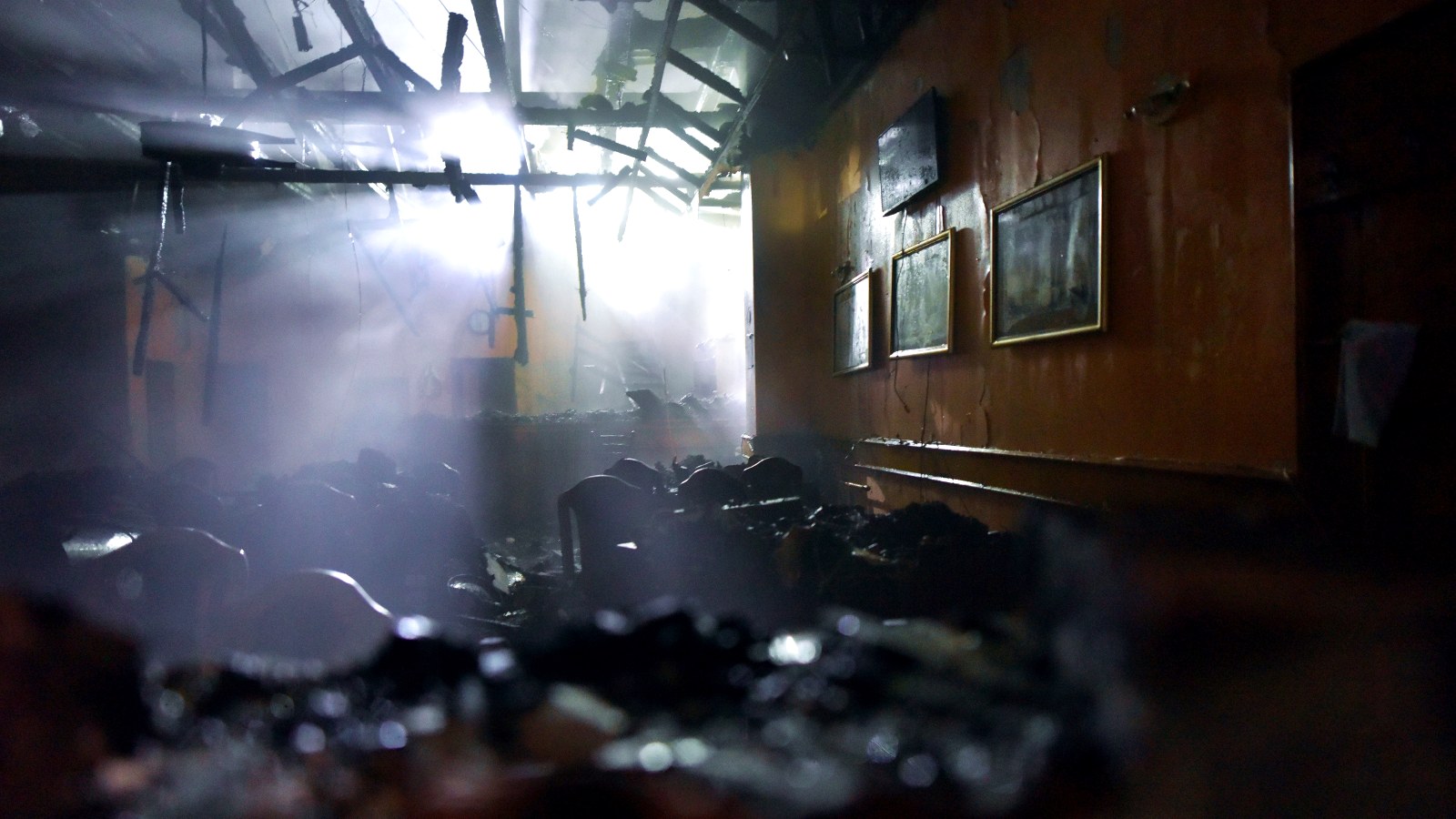
Fire-damaged interior before restoration
Industries / Facilities & Service / Flood & Fire Restoration
Industries · Facilities & Service

Ultrasonic Cleaning for Flood & Fire Restoration

After fire or flood, the difference between restore and replace is measured in insurance dollars and sentimental value — and soot, smoke residue and floodwater contamination respond to cavitation better than to any hand process.

Misonics systems give restoration contractors production-rate contents cleaning: consistent results across mixed items, documented for the claim file.

The Contamination Problem

What we remove in flood & fire restoration

Soot & smoke residues

Acidic films that keep corroding until removed — time matters.

Char & protein smoke

Bonded residues from structure and contents fires.

Floodwater contamination

Silt, sewage-borne soils and biological contamination.

Corrosion bloom

Flash corrosion on metals after water exposure.

Extinguisher residues

Powder and foam residues through contents.

The endpoint is a defined, repeatable process condition — cycle time, chemistry, concentration, frequency and temperature are recorded parameters, not operator judgement.
Components We Clean

Real parts, real materials

Contents & electronics-adjacent

Hardware, fittings, tools and household metalware — production-rate cleaning with per-batch documentation.

HardwareToolsMetalware

Mechanical & electrical hardware

Motors hardware, fittings and components recovered rather than written off.

FittingsComponentsHardware

Heritage & high-value

Items where replacement is impossible — controlled, gentle parameters and material-specific chemistry.

Antiques hardwareInstrumentsFixtures
Why Ultrasonics — And Why These Machines

Cavitation cleans geometry it cannot see

Bubble collapse at the liquid–metal boundary lifts contamination from passages, galleries and cavities without anything touching the surface. Nothing abrades, nothing embeds, no metal is removed.

GeneratorResonance held all shift

The VarioSonic G5 tracks the transducer array as temperature and load shift — conversion efficiency up to 95%.

Sound fieldSweep modulation

Eliminates standing-wave hot and cold zones across a loaded basket.

Process controlLogged, recipe-driven cycles

Stored recipes and logged cycles — audit evidence produced as a by-product of running.

Bath conditionFiltration & oil separation

Multi-stage filtration and weir oil capture hold results steady as the bath loads.

SupportOver-the-air diagnostics

Most faults identified — many resolved — without a site visit.

ConstructionBuilt to work hard

Heavy 316 stainless tanks, tested before despatch, every wearing part replaceable.

Equipment Fit

The machine follows the process

From manually loaded single-tank units to automated lines — and engineered systems where the catalogue ends.

MSX

Production platforms for contents restoration.

Explore the range →

Powersonic

Bench units for delicate and small items.

Explore the range →
Chemistry

Matched to the soil and the substrate

Restoration chemistry neutralises acidic smoke residues and arrests corrosion in one pass — with material-specific selection across the mixed loads restoration actually sees.

Applications Matrix

Component coverage at a glance

Component categorySpecific parts / assembliesCompatible materials
ContentsMetalware, tools, hardwareMixed metals
Building hardwareFittings, fixtures, handlesBrass, plated finishes
MechanicalComponent hardwareSteels, aluminium
HeritagePeriod items, instrumentsBrass, bronze, silver
Electronics-adjacentHousings, chassis hardwareAluminium, plated steel

Prove it on your parts

Where an application needs validation, we clean sample components in our laboratory, document the result, and specify the machine around the verified process. If ultrasonics is the wrong answer, the trial shows that too, and we will tell you.

Talk to an engineer
FAQ

What flood engineers ask us

How soon after the event should cleaning happen?
Fast — smoke residues are acidic and keep corroding. Early cleaning arrests loss and lifts restoration rates.
Can you document for insurers?
Per-batch logs support the claim file — what was cleaned, when, and how.
What restoration rate is realistic?
Far higher than write-off assessments assume — the trial on a sample lot produces your actual number.
Delicate and sentimental items?
Gentle parameters and material-specific chemistry — assessed item by item.
Related Industries · Facilities & Service

Also in this sector