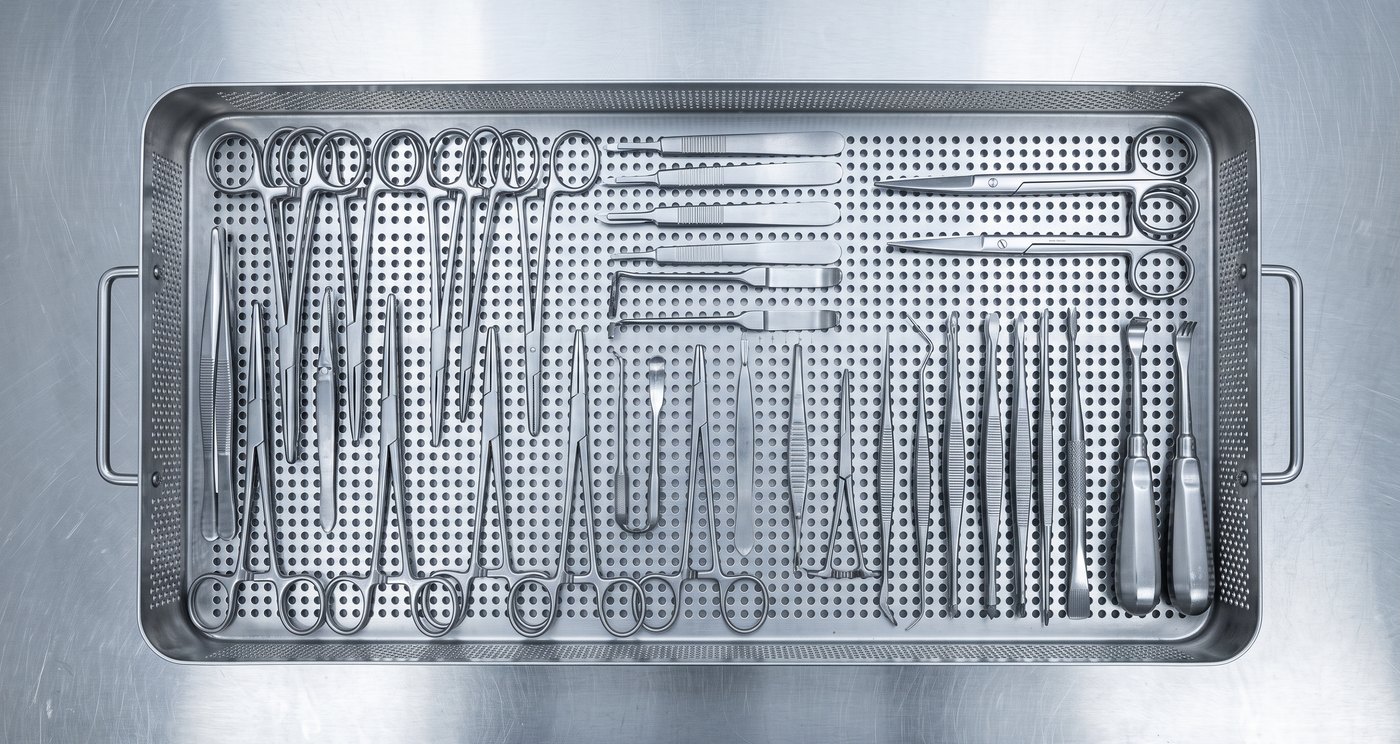
You cannot sterilise a dirty instrument. Every standard says it, and the cleaning stage is where most non-conformances are actually found.
If you reprocess reusable instruments in Australia, the standard governing you changed. This page covers what changed, and why the ultrasonic stage carries more weight than most people give it.
The change that matters most commercially: AS 5369 explicitly reaches beyond hospitals. It applies to health settings and non-health settings alike — dental practices, veterinary clinics, and non-medical facilities including beauty salons and tattoo studios. A great many premises that never considered themselves subject to a reprocessing standard now are.
The standard classifies devices by the risk of the procedure they are used in — critical (must be sterilised), semi-critical (sterilised or high-level disinfected) and non-critical (cleaned and low-level disinfected) — and introduces product families and validation testing to confirm the process actually works.
This page is an orientation, not compliance advice. Obtain the current standard and confirm your obligations with your accrediting body — transition arrangements differ by facility type.
Sterilisation does not penetrate soil. Protein, tissue and dried blood shield micro-organisms from steam and from chemical sterilants, so an instrument that goes into the steriliser dirty comes out contaminated and carrying a sterility label. That is the failure mode the whole standard exists to prevent.
Cleaning is therefore a critical stage of reprocessing, and the process must deliver results that are both verifiable and repeatable.
The time between using an instrument and cleaning it is the single biggest determinant of how hard it will be to clean. Blood and protein dry, adhere and become dramatically harder to remove — and if they are then exposed to heat, they coagulate onto the surface permanently.
Manual brushing cannot reach a box lock, a serration, a cannula or a lumen. Cavitation can, because it works wherever the liquid goes. The normal sequence is:
Two operational points that get missed. Degas the bath after every fresh fill or the first load of the day is cleaned in a gassy tank that is not cavitating properly — see degassing. And change the solution on a rule: an ultrasonic bath in a reprocessing setting accumulates bioburden, and a dirty bath re-deposits it on the next set.
"We ran it for ten minutes" is not evidence. What is defensible:
Single practice or surgery — the PowerSonic benchtop range: listed pricing, lid, timer and heater, and available to rent before you commit.
Higher volume or continuous duty — MSX 15 and MSX 30. The MSX 30 is the one built for reprocessing workflows: continuous duty, 316 stainless, condensate-deflector lid, LCD control with stored recipes so the cycle is set once and repeated, and load sensing so the delivered power does not change with the basket.
Where the sequence must be automated and recorded — UltraWash runs wash, rinse, hot-air and vacuum dry as one programmed sequence in a sealed chamber, and UltraKleen Pro runs it as a three-station line with a dedicated collection tank behind every wet tank. Both remove the operator variability that audits find.
The cleaning process is matched to the instruments, contamination and applicable reprocessing standard, with the cycle parameters documented to provide a repeatable and verifiable process. If you are transitioning your procedures to AS 5369, we can specify the equipment that makes the cleaning step demonstrable rather than assumed.
We assess each application. Where required, we validate the process through a controlled cleaning trial on the machine and chemistry we would specify, with the cycle and the result reported against your standard — ask us to scope it.