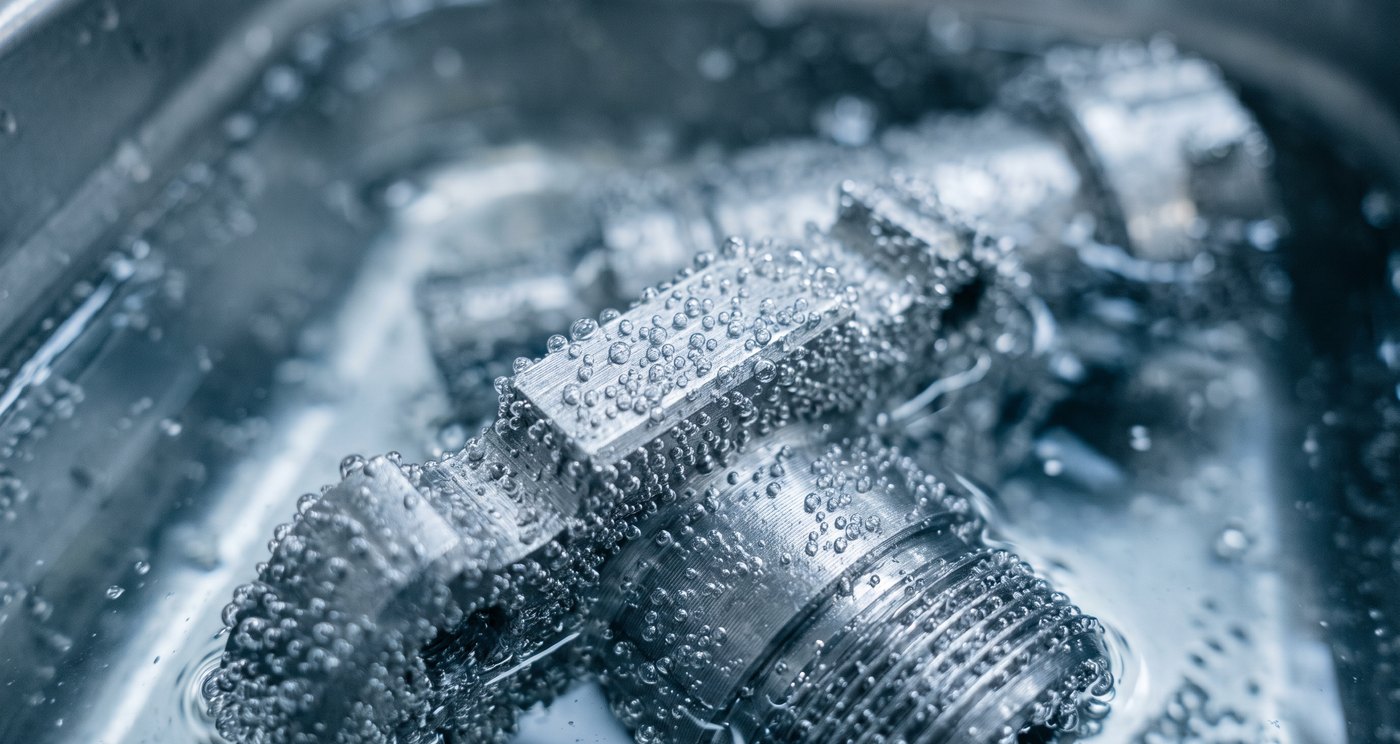
A freshly filled ultrasonic bath can initially clean less effectively than the solution it replaced. Fresh water contains dissolved air, which suppresses cavitation until the bath has been properly degassed.
Fresh solution contains dissolved gases that interfere with cavitation until the bath has been properly degassed. Understanding why takes two minutes and saves a great deal of pointless fault-finding.
Water from a pressurised mains supply carries dissolved gas — it has been held under pressure, and gas has gone into solution. When you fill a tank and switch on, that dissolved gas comes out of solution into the low-pressure phase of the sound wave and forms gas-filled bubbles.
Those bubbles are the problem. Cavitation cleans because vapour bubbles collapse violently. A gas-filled bubble does not collapse violently — the gas inside cushions it. It compresses, springs back and absorbs the energy that should have gone into an implosion at the surface of your part. A gassy bath is quieter, softer and measurably worse at cleaning.
Three routes, and you almost certainly want the second.
Fill the tank and leave it several hours. The gas comes out on its own. Free, slow, and fine if you fill at the end of a shift for the next morning.
The practical method. Run the tank empty of work for 5–10 minutes. The ultrasonics themselves drive the gas out far faster than standing will. Heating at the same time helps, because gas solubility falls as temperature rises — so bringing the bath up to working temperature and degassing are the same operation.
Many machines, ours included, have a degas mode that pulses the ultrasonics rather than running them continuously. The pulsing lets bubbles rise and escape between bursts instead of being held in suspension, so it clears the gas faster than a straight run.
Watch and listen. While degassing, fine bubbles stream to the surface and the tank has a distinctly harsher, higher-pitched sound. As the gas clears, the visible bubbling drops away and the note changes to the steady hiss of a properly cavitating bath. If you want to be certain, run a foil test before and after — the difference in the perforation pattern is obvious.
Once the bath is degassed it stays degassed. You do not need to repeat it every morning. You degas when you:
A modest top-up during a shift is not worth stopping for. Half a tank of fresh mains water is.
Sweep, pulse and degas: what the settings actually do · Water quality: what to fill the tank with
We assess each application. Where required, we validate the process through a controlled cleaning trial on the machine and chemistry we would specify, with the cycle and the result reported against your standard — ask us to scope it.