A tank full of solution, a generator drawing power, a basket of parts — and the entire result rests on something a few tens of microns across that exists for less than a millionth of a second. Understand that one event and every specification decision on an ultrasonic machine stops being a brochure argument and starts being physics.
Sound, but far past hearing
Ultrasound is simply sound above the limit of human hearing — roughly 20 kHz. The band splits three ways in practice. Power ultrasound runs 20–100 kHz and is where cleaning, welding and sonochemistry live. High-frequency ultrasound covers 100 kHz to 1 MHz, used for fine and precision work. Diagnostic ultrasound sits at 1–10 MHz and carries almost no mechanical energy at all — it is there to look, not to work.
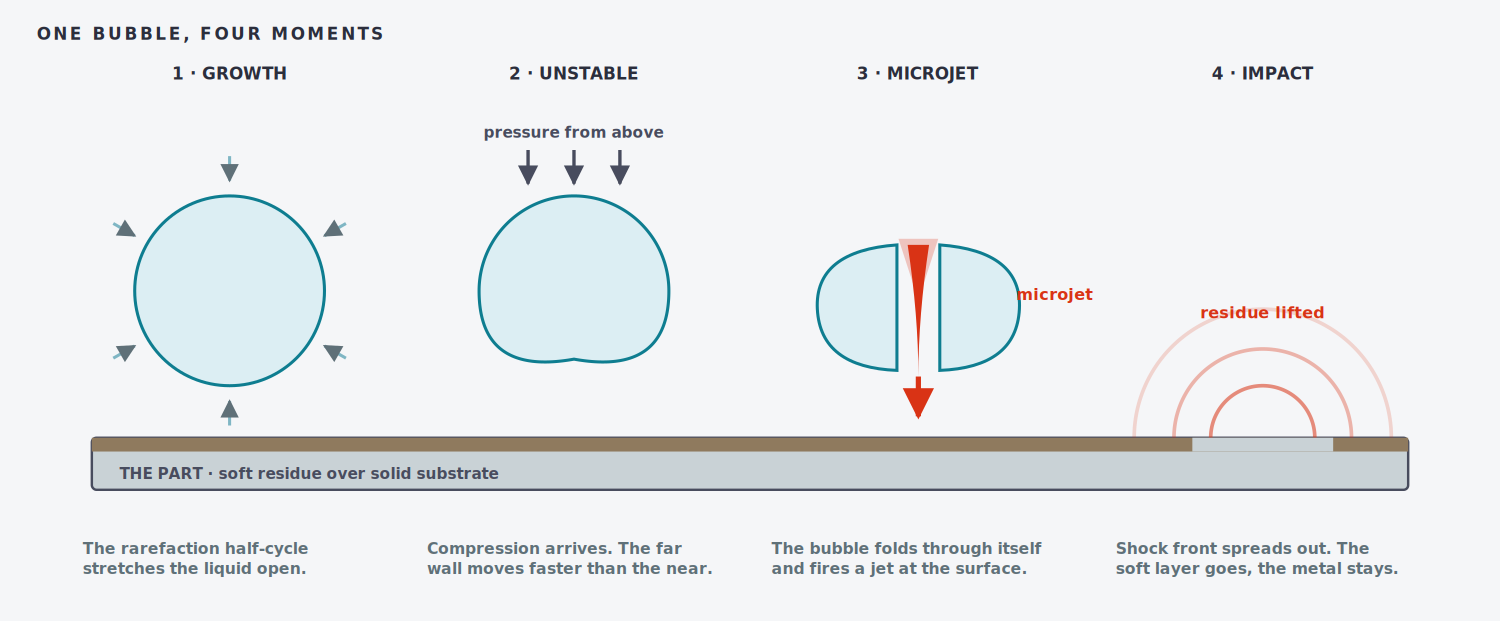
A sound wave in liquid is nothing more than alternating zones of high and low pressure travelling through it. The compression half-cycle squeezes the liquid. The rarefaction half-cycle pulls it apart. In air that is unremarkable. In a liquid, pulling hard enough tears a hole in it.
How the bubble forms, and why it cannot last
In the stretched zone, cavities open in the liquid. Molecules migrate into that empty volume as vapour, and a bubble exists. On the next cycle the same wave stresses it again, and it takes on a little more vapour. Its internal pressure and temperature climb with every pass.
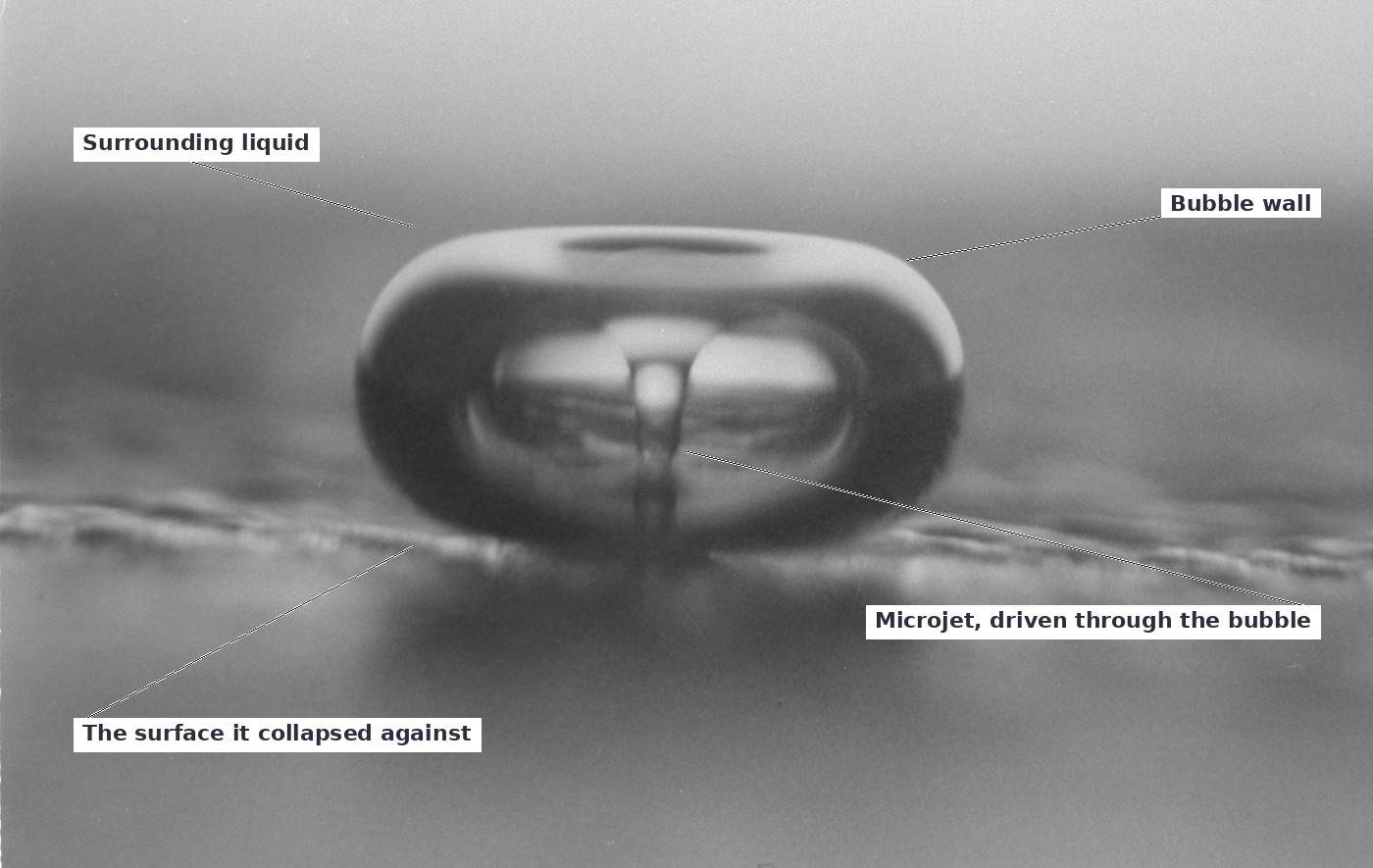
There is a size it cannot sustain. When the compression half-cycle arrives and the bubble can hold no more, it collapses — and because a bubble sitting against a solid surface is not free to collapse evenly, it does not collapse into a point. The far wall moves faster than the near wall, the bubble folds through itself, and it fires a jet of liquid straight at the surface it was resting on.
What one collapse is worth
The numbers are the reason ultrasonics does work that mechanical methods cannot.

Those look alarming until you notice the scale. The 5,000 °C exists inside a bubble a few tens of microns across, for well under a microsecond, and the surrounding liquid swallows the heat immediately. That is why a tank running this violently sits at a hand-warm 60 °C. The energy is not large. It is concentrated, and it is delivered exactly where the bubble was — at the surface.
The jet matters more than the heat
The microjet is the part that cleans. It arrives at the surface at a speed measured in hundreds of kilometres an hour, in a spot a few microns wide, and it does that continuously across every wetted surface at once.
Because the jet is carried by the liquid rather than aimed by a nozzle, it needs no line of sight. Wherever the solution reaches, cavitation reaches: up a blind hole, through a cross-drilling, inside a gallery, between the plates of a stacked assembly. No brush, jet or blast line will follow a part into its own geometry. This is the single capability that puts ultrasonics in a class of its own — and it is covered in detail in cleaning blind holes, galleries and internal passages.
Frequency sets the size of the bubble
The drive frequency decides how long the rarefaction half-cycle lasts, and therefore how large a bubble can grow before it is collapsed. At 20 kHz the bubbles reach around 170 microns and collapse hard: fast, aggressive, well suited to heavy castings and baked-on soil, and capable of marking a soft surface. Raise the frequency and the bubbles get smaller, more numerous and gentler, and they penetrate finer features and tighter boundary layers.
That is the whole trade. Aggression at the bottom of the band, finesse at the top, and a middle where most industrial work is done. Which band your parts want is decided by soil, substrate and geometry together — see choosing the right ultrasonic frequency.
The field is not even — and that is a design problem
Cavitation only happens where the sound field is actually stretching and relaxing the liquid. Sound waves reflecting off the tank walls interfere with themselves, and the result is a fixed pattern of antinodes, where the field is strong, and nodes, where the waves cancel and nothing happens at all. These are standing waves, and in a fixed-frequency tank they sit in the same places all day.
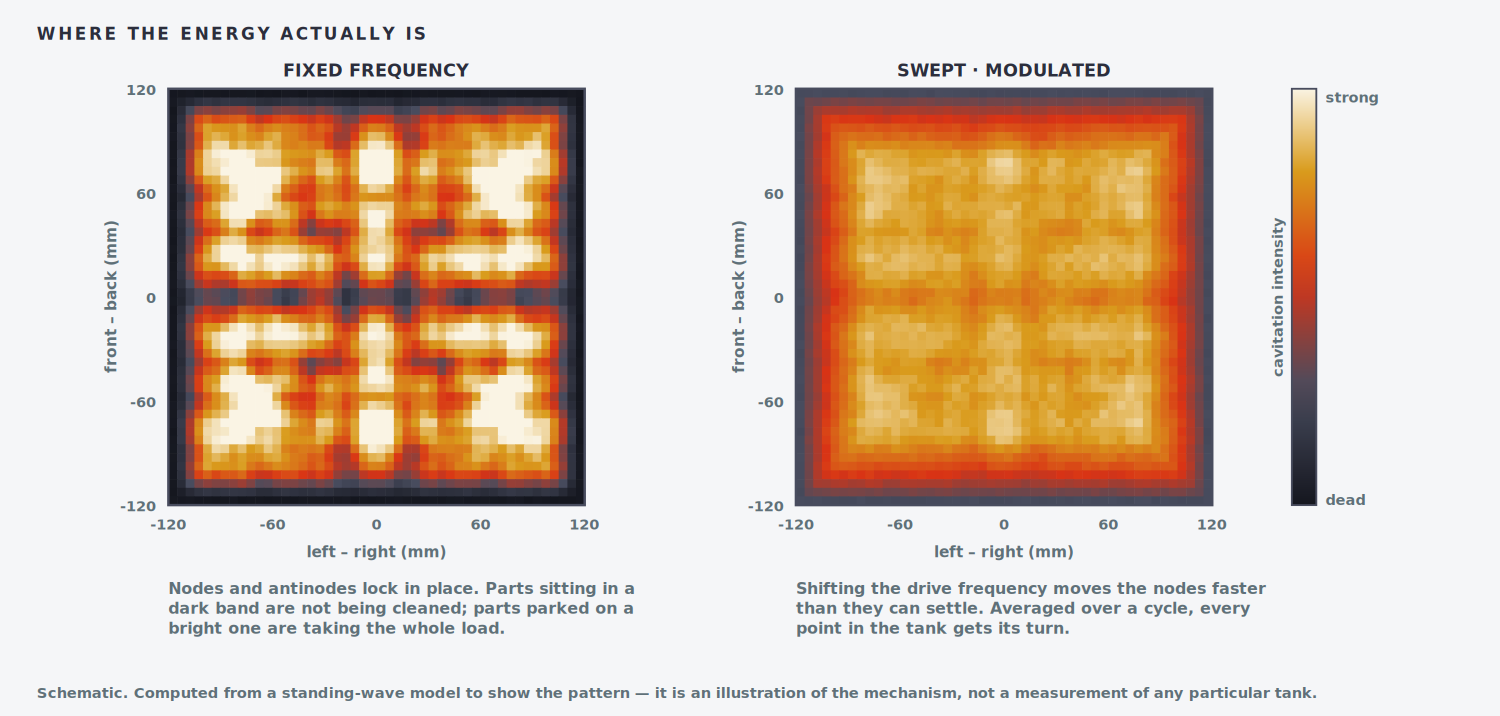
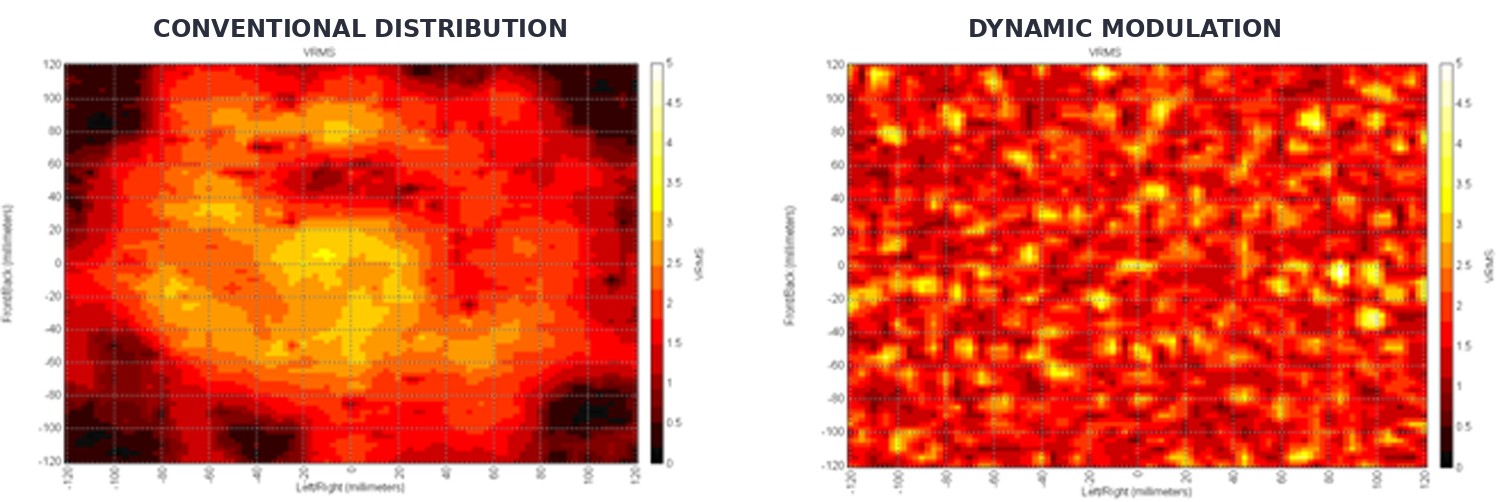
A part parked in a node is not being cleaned, no matter what the generator is drawing. A part on an antinode is taking the whole load and, given enough time, may show for it.
The fix is to refuse to let the pattern settle. Sweep moves the drive frequency cyclically through a band of 1–2 kHz, which moves every node and antinode continuously. Averaged over a few seconds, every point in the tank gets its turn. Sweep, pulse and degas covers what each control actually does.
The load changes the tank
Lower a basket of parts into a bath and the sonic load on the transducers changes — the tank is no longer driving the same mass of liquid it was tuned against. The resonance shifts, and a generator that keeps driving the old frequency is now off resonance and quietly delivering less than it says on the dial.
Automatic frequency tracking measures that shift and follows it, continuously, as the load changes through the cycle. It is not a luxury feature; it is the difference between a machine that performs the same on a full basket as on an empty tank and one that does not.
Where the energy comes from
The transducer converts oscillating electrical energy into oscillating mechanical energy. Two technologies exist — magnetostrictive, which works from an oscillating magnetic field and is robust but inefficient, and piezoelectric, which is what serious industrial equipment uses today.
Nearly all piezoelectric transducers share one construction: one or two piezoelectric ceramic elements clamped between two metal masses by a bolt through the centre. This is a Langevin, or bolt-clamped Langevin transducer — BLT. Where there are two elements they are arranged so their motion adds, with their positive faces meeting a central electrode insulated from the rest of the assembly, and the two masses at ground completing the circuit.
Two details decide whether it performs. The ceramic faces are silver-coated to make the electrical connection, and the clamping bolt is tightened to a precise, specified compression at assembly. That torque is not fastening — it is part of the tuning. The finished assembly is resonant over its whole length, and it transmits maximum power only at that resonance. The ceramic is a small part of the stack; the assembly is the resonator. Dual and multi-frequency ultrasonics goes into what happens when you build two of these into one assembly.
Cleaning and eroding are the same mechanism
Cavitation attacks the softest thing it can reach. On a contaminated part that is the residue, which is why the carbon leaves and the casting does not. Push the power density or the cycle time far enough, though, and once the residue is gone the same jets start work on the part itself.
Well-designed equipment is specified so that the process stops at the residue for the parts it is meant to clean. Where the substrate is soft, thin, polished or coated, the margin is narrower and worth understanding before you commit — see cavitation erosion: when the cleaning damages the part.
The detergent does two jobs, and more is not better
Chemistry in an ultrasonic bath is not there to dissolve everything on its own. It does two specific things. It wets both the radiating surfaces of the tank and the part itself, so there is intimate contact for the energy to transfer through and so cavitation can actually form at the surfaces you want cleaned. And it lifts the soil — wetting particles so they release, dissolving oily films so they leave.
Here is the part that catches people out. Detergent works by lowering surface tension, and surface tension is also what holds a cavitation bubble together long enough to collapse hard. Overdose the bath and you drop the surface tension so far the bubbles collapse early and weakly. The tank sounds the same and cleans worse. More chemical is one of the most common causes of a bath that has stopped performing — the dosage calculator gives the concentration your volume actually wants, and the chemistry guide covers matching the family to the soil.
And before any of it works: degas
Mains water carries dissolved air. Fresh chemistry carries air stirred in during mixing. Those microscopic air bubbles absorb ultrasonic energy and cushion the collapse of the cavitation bubbles, so a newly filled tank is running at a fraction of its capability and feels, to the operator, like a machine that has gone soft.
Degassing drives that air out over the first twenty to thirty minutes of a new fill. It is the most undervalued step in the whole process and the first thing to check when a bath underperforms from cold — degassing, and why the first half hour matters.
What this is worth knowing for
Every specification decision on an ultrasonic machine traces back to this one event. Frequency sets the bubble size. Power density sets how many of them there are. Sweep and modulation decide whether they are everywhere or only in bands. Frequency tracking decides whether that holds once the parts are in. Chemistry decides whether they form at the surface at all, and degassing decides whether they form properly on day one.
Which is why the honest way to specify a machine is not from a brochure. It is to run your own parts, with the soil actually on them, through the machine and chemistry being proposed — and read the result.
Image credits
The cavitation bubble photograph on this page was recorded by Professor Lawrence A. Crum, Director of the Center for Industrial and Medical Ultrasound at the University of Washington, and is reproduced with thanks. The measured tank field maps are reproduced courtesy of Honda Electronics. The four-stage collapse sequence, the figures panel and the schematic field comparison were drawn by Misonics.