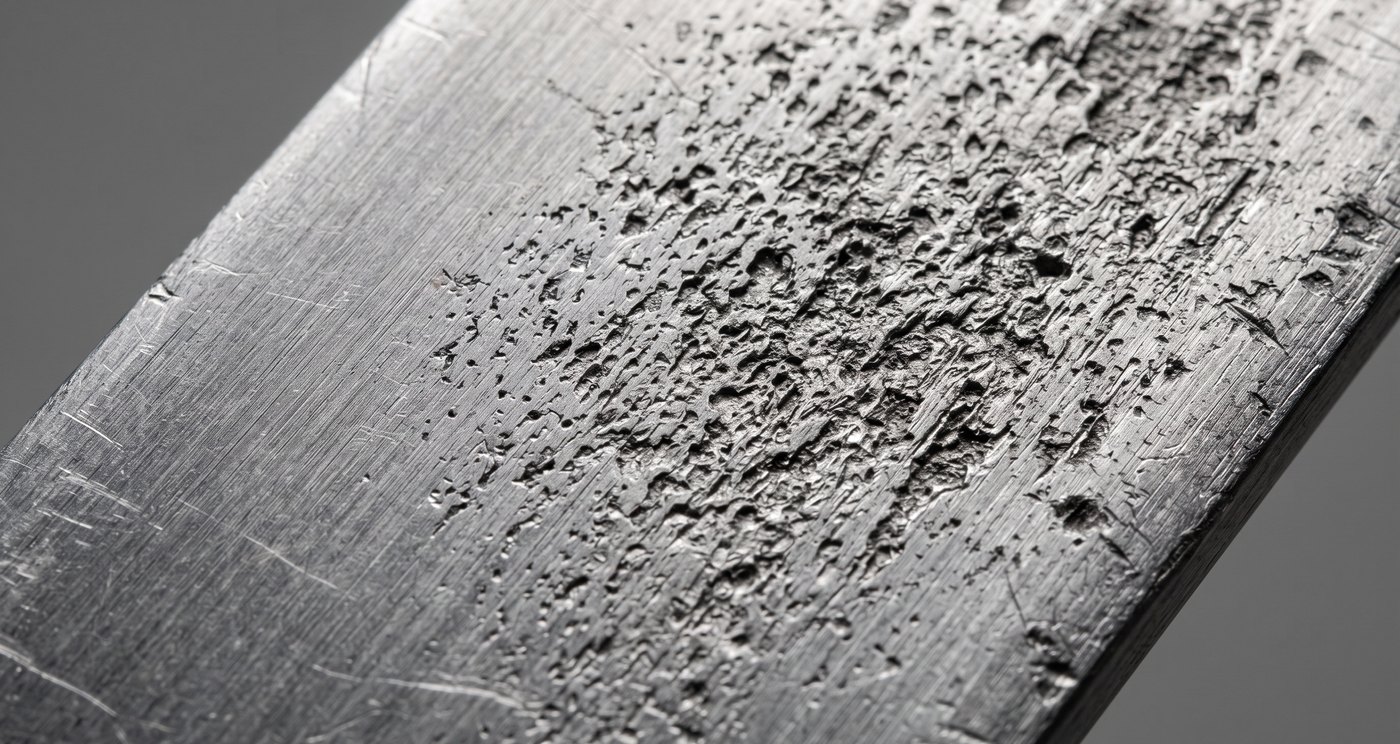
Ultrasonic cleaning relies on controlled cavitation at the part surface. For most industrial components this presents no issue, but susceptible materials can be affected if the frequency, power, chemistry or exposure time is inappropriate for the application.
Cavitation erosion is highly application-dependent. Soft metals, thin sections, delicate surface finishes and some coatings are more susceptible, particularly when exposed to excessive power density or prolonged cleaning cycles.
Cavitation cleans by imploding bubbles at a surface, producing brief, extremely local jets of liquid at high velocity. Against a layer of baked carbon that is exactly what you want. Against a soft, thin or highly finished surface, the same jets remove material from the part itself.
Left long enough, it shows as a dull, matte, slightly frosted appearance, then as visible pitting. On a mirror finish you will see it long before it becomes dimensional.
Erosion is cumulative. The single most common cause of damage is a cycle that was never optimised — someone set fifteen minutes because it was a round number, when four would have done. Cleaning is not linear: most soil comes off early, and the extra time is doing nothing but eroding.
Lower frequency means fewer, larger, more violent bubbles. 25 kHz is aggressive and appropriate for cast iron and heavy carbon. It is the wrong choice for a polished aluminium component. Higher frequencies — 40 kHz and above — produce smaller, gentler implosions and are far safer on delicate work. This is the real argument for dual and multi-frequency machines: run the aggressive pass on the soil, the gentle pass on the finish.
Watts per litre matters, but so does where it goes. An under-loaded tank concentrates all the available energy into whatever is in it.
Intensity is not uniform. Parts sitting close to a transducer face or in a standing-wave antinode see far more energy than the tank average. Sweep exists partly to even this out.
Aggressive chemistry plus cavitation compounds. A high-alkaline bath attacking aluminium chemically while cavitation attacks it mechanically will do damage neither would alone. See temperature and substrate tolerance.
Do not guess. Run a sacrificial part, or the least valuable real one, at your intended cycle and then at two and three times the cycle. Inspect under magnification. If three times the cycle shows nothing, your margin is comfortable. If your intended cycle already shows frosting, you have a problem to solve before production, not after.
For anything valuable or irreplaceable — heritage restoration, aerospace hardware, instruments — that trial is not optional.
For finish-critical parts, the cleaning parameters need to be established against the material and required surface finish. A controlled trial allows us to determine a cycle that cleans effectively without damaging the surface — or to confirm that an alternative cleaning method is more appropriate for the part.
We assess each application. Where required, we validate the process through a controlled cleaning trial on the machine and chemistry we would specify, with the cycle and the result reported against your standard — ask us to scope it.