Every serious generator has them: sweep, pulse, degas. Most operators leave them wherever the commissioning engineer did, understanding none of them. That is a waste — these three settings are the difference between a tank that cleans and a tank that cleans everywhere, every time. Here is what each one actually does.
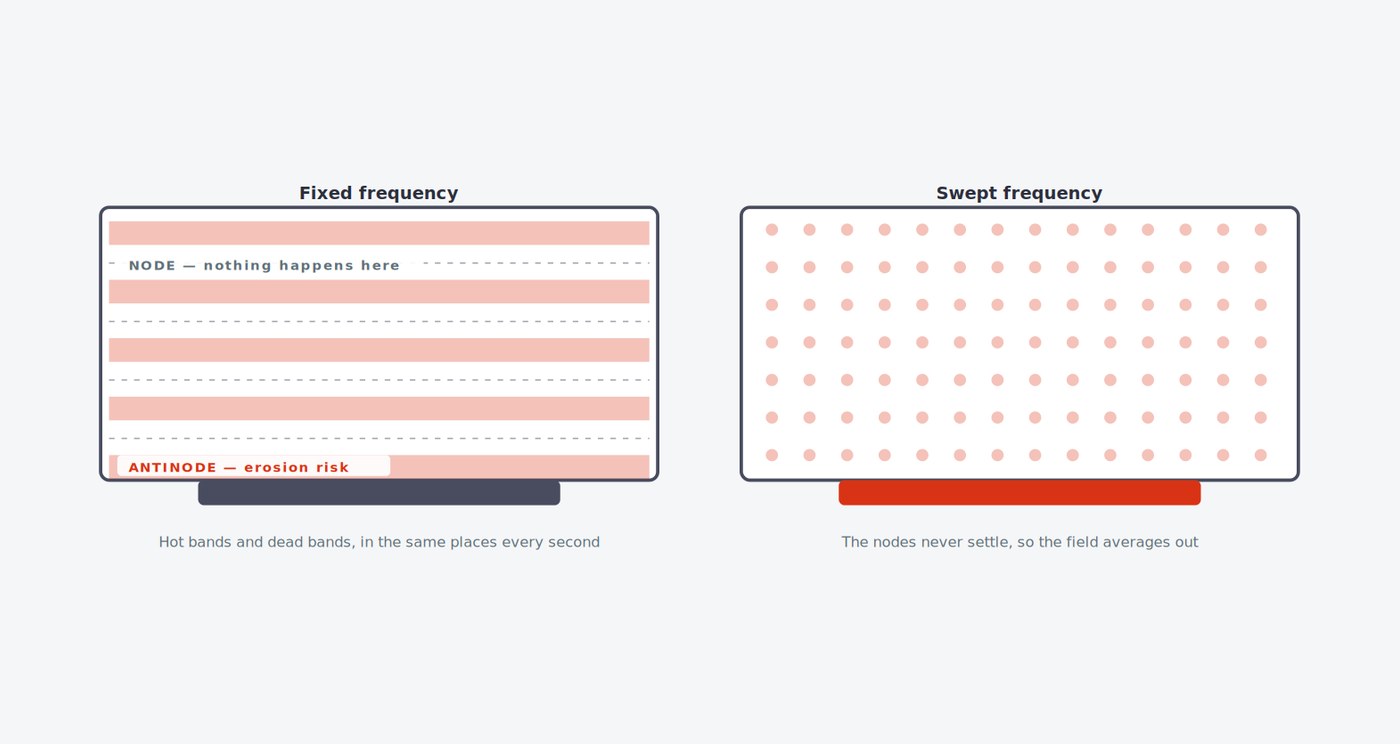
Run a fixed frequency in a fixed tank and the sound reflects into standing waves — stationary zones of high and low intensity. Parts clean in stripes: fierce at the antinodes, nothing at the nodes, and bubbles sit trapped at pressure nodes doing no work. Sweep modulates the drive continuously around the centre frequency, moving the pattern faster than it can stand still. The field averages even; the stripes vanish; a loaded basket cleans uniformly. It also stops any single part resonating — which matters for thin sections. Default: on, always, unless a specific process says otherwise.
Pulse interrupts the drive rhythmically — bursts of full power with micro-pauses between. The pauses matter twice: they let fresh solution flood back against the surface, and they let bubble populations reset instead of saturating. The result is higher peak cavitation intensity from the same average power — more punch per watt. Use it on stubborn, bonded soils and heavy loads; skip it for delicate work where steady gentleness wins. On our platforms this is the peak-power mode that shifts deposits steady drive will not.
Fresh solution is saturated with dissolved air, and air-cushioned bubbles collapse softly — absorbing energy without cleaning. Degas mode drives the gas out: typically pulsed operation that coalesces microbubbles and floats them to the surface. Classic machines needed a dedicated degas program after every fill; modern sweep-equipped generators degas continuously as a side effect, so the dedicated cycle matters mostly at fresh fills and top-ups — give a new bath its 15–30 minutes at temperature before judging anything it does.
Sweep ON always · Pulse ON for stubborn soils, OFF for delicate · Degas after every fill and top-up, then trust the sweep. Laminate that and you are ahead of most of the industry.
The literature backs the button: fixed-frequency erosion tests show foil perforation concentrated in horizontal stripes at half-wavelength spacing — the standing-wave signature — while swept drives spread erosion into a uniform stipple. Run the pair on your own tank (№14 method) and keep both foils; no vendor argument survives two pieces of aluminium held up to a window.
Thin blades ring at fixed frequencies — the sweep/fixture solution documented.
On file — to be written up: Case Studies/Saw BladesThese settings are only as honest as the generator running them. The VarioSonic G5 platform holds the drive on true resonance while it sweeps (frequency tracking), delivers constant power as the load changes, and shows frequency and output live on the HMI — so "is it actually sweeping?" is a glance, not a faith position. Cheap generators print the same words on the panel; the oscilloscope tells a different story.
Standing waves are not a subtle defect. In an unswept fixed-frequency tank, node-to-antinode intensity can differ severalfold across a few centimetres — parts centimetres apart living in different machines. Sweep collapses that variance to near-uniformity, which shows up directly in reject statistics on precision loads: the difference between "clean sample" and "clean batch". The foil test (№14) photographs the improvement in sixty seconds.
At 50 kHz in water, standing-wave nodes repeat roughly every 15 millimetres — an unswept tank cleans in stripes finer than your basket spacing.Acoustic wavelength in water ≈ 1,480 m/s ÷ frequency; halved for the standing-wave pattern.
These three functions get set correctly in one afternoon and then mostly left alone — the failure mode is not wrong settings but nobody ever setting them. The routine: fill, heat to operating temperature, and run degas until a foil strip shows even attack (a fresh fill can need 15–30 minutes; log what yours needed and that is your standing degas budget after every water change). Then the sweep check: one foil with sweep off, one with sweep on, same position and time. The striped foil and the stippled foil go in the commissioning file, and sweep stays on for the life of the machine — the pair exists so that anyone who later wonders what sweep does can be shown rather than told. Pulse gets reserved deliberately: agreed part numbers with tenacious soils, noted on the process card, rather than left as a knob operators toggle when bored.
The quarterly repeat is the health trend. Same foil, same positions, same time — compared against the commissioning set. Drift shows up as thinning attack in a region months before parts complain, and the conversation with the service technician starts from evidence: "bank two's corner has faded since March," not "it seems weaker lately."
Commissioning trial: your parts, our lab, every setting documented and explained — so the panel stops being folklore.