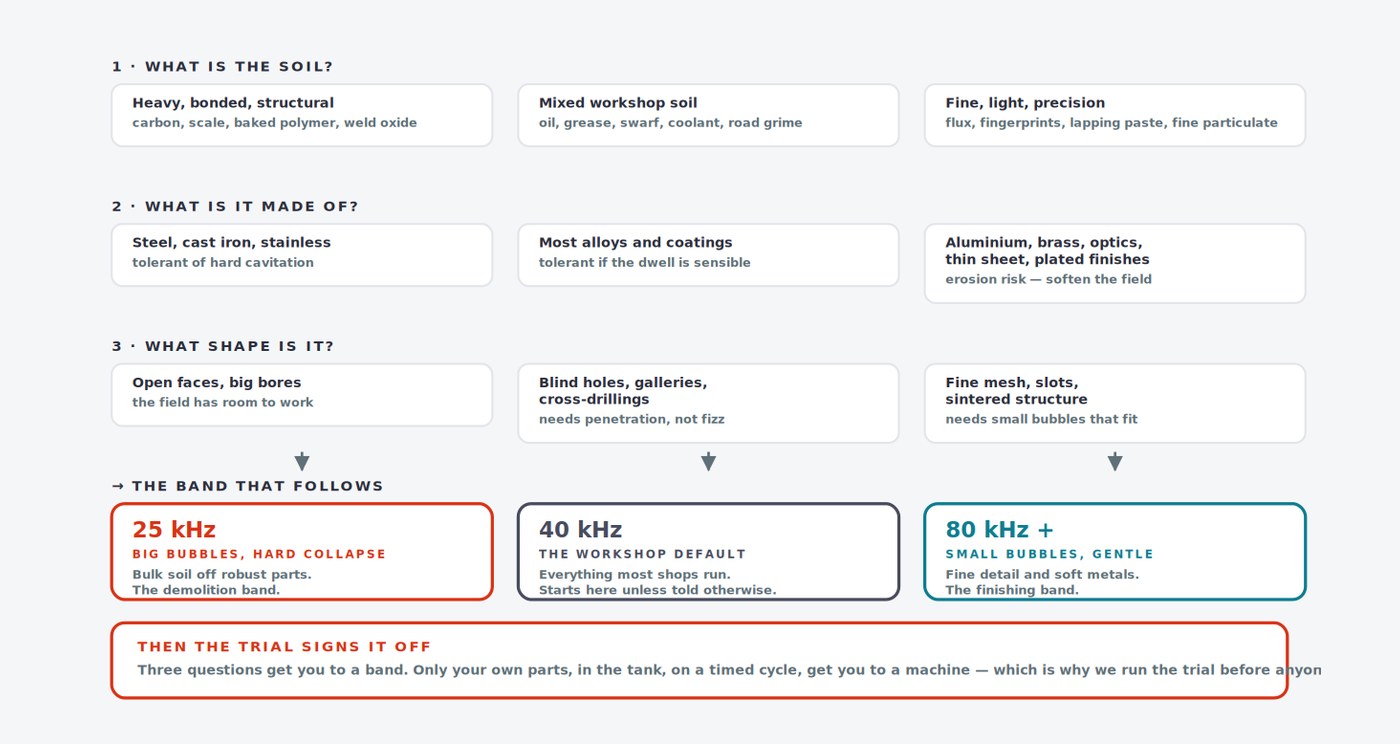
Frequency is the first specification decision on any ultrasonic machine — and the one most buyers let the salesman make for them. It sets the size and violence of every cavitation bubble in the tank, which means it decides what cleans, what survives, and what disappoints. Ten minutes here saves years of the wrong tank.
A cavitation bubble grows during the low-pressure half of each sound cycle. Lower frequencies give it longer to grow, so it gets bigger — and a bigger cavity collapses with far more energy. Higher frequencies give bubbles less time, so they stay small, collapse gently, and form in vastly greater numbers, reaching into finer detail.
Low frequency hits harder in fewer places; high frequency hits softer in millions more places. Everything else about frequency selection is this sentence applied to your part.
| Band | Character | Built for | Wrong for |
|---|---|---|---|
| 20–28 kHz | Large, aggressive bubbles | Coked carbon, heavy grease, castings, mining and engine work | Polished, plated and delicate surfaces |
| 40 kHz | The industrial all-rounder | General precision — machined parts, mixed workshop loads | Extremes at either end |
| 68–80 kHz | Fine, dense field | Fine detail, small passages, sensitive substrates | Heavy soils — it will bore you |
| 120–130 kHz | Gentlest, densest | Optics-adjacent, polished dies, micro-features | Anything a workshop calls dirty |
What is the soil? Baked and bonded → low band. Films and fines → high band. Mixed → keep reading.
What is the substrate? Robust ferrous castings shrug off 25 kHz all day. Soft aluminium, brass and coatings prefer 40+ — low frequency can mark soft surfaces over long exposures.
What is the geometry? Fine passages and dense detail favour the smaller bubbles of higher bands, which follow contours the big bubbles bridge over.
Published cavitation-erosion work confirms what workshops learn expensively: low-frequency exposure erodes soft substrates measurably over time — erosion-test foils and soft aluminium coupons show it within minutes — while the same energy at 80 kHz leaves them untouched. The practical translation is the exposure budget: aggressive frequencies buy speed on robust parts and spend surface on soft ones. When a load mixes both, sequence the bands (№10) instead of splitting the difference — a compromise frequency compromises everything.
Opel and general head-rebuild work — the frequency decision documented with outcomes.
On file — to be written up: Case Studies/Cylinder Heads + Opel HeadsPlenty of real loads sit across the trade: heavy soil and delicate features, castings and finished faces in one basket. Dual-frequency platforms answer with two resonant systems in one tank — run the aggressive band for the bulk, switch to the fine band for the finish, without moving the part. Our dual-piezo BLT architecture drives each frequency at its own true resonance — no off-resonance compromise. The dual-frequency article (№10) goes deep; the short version is that it exists precisely for mixed reality.
"Higher frequency = better machine." Frequency is a fit, not a grade. A 130 kHz tank on mining hydraulics is a very expensive way to do nothing; 25 kHz on polished mould cavities is vandalism with a power cord. The best frequency is the one your soil and substrate vote for.
The damage conversation deserves numbers rather than nerves. Low-frequency cavitation can mark soft substrates — but the mechanism is cumulative exposure, not instant harm. Short aggressive passes followed by fine-band finishing keep total low-band exposure under the threshold while still breaking heavy soil: the sequencing strategy that dual-frequency platforms automate. Hard ferrous parts, by contrast, tolerate the aggressive bands essentially indefinitely — which is why 25 kHz remains the rebuild industry standard.
Bubble diameter scales roughly inversely with frequency — the aggressive band collapses cavities several times larger, each carrying far more energy per implosion.Standard acoustic cavitation relationships; see also №1 in this series.
A general rebuild shop asks for "the right frequency" for a workload of cast-iron heads, aluminium housings and the occasional rack of injectors. There is no single right answer — there are three, and the exercise shows how the decision actually runs.
The iron heads carry baked carbon and need demolition: 25–28 kHz, hot alkaline chemistry, no apology. The aluminium housings carry oils and light varnish on machined faces that will be measured afterwards: 40 kHz covers them comfortably, and if the shop later takes on polished or anodised work, 68–80 kHz earns its place. The injectors have micro-drillings and lapped seats: high band only, ever. Three duties, three bands — and the purchasing decision becomes honest: either two tanks at different frequencies (the usual answer, and cheaper than it sounds when one is a small high-frequency bench unit), or one dual-frequency platform where floor space or budget forces a single vessel.
What the shop should not do is buy one 28 kHz tank and feed everything through it. The iron will be delighted; the aluminium will develop the matte frosting of early cavitation erosion within weeks, and the injectors should never go near it. Nor should they buy a "safe" 40 kHz compromise and wonder why head carbon takes three cycles. Frequency mismatch is invisible on the quote and expensive on the floor.
The honest close: frequency selection from a blog gets you to a shortlist. The trial gets you to a number — your parts, two or three candidate bands, results side by side. That comparison costs a box of parts and settles the biggest specification on the machine.
The trial runs candidate bands side by side and lets the results choose. Bring the shortlist; leave with the number.