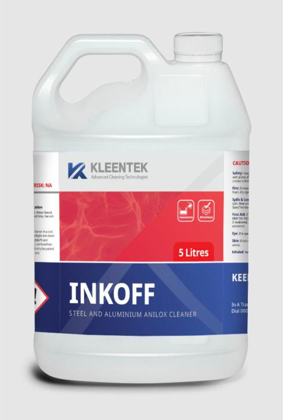
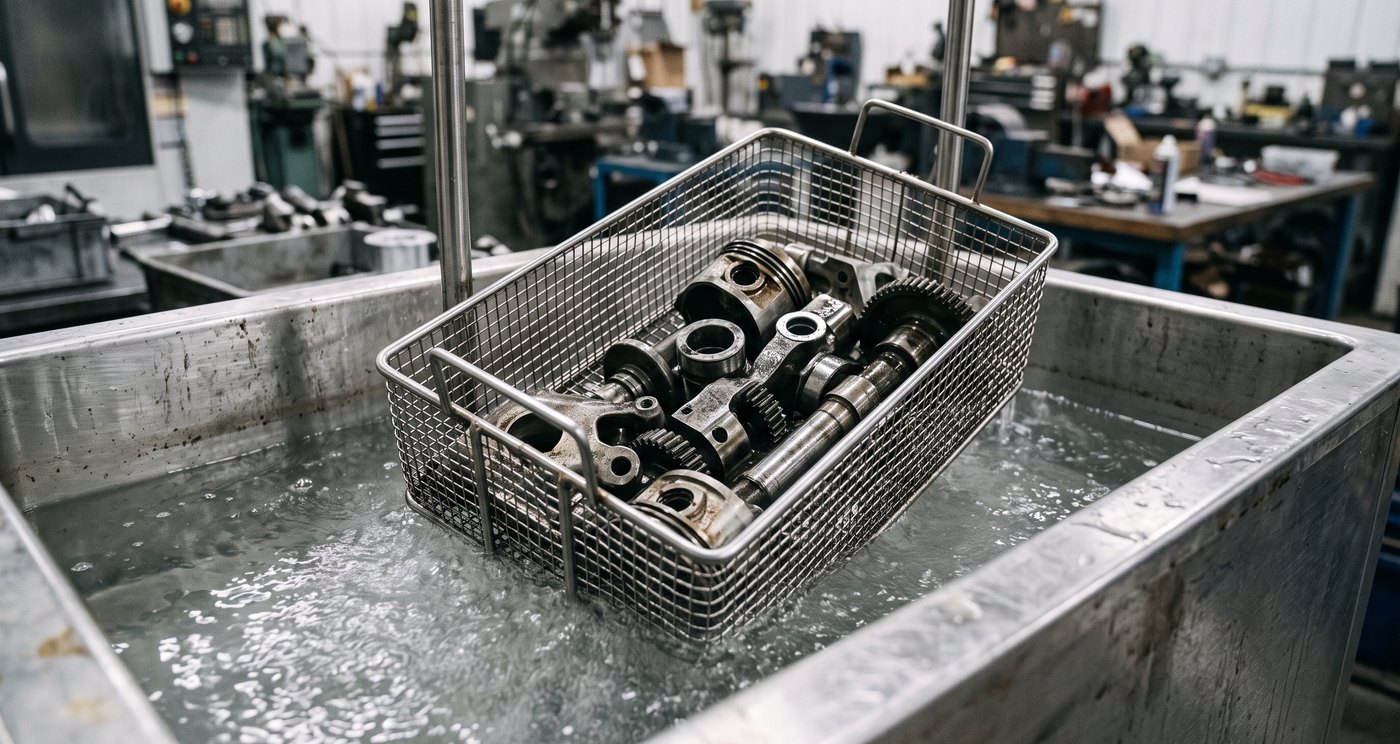
Cell volume back. Engraving intact.
An anilox roll is a metering instrument: millions of engraved cells whose volume decides ink delivery. Every dried film in those cells changes the maths, and every mechanical recovery — blades, bicarb — spends engraving life to buy back volume.
Inkoff dissolves the inks and coatings instead, formulated with anti-foam behaviour that matters more than it sounds: foam kills cavitation, and cavitation is what empties cells at 1500 LPI. This is ink chemistry built for ultrasonic tanks, not adapted to them.
Volume measurement before and after is the honest scoreboard — typical recoveries land within measurement error of nominal, on rolls the blades had been slowly retiring. Aluminium roll cores need the controlled-immersion discipline the card describes; the ceramic itself never notices the process.
Where it earns its keep
Anilox rolls and sleeves; screens; press and coating hardware.
Dose: 10–25%. The trial sets your exact process values; the TDS governs.
The working process
Right product, right job
Inkoff — inks & coatings
Anilox, screens, press hardware.
Electro
Electronics-side press control gear
View → Rinse AidSpot-free final rinseView & buy →
 ZeroResidueFinal-stage cleanlinessView & buy →
| Mild & carbon steel | Safe in prescribed use |
| Stainless steel | Safe in prescribed use |
| Cast iron | Safe in prescribed use |
| Aluminium & titanium | Do not use — high-alkaline, etches aluminium |
| Magnesium & soft alloys | Do not use |
| Zinc & galvanised | Do not use — attacks zinc & tin |
| Copper & brass | Discolouration likely — test first |
| Plated finishes (Cd·Cr·Ni) | Cadmium unsafe — confirm Cr·Ni first |
| Plastics & rubbers | PP · HDPE · most industrial plastics safe |
| Painted / coated surfaces | Removes paint & coatings — that is the job |
| Transport | Not classified as Dangerous Goods for road and rail |