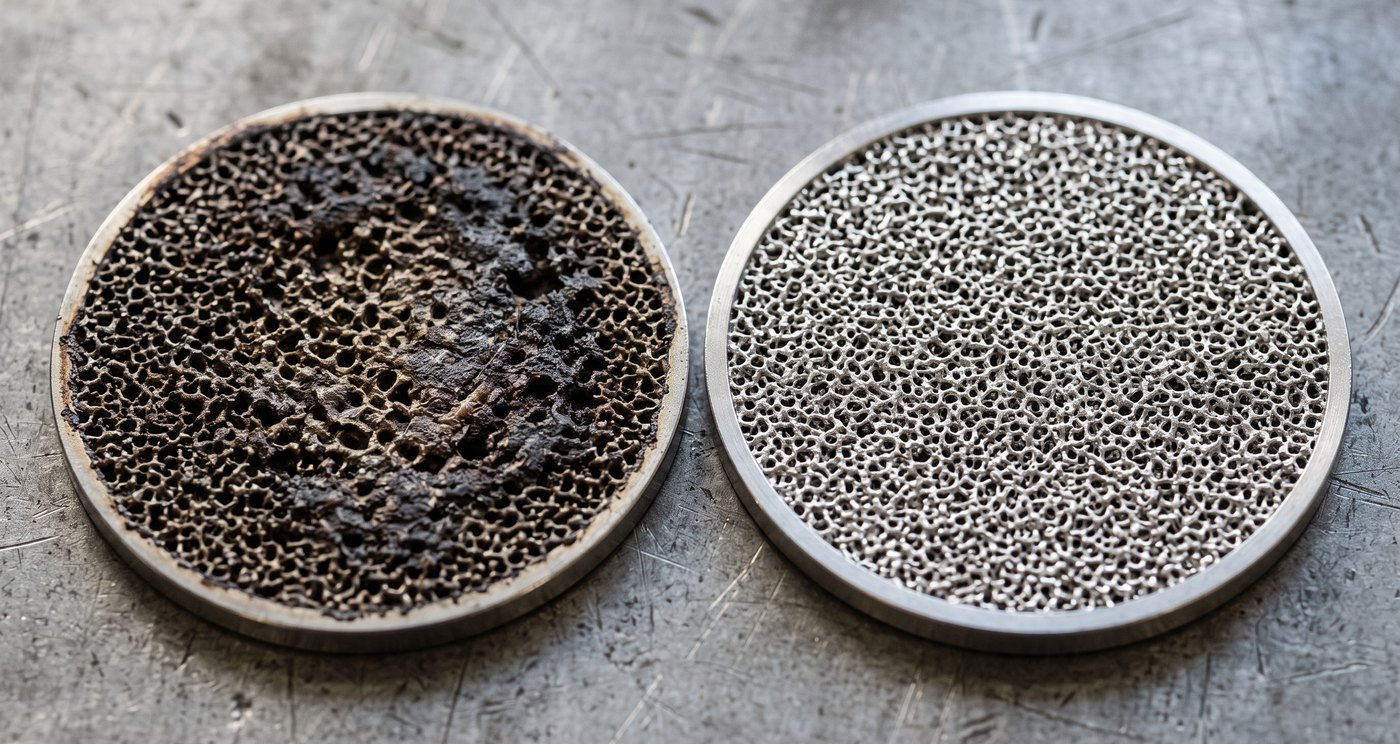
If you run hot-melt filtration — extrusion, recycling, fibre, film — you already know the economics: filter discs and screen packs are consumables priced like components, and every changeover is margin leaving the building. Ultrasonic cleaning turns most of those "consumables" back into inventory. This is the application guide.
A sintered disc or woven screen pack is all internal geometry — thousands of tortuous pores that trap polymer exactly where no brush, jet or oven burn-off behaves well. Burn-off ovens degrade the sinter and leave ash bridging the pores; solvent soaks stall on cross-linked residue; manual methods are theatre. Cavitation works inside the pore structure, and paired with the right chemistry it lifts both the polymer and its degradation products without touching the metal matrix.
Thermal or mechanical bulk removal first where heavy polymer masses the surface — the tank is the precision stage, not the dumping ground.
Hot alkaline ultrasonic stage at 25–40 kHz depending on disc robustness — staged cycles with inspection, because pore-deep recovery is progressive.
Flow or bubble-point verification. Visual clean means nothing on a filter; restored flow numbers are the product. Test, log, return to stock.
A disc recovered for a few dollars of chemistry and tank time replaces a disc purchased at full price — and a verified recovery program typically pays for the machine within its first year on media savings alone. This is one of the rare applications where the ROI slide writes itself.
A recovered disc without numbers is a hope. The industry-standard checks translate directly: bubble-point testing confirms pore structure integrity (first-bubble pressure maps to largest pore), and flow-rate comparison against a new-disc baseline quantifies recovery percentage. Log both per disc serial and the recovery cell earns quality-system status instead of workshop-hack status — which is what lets purchasing treat recovered media as stock.
Hot-melt filter disc recovery with before/after flow numbers — folder on file awaiting write-up.
Read the study: £75,328 a year back from disc recovery →Most operations run a dedicated recovery station: a heated industrial tank sized to the largest screen changer plus baskets that hold discs vertically so pores drain, with filtration on the bath because what comes out of the discs has to go somewhere. Volume from a benchtop MSX for lab-scale packs to EvoSonic-class tanks for large-format discs; fully automated lines where changeover volume justifies them.
The arithmetic in the key box above is not hypothetical. A running recovery program in our case file documents annual media savings of at least £75,000 (≈A$145,000) against purchase-and-discard — before counting the changeover flexibility of holding recovered stock. Media recovery is one of the few industrial investments where the first year routinely pays for the entire cell.
Documented annual filter-media savings from a single hot-melt recovery program in our case file — the ROI slide, already written.Misonics hot-melt recovery case file; write-up in production.
A workable disc-recovery cell is smaller than most plants expect. Size the tank to the disc stack plus clearance — a 50–100 L bench platform handles most extrusion-line disc formats — and specify the frequency band to the sinter, not the polymer: the porous matrix is robust, but the objective is polymer removal from within the pores, which favours thorough mid-band work over brute low-frequency exposure. Chemistry follows the polymer: hot-melt adhesives and olefins respond to high-alkaline saponifying chemistry at elevated temperature; where the polymer is degraded and carbonised from running hot, the process leans toward the strip-grade end of the range. The cycle that works in practice is soak-assisted — let the heated bath soften the polymer mass, then apply ultrasonics to evacuate the pores — because cavitation is superb at extraction and merely adequate at bulk melting.
The back end matters as much as the tank: a hot rinse to clear chemistry from the pores before it dries in them, a proper dry (residual moisture reads as pressure anomalies at the next bubble-point test), and the verification bench — bubble point and flow — with results logged against disc serials. Plants that run the full loop treat discs as rotating stock with a known recovery rate; plants that only run the tank end up arguing about whether recovered discs are trustworthy. The numbers end the argument.
Not every disc recovers. Sinter damaged by previous burn-off cycles, or polymer degraded past a point, stays blocked — and the trial tells you your real recovery rate before you build a cell around an assumption. Typical programs still retire the minority and profit on the majority.
The trial returns them with before/after flow numbers — your real recovery rate, measured, before you invest in anything.