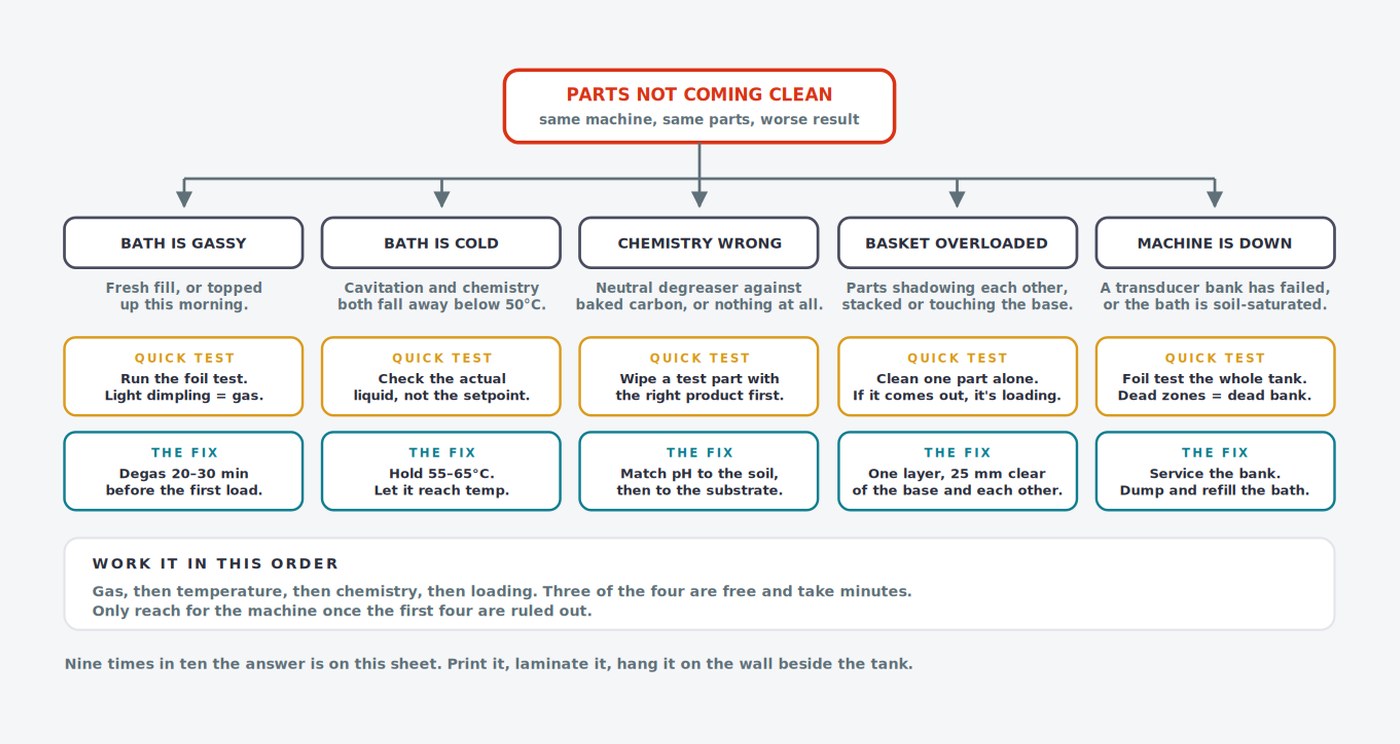
Your machine hums, the bath is warm, the timer ran — and the parts came out disappointing. Before you blame the tank (or the supplier), run this list. In fifteen years of investigating "broken" ultrasonic cleaners, the machine itself has been the culprit in almost none of them. These five causes, in this order, cover nearly everything.
Half of all disappointment lives here. A degreaser will not touch mineral scale; a descaler ignores grease; a general detergent bounces off baked carbon; and household chemistry foams the tank into uselessness. Diagnose with a wipe test — oily smear says non-polar soil, white crust says mineral, both says staged process — and read the like-dissolves-like guide. Then match against the range selector. Right family first; strength second.
Chemistry depletes with work. If cleaning faded gradually over days, suspect concentration: titrate or test-strip the bath against its specification, and top up — or change out if the bath is carrying more soil than the filtration can hold. If you have never measured concentration, start: guessing costs more than the test kit every month. A defended, measured bath lasts weeks; an unmeasured one is a mystery with a heater.
A freshly filled bath is saturated with air, and gas-filled bubbles collapse softly — absorbing the ultrasonic energy that should be cleaning. The fix costs nothing: run the tank at temperature for 15–30 minutes after every fresh fill before the first basket (modern sweep-equipped generators degas as they run, but give a new fill its settling time). If mornings clean worse than afternoons, this is why.
Cavitation cannot clean what it cannot reach. Overloaded baskets shadow the middle parts; nested parts mask each other; parts sitting flat on a solid tray shadow themselves; and a basket resting on the tank floor couples the field into the frame instead of the work. Load in a single layer where you can, use open-mesh baskets, keep the load off the floor and walls — and if the same spot on every part stays dirty, rotate or re-fixture: that spot is in shadow.
Last, because it is rarest — but real. Transducer faces erode over years; generators drift or lose output channels; and cheap tanks were never delivering their nameplate watts to begin with. The five-minute check is the foil test (№14): uniform perforation says the field is healthy, dead zones say service. On VarioSonic-driven machines, live frequency and power readings on the HMI make this a glance instead of a test.
Every cause on this list has a five-minute measurement. Concentration: titrate (drops × factor = %%). Degassing and field health: the foil test (№14) — and where audits demand numbers, handheld cavitation meters with NIST-traceable calibration turn "feels weak" into a logged reading. Loading: photograph the basket that failed and the basket that passed; the shadow map is usually visible. The shops that escape repeat disappointment are the ones that write the reading down.
Western Filters enquiry → diagnostic → carbon + RegeniK ash-stage process with flow-test results.
Read the study: the DPF two-bath ash process →Chemistry → concentration → degas → loading → machine. The first four are same-day fixes that cost almost nothing. Jumping straight to "the machine is broken" is how good tanks get replaced for a chemistry mistake.
Pattern recognition speeds the hunt. Across the diagnostic visits and inquiries we see, chemistry mismatch and bath exhaustion together account for well over half of all complaints; degassing and loading split most of the remainder; and genuine hardware failure trails far behind — real, but rare, and usually visible on a foil in five minutes. The order of the checklist is the order of the odds.
Of the five causes behind almost every "broken tank" complaint, four are process issues fixable the same day at near-zero cost.Misonics service and inquiry experience; see the fault tree above.
Here is the exact sequence we run on a "machine stopped working" call, in the order that catches the culprit fastest. Minute one: look at the bath. If you cannot see the elements through the liquid, the diagnosis is probably over — a loaded, oil-capped bath cleans nothing, whatever the transducers are doing. Minutes two and three: titrate. Drops times factor gives concentration; compare against the process card. Below spec is the answer more than half the time, and it costs a scoop of powder to fix. Minute four: thermometer in the bath, not faith in the display — set point and actual diverge on aging controllers. Minutes five and six: degas check — a freshly filled or topped-up bath needs its degas run before it can cavitate properly, and a surprising number of Monday-morning complaints are Friday-afternoon water changes. Minutes seven and eight: the foil strip at three positions. Even perforation says the machine is fine and the process is not; a dead zone says transducer bank or generator, and now — only now — is it a service call. Minutes nine and ten: look at the basket that failed. Stacked, nested, over-dense loads shadow themselves; the foil can be perfect and the middle of a crammed basket still dirty.
The order matters because it runs cheapest-first: chemistry and operating habits fix for dollars, hardware fixes for hundreds. Running it backwards — calling the technician before titrating — is how a $40 chemistry top-up becomes a $400 site visit that ends with the technician titrating.
If the foil test shows dead zones after the first four causes are cleared, talk to us about a service assessment — transducers and generators are replaceable line items on serious machines. And if your current tank was never serious, the assessment doubles as a fair-trade conversation.
Tell us the chemistry, the settings and what you are seeing. The lab finds what the checklist could not.