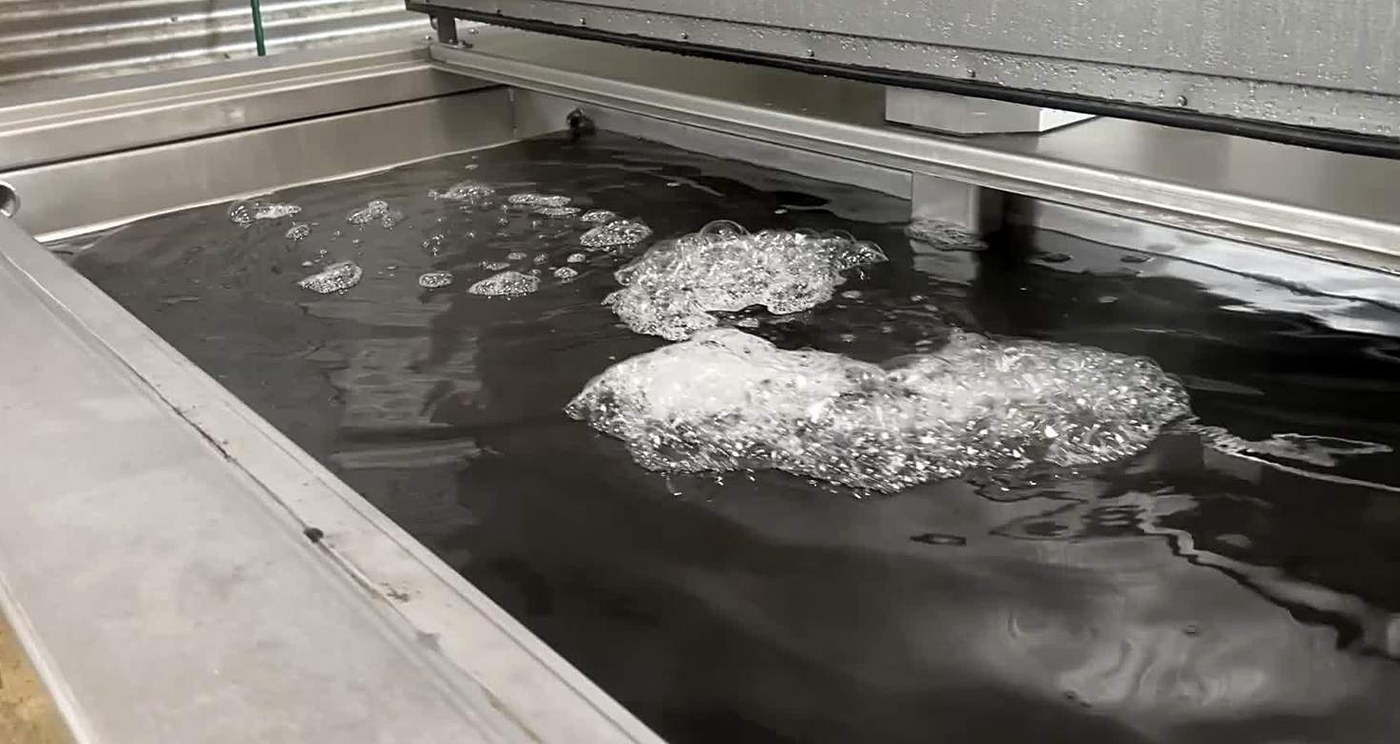
Sound that tears a liquid apart, millions of times a second — and why that cleans inside geometry no brush, jet or blast line will ever reach. The industrial explainer, from the physics down to your tank.
Here is the strange claim at the heart of our whole industry: we clean metal with sound. Not with scrubbing, not with pressure, not with anything that touches the part — with carefully controlled sound waves in a tank of water-based solution. It sounds like marketing. It is physics, and by the end of this article you will know exactly how it works and — more usefully — why it sometimes doesn't.
Every sound is a pressure wave travelling through a medium: air when someone speaks, steel when a bearing sings, water when a tank runs. The wave alternates — compressing the medium, then stretching it — thousands of times per second. "Ultrasonic" simply means the frequency sits above human hearing, from about 20,000 cycles per second (20 kHz) upward. Our machines work between 20 and 130 kHz.
Now the part nobody explains: liquids have a peculiar combination of properties. They cannot be compressed. They have very little strength in tension — pull on a liquid and it does not stretch, it breaks. And uniquely, a broken liquid heals itself completely, closing back into a whole the instant the force is gone. No solid can do that; no gas needs to. This odd trio of properties belongs to liquids alone — and it is the entire reason ultrasonic cleaning exists.
Play a loud enough sound into a liquid, and the stretch half of each sound wave literally tears the liquid apart — creating a microscopic vacuum cavity that the compression half then slams shut.
That tearing-and-slamming cycle is called cavitation, and the slam is the working part. Each microscopic cavity — a near-perfect vacuum, not an air bubble — grows during the low-pressure half-cycle, then collapses in on itself during the high-pressure half. The collapse is an implosion: liquid rushing into a void from every direction at once, concentrating its energy into a point.
The numbers on that pinpoint are genuinely startling. The collapse produces intense local temperatures and pressures — for a fraction of a microsecond, in a volume smaller than a bacterium. One implosion does almost nothing. But a working tank hosts millions of implosions per second, on every wetted surface — including surfaces you cannot see: down blind holes, through galleries, inside the folds of a filter, behind the shoulder of a thread.
Lower frequencies (20–28 kHz) give each cavity longer to grow, so the bubbles are larger and the implosions harder — right for coked carbon on a cylinder head or mud in a mining radiator. Higher frequencies (40 kHz and up) make smaller, gentler, far more numerous bubbles — right for precision surfaces, fine detail and delicate substrates. Matching frequency to the job is the first specification decision on any machine, and choosing wrong is one of the top three reasons ultrasonic cleaning disappoints. Full article on frequency selection — coming in this series.
Insoluble contamination is blasted off. Swarf, dust, carbon fines, polishing media — particles held on by adhesion are physically dislodged by the micro-jets and carried into suspension, where the filtration takes them out of play.
Soluble contamination is dissolved — faster than chemistry alone ever could. Oils, greases, fluxes and salts dissolve into the cleaning solution, but dissolution normally chokes on its own progress: a saturated boundary layer forms at the surface and fresh solution cannot reach the soil. Cavitation strips that layer away continuously. The chemistry always works on fresh contact — which is why a heated ultrasonic bath outcleans an identical heated soak by an order of magnitude.
This division of labour explains the partnership at the core of every good clean: cavitation is the energy, chemistry is the selectivity. The sound field hammers everything equally; the solution decides what dissolves. Pair the wrong chemistry with a perfect tank and you will still get a poor result — a truth we unpack properly in Why your degreaser won't touch scale.
Every other cleaning method needs access. A brush needs reach, a spray needs line-of-sight, blasting needs a straight shot — and every one of them touches the part, which on gauged, coated or fatigue-critical components is precisely the problem. Cavitation needs only one thing: liquid contact. Wherever the solution flows — internal passages, cross-drillings, the inside of a heat exchanger, the thousand parallel channels of a DPF — the implosions are already there, working at full intensity, touching nothing.
Three components turn wall power into cavitation. A generator converts mains electricity into a high-frequency electrical signal — and in a good machine, continuously retunes that signal as the tank warms and the load changes. Transducers — stacks of piezoelectric ceramic bonded to the tank or sealed in immersible pods — convert the signal into physical vibration, flexing tens of thousands of times a second. And the tank and solution carry that vibration as the sound field your parts sit in. Heating, filtration and oil separation keep the field and the chemistry working shift after shift.
"Ultrasonic cleaning is too gentle for industrial soil." Tell that to the ring-groove carbon we strip at 70 °C, or the mining radiators that come out of a 25 kHz tank with clear passages. Gentleness is a settings choice, not a limitation — the same physics that safely cleans an aerospace sensor will, at 25 kHz and full power, remove deposits a needle gun cannot. What it will never do is remove metal. That is the point.
The figures inside a collapsing cavity have been measured, not estimated — sonoluminescence spectroscopy puts the effective cavitation temperature at roughly 5,000 K with pressures around 500–1,000 atmospheres, over lifetimes of a few microseconds and cooling rates beyond a billion kelvin per second. Each event is vanishingly small; the tank hosts millions per second. That is the entire energy budget of ultrasonic cleaning, delivered with the precision of something that cannot scratch.
Effective temperature inside a collapsing cavitation bubble — hotter than the surface of the sun, in a volume smaller than a bacterium, for microseconds.Measured spectroscopically — Suslick et al., Science; standard sonochemistry literature.
Two case files from our own tanks put flesh on the physics — the ring-groove work that opened this article, and a bundle of exchanger recoveries where cavitation reached tube surfaces nothing else could:
When ultrasonic cleaning disappoints, the physics was never the problem. In near enough every case we investigate, it is one of these: the wrong chemistry family for the soil (the number-one cause), dissolved air in a fresh bath cushioning the implosions before degassing, foam from a non-ultrasonic detergent absorbing the sound field, overloaded baskets shadowing parts from the transducers, or a tank running cold because someone was saving power in the wrong place. Every one is fixable in an afternoon — and every one is covered in this series.
You now know more about how ultrasonic cleaning works than most people selling it. The practical next step is never theoretical: it is your parts, your contamination, in a tank with the parameters set by someone who does this daily. That is what our cleaning trial exists for — you get the result and the documented process, before you commit to anything.
Where a process needs validating, a documented trial records cycle, chemistry, temperature and result — and if ultrasonics is the wrong answer we will tell you.