Machining and rebuild work is oily work — coolant films, hydraulic residue, preservative grease — and every gram of it ends up in your bath. What happens next depends entirely on plumbing you may never have looked at: the weir, the interceptor and (in the marketing, at least) the coalescer. Here is how oil actually leaves a cleaning system, and the chemistry decision that makes it possible.
Emulsifying chemistry locks oil into the solution — cleaning stays consistent early, but the bath carries its oil load everywhere, onto every part, until changeout. Demulsifying (oil-splitting) chemistry releases oil after capture: it rises to the surface, where hardware can take it away. For oily industrial duty, splitting chemistry plus separation hardware is the long-life pattern — the bath sheds its load instead of wearing it.
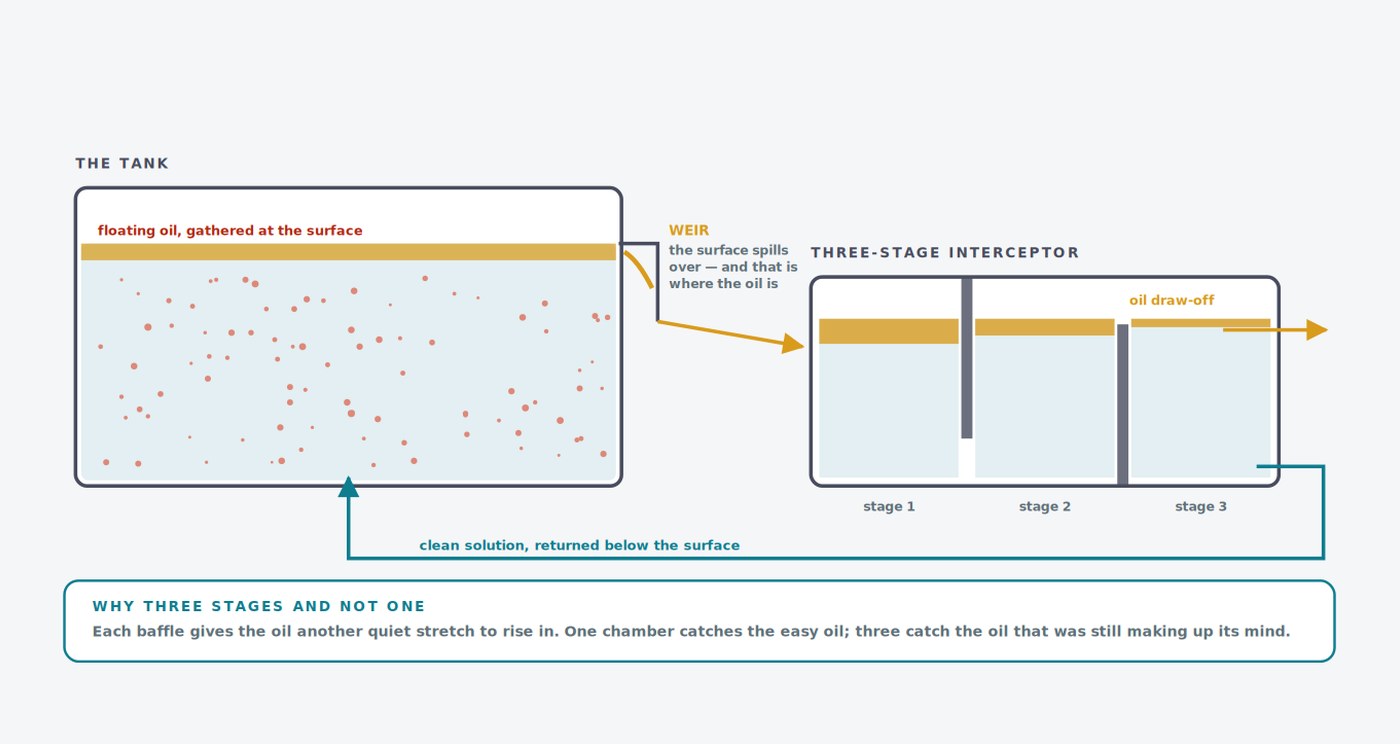
A weir is an overflow edge: the top millimetres of the bath — exactly where split oil floats — spill continuously into a side chamber, and the oily surface layer leaves the working volume. In the interceptor chamber, baffles slow the flow so oil separates and collects for draining while cleaned solution returns. No moving parts in the separation itself, nothing to foul: the geometry is the machine. Our triple-interceptor design stages this settlement so even fine droplets surrender before the return.
A coalescer packs the flow path with oleophilic media that merges fine droplets until they float. Genuinely valuable where oil arrives finely dispersed — some coolant systems, some rinse loops — and routinely oversold as magic for baths whose real problem is emulsifying chemistry. The honest order of operations: fix the chemistry fork first, size the weir second, add coalescing media only when droplet size demands it.
Splitting chemistry for oily duty · weir running whenever the bath is warm · interceptor drained on schedule, not on overflow · skim before idle periods so the bath never sleeps under an oil lid (which also feeds the algae problem from the chemistry guide).
One operating habit completes the system: skim before idle. A bath parked under an oil lid all weekend starts Monday anaerobic, odorous and — per the chemistry guide — a step closer to biological growth. The weir running an extra ten minutes on Friday is the cheapest Monday you can buy.
Mesabi-pattern radiator cleaning with weir capture — cores, oil load and bath-life data.
Read the study: radiator & cooler core recovery →Bath life in multiples, not percentages. Parts that leave clean instead of oil-filmed. Chemistry spend that tracks work done rather than oil absorbed. And a changeout that is a scheduled event instead of a Thursday emergency. Oil management is the least visible system on the machine and the most visible line in the operating budget.
Oil load is the quiet unit of bath ageing. Every basket of oily parts donates its film; without separation the donation compounds until the bath is a diluted oil drum with a heater. A working weir removes the surface layer continuously — which converts oil from an accumulating poison into a managed waste stream, drained from the interceptor on schedule. The chemistry fork decides whether the weir gets anything to catch; the weir decides whether the bath keeps working.
Split oil concentrates in the bath's top few millimetres — exactly the layer a weir overflow continuously removes.Weir and interceptor design practice; see the cutaway above.
A weir is simple enough that its failures are always operational, not mechanical. Set the working level so the surface film creeps over the lip continuously during operation — a weir sitting proud of the liquid line is sculpture. The overflow feeds the separation stage: an interceptor or coalescer sized so the liquid has genuine residence time to split, with the recovered oil drawn off to waste and the cleaned solution returned. Undersized separation just circulates the oil on a scenic route and returns it emulsion-tired; the residence-time question is worth asking on every quote.
Chemistry co-operates or sabotages. The splitting (demulsifying) formulation releases oil to the surface where the weir can take it — the pairing this whole architecture depends on. Run an emulsifying chemistry in the same tank and the weir has nothing to skim while the bath quietly saturates; the fork from the chemistry guide is not a footnote here, it is the operating principle.
Then the habits. Skim to a clear surface before any idle period — the Friday rule — because a bath parked under an oil lid goes anaerobic and odorous by Monday. Watch the interceptor's oil draw-off and empty it on level, not on memory. And record weekly what the weir recovers: the jar of tramp oil that did not stay in the bath is the cheapest KPI in the plant, and the fastest way to justify the option price on the next machine.
We split-test your current chemistry, size the weir duty, and show you the bath-life arithmetic before you change anything.