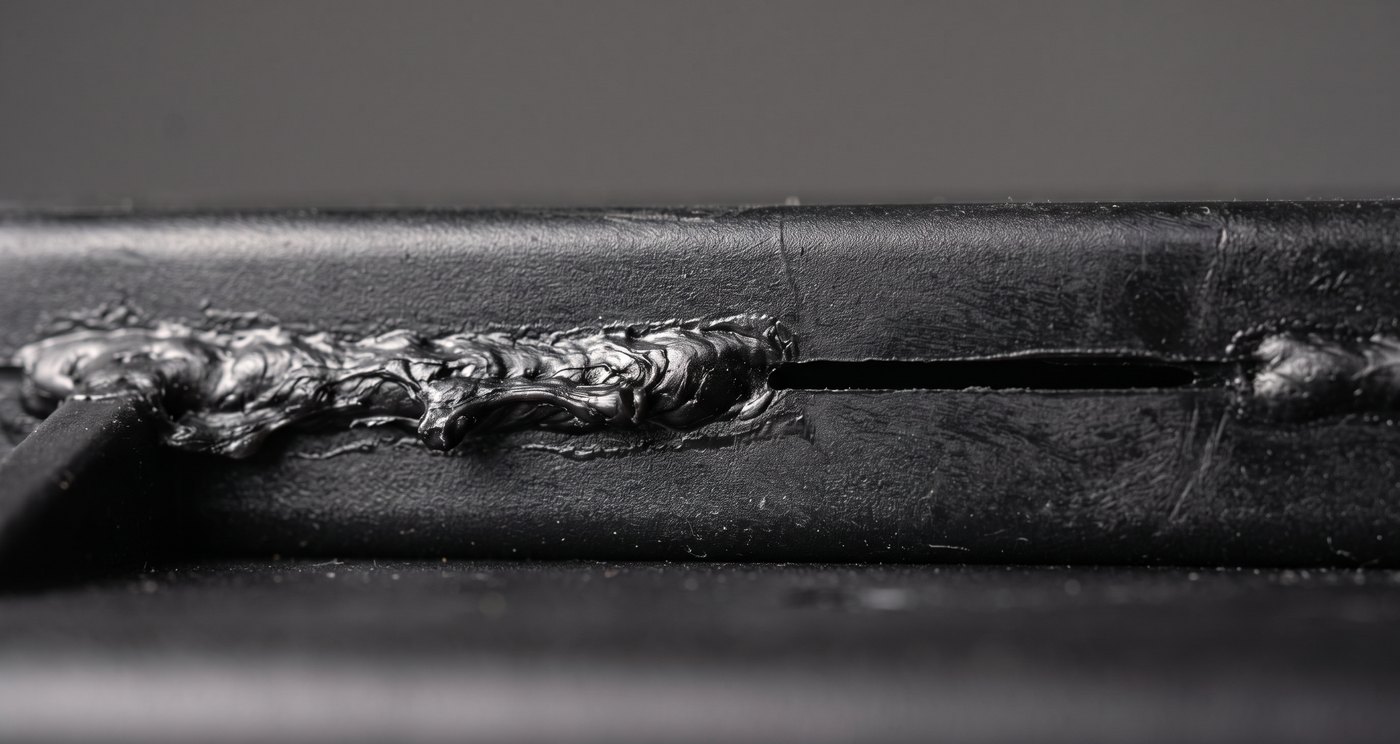
Ten symptoms, their usual causes, and what to change — in the order worth checking them.
Work down this table before changing anything expensive. In our experience most calls resolve to one of three things: the resin changed, the joint was never designed properly, or the horn is worn.
| Symptom | Usual cause | What to do |
|---|---|---|
| Weak or inconsistent welds | Under-welding — not enough energy into the joint. | Increase amplitude, energy or down-force. Check you have not changed resin: moving from ABS (30–70 µm) to PP (90–120 µm) needs roughly triple the amplitude, which often means a different booster. Verify the energy director is present and to dimension. |
| Flash squeezing out where it shows | Over-welding, or no flash trap in the design. | Reduce energy, amplitude or collapse distance first. If the weld strength is right and flash is still visible, the joint needs a designed flash trap — a tooling change, not a settings change. |
| Horn marking on the visible surface | Amplitude too high, horn face finish, or contact on a cosmetic area. | Reduce amplitude and increase weld time to compensate. Have the horn face polished, textured or coated. Where possible move horn contact to a non-cosmetic face. |
| Parts damaged, internals shaken loose | 20 kHz amplitude too aggressive for a delicate assembly. | Move to 35/36 kHz — higher frequency is gentler. Reduce amplitude. Support the internals in the fixture so they cannot resonate. |
| Diaphragming — a large flat face oil-cans and cracks | Unsupported flat area vibrating in far-field welding. | Support the panel from below in the fixture, move to near-field horn contact, raise the frequency, or add ribs to stiffen the panel. |
| Weld holds but leaks — not hermetic | Butt joint or step joint used where a sealed joint was needed. | A hermetic seal wants a tongue-and-groove or a shear joint. A butt joint with an energy director rarely seals reliably across a whole perimeter. |
| Results drift through the shift | Material variation — moisture, regrind or resin batch. | Move from time mode to energy mode, which compensates. Dry hygroscopic resins. Cap regrind at 10%. Ask the moulder whether anything changed. |
| Power draw creeping up, then a failure | Sonotrode developing an internal crack. | Have the horn frequency-scanned. A cracked horn draws increasing power before it fails, and it can take the converter with it. Keep a spare production-quality horn and converter. |
| Cracking at internal corners | Sharp 90° internal corners concentrating stress under vibration. | Add fillet radii. This is a mould change — there is no machine setting that fixes it. |
| Weld works on the bench, fails in production | Fixture not repeatable, or operator variation on a hand welder. | Fixture must locate the part identically every cycle and support the joint line. If the process is validated, it belongs on a press with distance control, not a hand welder. |
If the joint has no energy director, if the resin is polypropylene welded far field, if the filler is 40% glass, or if the moulder is spraying silicone release — there is no setting that fixes it. Those are design and supply-chain problems, and they are worth confirming before anyone spends money on equipment. See joint design and materials.
Ultrasonic welding is decided by the parts — the resin, the wall, the joint and what the weld has to do. Send photos and drawings through the enquiry form and you get an engineered answer, not a price range.