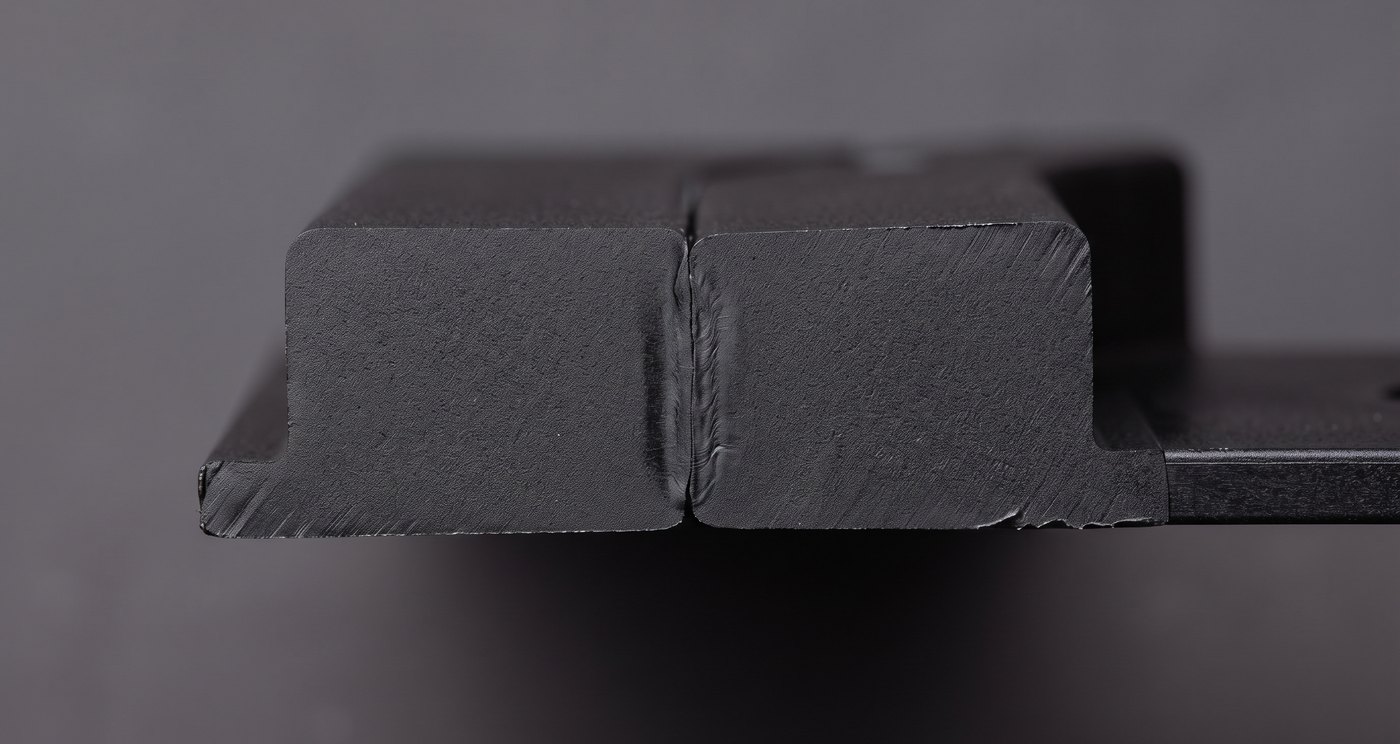
Amorphous against semi-crystalline, a weldability table by resin, and the four contaminants — moisture, regrind, filler and mould release — that ruin welds regardless of the machine.
Whether a part welds well is decided mostly by the polymer, and it is decided before you buy anything. This is the table to check first.
Amorphous polymers have no sharp melting point — they soften gradually over a temperature range. That makes them forgiving: the melt forms progressively and flows into the joint. ABS, polystyrene, polycarbonate and acrylic all weld easily, including far field.
Semi-crystalline polymers hold their structure until a sharp melting point and then go from solid to liquid abruptly. They also absorb vibration rather than transmitting it. That means higher amplitude, near-field horn placement, and joint designs — usually shear — that keep the melt away from air. Nylon, acetal, PP and PE are all in this group.
| Resin | Type | Ultrasonic weldability | Typical amplitude (µm, 20 kHz) | Notes |
|---|---|---|---|---|
| ABS | Amorphous | Excellent | 30–70 | The benchmark. Welds easily near and far field. |
| Polystyrene (PS) | Amorphous | Excellent | 30–70 | Very easy. Brittle grades can crack — radius corners. |
| Polycarbonate (PC) | Amorphous | Very good | 40–80 | Hygroscopic — must be dry. Welds to ABS. |
| Acrylic (PMMA) | Amorphous | Very good | 40–80 | Good. Watch for stress cracking and cosmetic marking. |
| PVC (rigid) | Amorphous | Fair | 40–80 | Welds, but can degrade and release corrosive products. Ventilate. |
| SAN | Amorphous | Excellent | 30–70 | As easy as ABS. |
| PETG | Amorphous | Very good | 40–80 | Good in packaging and medical. |
| Nylon (PA) | Semi-crystalline | Fair to good | 60–100 | Hygroscopic — the single biggest problem. Weld dry, from the moulding machine if possible. |
| Acetal (POM) | Semi-crystalline | Fair | 60–100 | Narrow melting range. Needs precise control; shear joint preferred. |
| Polypropylene (PP) | Semi-crystalline | Difficult | 90–120 | Soft, absorbs vibration. Near field only. Consider spin or hot plate. |
| Polyethylene (PE) | Semi-crystalline | Difficult | 90–120 | Worse than PP. Near field, shear joint, high amplitude — or a different process. |
| PEEK | Semi-crystalline | Fair | 60–100 | High melting point, needs power. Achievable with the right stack. |
| TPE / TPU | Elastomer | Poor | — | Absorbs energy. Generally not weldable ultrasonically. |
| PTFE | Semi-crystalline | Not weldable | — | Does not weld ultrasonically. |
Amplitude figures are indicative for 20 kHz and vary with grade, joint design and horn. They illustrate the point that a PP part needs roughly three times the amplitude of an ABS one — which is why a stack set up for ABS often simply cannot weld PP.
A true ultrasonic weld is a molecular bond, and that requires chemically compatible materials with overlapping melt ranges. Weld a resin to itself. The practical exceptions are few — ABS to polycarbonate is the well-known one, and ABS to SAN or acrylic will often work.
Nylon and polycarbonate absorb water from the air. Heat it during welding and it turns to steam inside the joint — foaming, voids and a weak weld. Weld nylon straight from the moulding machine, or dry it and keep it in sealed bags.
Regrind has shorter polymer chains and inconsistent properties, so weld results drift. Keep it to 10% or less in parts that will be ultrasonically welded.
Glass and mineral fill improve stiffness and hurt weldability — there is simply less polymer at the interface to melt. Keep filler below 30%. Abrasive fillers such as calcium carbonate, talc and glass also wear sonotrodes, so budget for titanium horns and coatings.
Silicone and PTFE release agents contaminate the joint surface and prevent bonding. If the moulder sprays the tool, the weld will be unreliable. This is a process conversation with the moulder, not something the welder can fix.
Send us the resin, the grade, the filler and regrind content, and both parts. A trial weld answers this in a morning — and if the answer is that the material will not weld ultrasonically, you will hear that rather than discovering it after buying a machine.
Ultrasonic welding is decided by the parts — the resin, the wall, the joint and what the weld has to do. Send photos and drawings through the enquiry form and you get an engineered answer, not a price range.