Home / PowerSonic / Applications
Application · repair centres · rework benches · phone & device repair

The liquid-damage and rework bench standard

Corrosion from a wet phone, flux from a rework job, grime from a decade of service — the repair trade's soils all live under components where nothing else reaches. This is the bench tool that does.

See the machinesRent from $26/week
The liquid-damage and rework bench standard

The repair bench sequence

Strip & screen

Boards out of housings; batteries OFF and out, always. Screen the exclusion list (unsealed relays, some MEMS/mics per BOM).

Ultrasonic clean

Electronics-safe aqueous chemistry, 40–55 °C, gentle power, 5–15 minutes — flux, electrolyte corrosion and contamination out from under BGAs and connectors.

DI rinse

Ionic residues carried off in a clean DI rinse — the step that turns "looks clean" into "measures clean".

Dry thoroughly, then power

Warm-air dry until genuinely dry — hours for dense boards, never minutes — then test. Powering a damp board undoes everything.

What goes in the tank

Liquid-damaged phone boardsPCBs after reworkConnectors & flexes (per rating)Game console boardsAutomotive ECUs (per rating)Vintage electronicsMechanical keyboards (stripped)

Why repair centres run one

Liquid-damage recovery rate

Electrolyte corrosion under shields and connectors is the killer; cavitation reaches it the day the device arrives. Recovery rates climb when cleaning is same-day and complete.

Under-component cleaning

Flux and residue under BGAs breed dendrites and callbacks. The tank cleans where the brush and swab genuinely cannot.

Bench throughput

Boards clean while techs diagnose the next device — the queue moves without another hire.

The machines repairers buy

Production electronics cleaning to IPC limits is documented in our PCB case study.

Typical starting cycle — refined in your first week

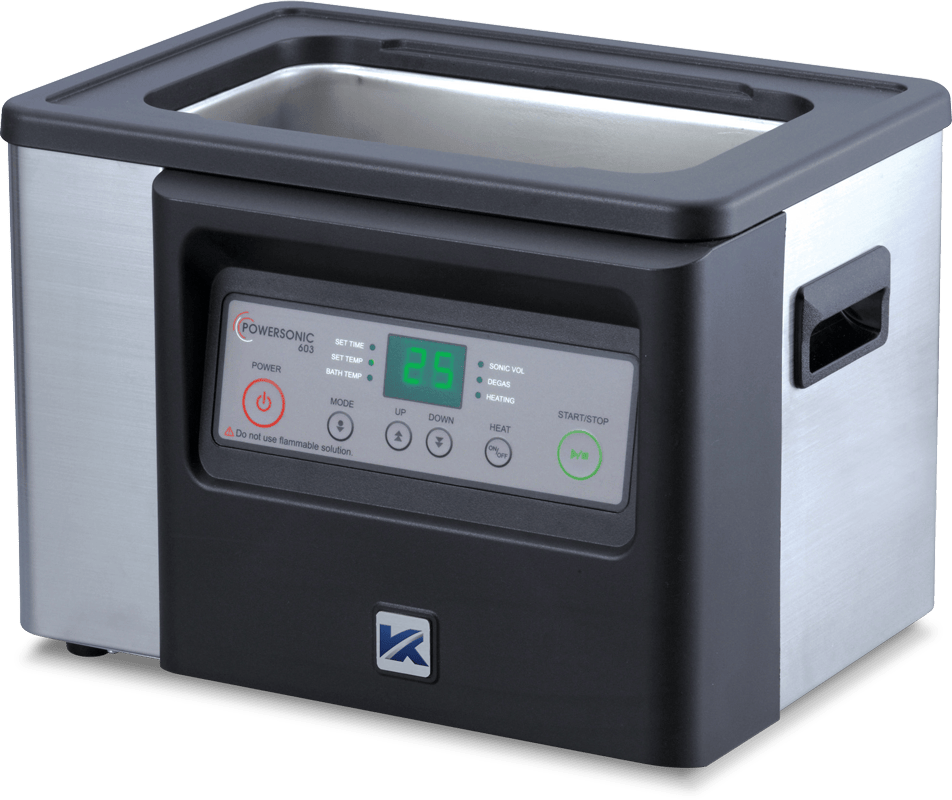
ChemistryElectro electronics-safe aqueous — the 3 L PS 603 with Electro is the classic electronics bench setup
Temperature40–55 °C
PowerLow
Time5–15 minutes
ThenDI rinse · thorough warm dry · then power

Starting points only — part condition, chemistry and load set the final card. We help you dial it in.

Questions from this trade

Asked every week

Is ultrasonic cleaning safe for PCBs?
Yes, with the discipline: electronics-safe chemistry, moderate temperature, low power, sweep on, and the exclusion screen for unsealed components. It is how production electronics are cleaned to IPC limits — the repair bench inherits a proven process.
Batteries?
Out. Always. Before anything touches liquid. No exceptions worth writing down.
How long before I can power the board?
When it is dry, not when it looks dry — warm airflow and patience. Most callbacks from 'ultrasonic damage' are actually powering-while-damp damage.
Does it fix liquid damage?
It removes the corrosion and electrolyte that would keep killing the board; damaged components still need diagnosis. Clean first, then diagnose on a stable board — recovery rates follow.
What about microphones and sealed parts?
Some MEMS mics, unsealed relays and certain sensors are not rated for immersion — screen per BOM and mask or remove. The exclusion list is short and learnable; we supply a starter card.
Prove it on your own kit

Send us a tray of your worst — we clean it, photograph it and send back the result with the machine and cycle that did it.

See the PowerSonic rangeRent from $26/week