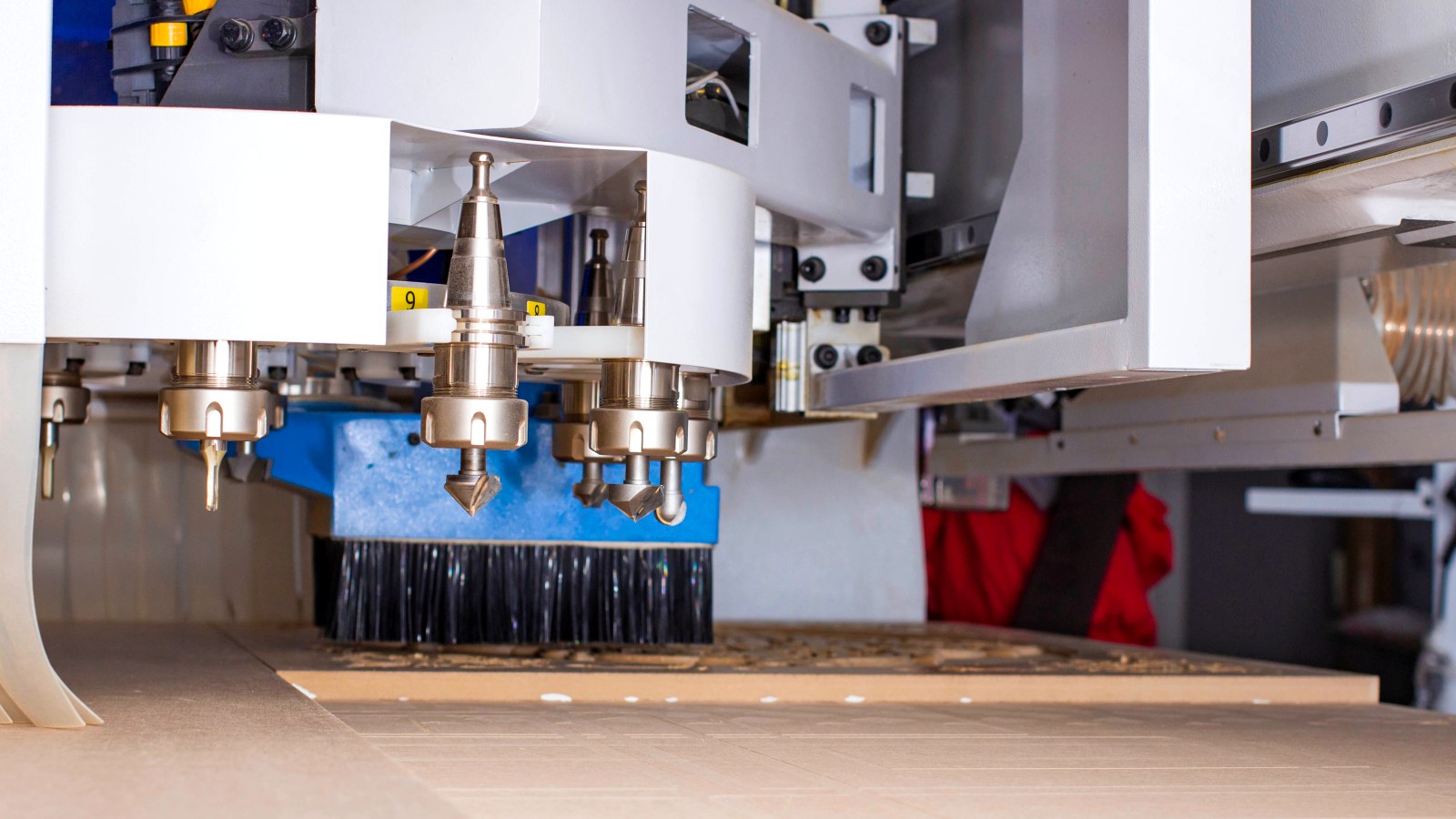
CNC router head over a timber panel
Industries / Manufacturing & Process / Wood, Timber & Cabinetry
Industries · Manufacturing & Process

Ultrasonic Cleaning for Wood, Timber & Cabinetry

Resin and pitch on a cutter change its geometry — burn marks, tear-out, and feed rates dropped to compensate. Wire-brushing carbide chips it; solvent soaking barely moves set pitch.

Misonics systems strip resin, pitch and glue off profile cutters, blades and heads in minutes, without touching carbide edges — sharpening lasts longer because the grinder meets clean steel.

The Contamination Problem

What we remove in wood, timber & cabinetry

Resin & pitch

Baked onto blades, cutters and heads — the production killer.

Glue & adhesive residues

Cured PVA, PUR and melamine carryover on tooling and applicators.

Coating overspray

Lacquer and stain residues on finishing-line hardware.

Dust & extractives

Bonded fine dust in tooling and machine components.

Corrosion products

Tannin-driven staining and rust on tooling steel.

The endpoint is a defined, repeatable process condition — cycle time, chemistry, concentration, frequency and temperature are recorded parameters, not operator judgement.
Components We Clean

Real parts, real materials

Cutting tools

Profile cutters, saw blades, planer heads, router bits — pitch off carbide without edge damage.

Profile cuttersBladesHeads

Gluing & pressing

Applicator hardware, spreader rolls, press platens hardware — cured adhesive removed intact.

ApplicatorsRollsHardware

Finishing lines

Spray hardware, pumps and fittings through stain and lacquer lines.

GunsPumpsFittings
Why Ultrasonics — And Why These Machines

Cavitation cleans geometry it cannot see

Bubble collapse at the liquid–metal boundary lifts contamination from passages, galleries and cavities without anything touching the surface. Nothing abrades, nothing embeds, no metal is removed.

GeneratorResonance held all shift

The VarioSonic G5 tracks the transducer array as temperature and load shift — conversion efficiency up to 95%.

Sound fieldSweep modulation

Eliminates standing-wave hot and cold zones across a loaded basket.

Process controlLogged, recipe-driven cycles

Stored recipes and logged cycles — audit evidence produced as a by-product of running.

Bath conditionFiltration & oil separation

Multi-stage filtration and weir oil capture hold results steady as the bath loads.

SupportOver-the-air diagnostics

Most faults identified — many resolved — without a site visit.

ConstructionBuilt to work hard

Heavy 316 stainless tanks, tested before despatch, every wearing part replaceable.

Equipment Fit

The machine follows the process

From manually loaded single-tank units to automated lines — and engineered systems where the catalogue ends.

Powersonic

Bench units at the sharpening station.

Explore the range →

MSX

Workshop platforms for heads and line hardware.

Explore the range →
Chemistry

Matched to the soil and the substrate

Pitch and resin dissolve in warm alkaline formulations that leave carbide and brazing untouched — cycles run minutes, matched to the tooling rotation.

Applications Matrix

Component coverage at a glance

Component categorySpecific parts / assembliesCompatible materials
ToolingCutters, blades, bitsCarbide-tipped, HSS
HeadsPlaner, moulder headsSteels, carbide inserts
GluingApplicators, rollsStainless, rubber-covered
FinishingSpray and pump hardwareStainless, aluminium
MachineGuides, fences hardwareSteels

Prove it on your parts

Where an application needs validation, we clean sample components in our laboratory, document the result, and specify the machine around the verified process. If ultrasonics is the wrong answer, the trial shows that too, and we will tell you.

Talk to an engineer
FAQ

What wood engineers ask us

Does it harm brazed carbide tips?
No — cavitation lifts pitch without shock to the braze line; wire wheels are the thing that chips tips.
How long does a blade set take?
Minutes — a sharpening service's whole intake rack cycles in an hour.
Does clean tooling really cut better?
Clean cutters run cooler, feed faster and grind truer at sharpening — operators see it immediately.
What about PUR adhesives?
Cured PUR is stubborn; the trial establishes what is recoverable per adhesive system.
Related Industries · Manufacturing & Process

Also in this sector