Cycle time, weldable materials, hermetic seals, frequency choice, tooling lead time and what actually drives the price.
The questions we are actually asked, answered without sales language. If yours is not here, ask it — the answer usually starts with seeing the part.
The weld itself is typically 0.2 to 1.0 seconds, plus a hold time of similar length while the melt solidifies under pressure. In practice the cycle is set by how fast an operator or robot can load and unload the fixture, not by the weld. On a well-fixtured part, three to five seconds a cycle is normal.
Amorphous resins — ABS, polystyrene, polycarbonate, acrylic, SAN — weld easily. Semi-crystalline resins — nylon, acetal, polypropylene, polyethylene — are harder and need higher amplitude, near-field horn placement and usually a shear joint. TPE and PTFE do not weld ultrasonically. The full table is on the materials page.
Usually no. A true ultrasonic weld is a molecular bond and needs chemically compatible resins with overlapping melt ranges. The practical exceptions are ABS to polycarbonate, and ABS to SAN or acrylic. If the two halves are different materials, expect to need adhesive, a mechanical joint or a redesign.
A small triangular ridge moulded onto one half of the joint that concentrates the ultrasonic energy so melting starts in one place and flows out to fill the joint. For a butt joint, yes — without it the energy spreads over the whole face and you get a weak weld or none. Height 0.3–0.7 mm, base no more than 20–25% of wall thickness, 90° included angle for amorphous resins and 60° for semi-crystalline. Shear joints do not use one.
Yes, with the right joint. A tongue-and-groove or a shear joint will seal reliably. A plain butt joint with an energy director rarely seals consistently around a whole perimeter. If the part must hold pressure or vacuum, say so at enquiry stage — it changes the joint design and therefore the mould tool.
Lower frequency means higher amplitude and more energy carried further — for large parts, thick sections and soft semi-crystalline resins. Higher frequency is gentler and uses smaller horns — for small, thin or delicate parts and assemblies containing electronics. 20 kHz is the general-purpose choice; 15 kHz for the largest parts; 35/36 kHz where 20 is damaging the part.
Roughly a 250–300 mm square footprint for a single continuous weld, material depending. Beyond that you are looking at multiple horns, sequential welding, or a different process — vibration or hot plate welding for large irregular parts.
Often yes, if the parts were not designed for welding. The joint geometry — energy director, shear interference, flash trap — is moulded in. This is exactly why we ask to see the parts and the CAD before anyone quotes a machine: a joint reviewed before the tool is cut costs nothing to change.
The same press does all of them. Staking melts a moulded boss over another component to lock it in. Insertion drives a threaded metal insert into a moulded boss — far stronger than cold pressing. Riveting forms a head on a moulded pin. They often share tooling with your welding application.
The ultrasonics themselves are above hearing, but the parts and fixture radiate audible sound, and 20 kHz machines are noticeably louder than 35 kHz. An acoustic enclosure solves it, and is standard on most production installations. Treat it as a workplace noise question and assess it.
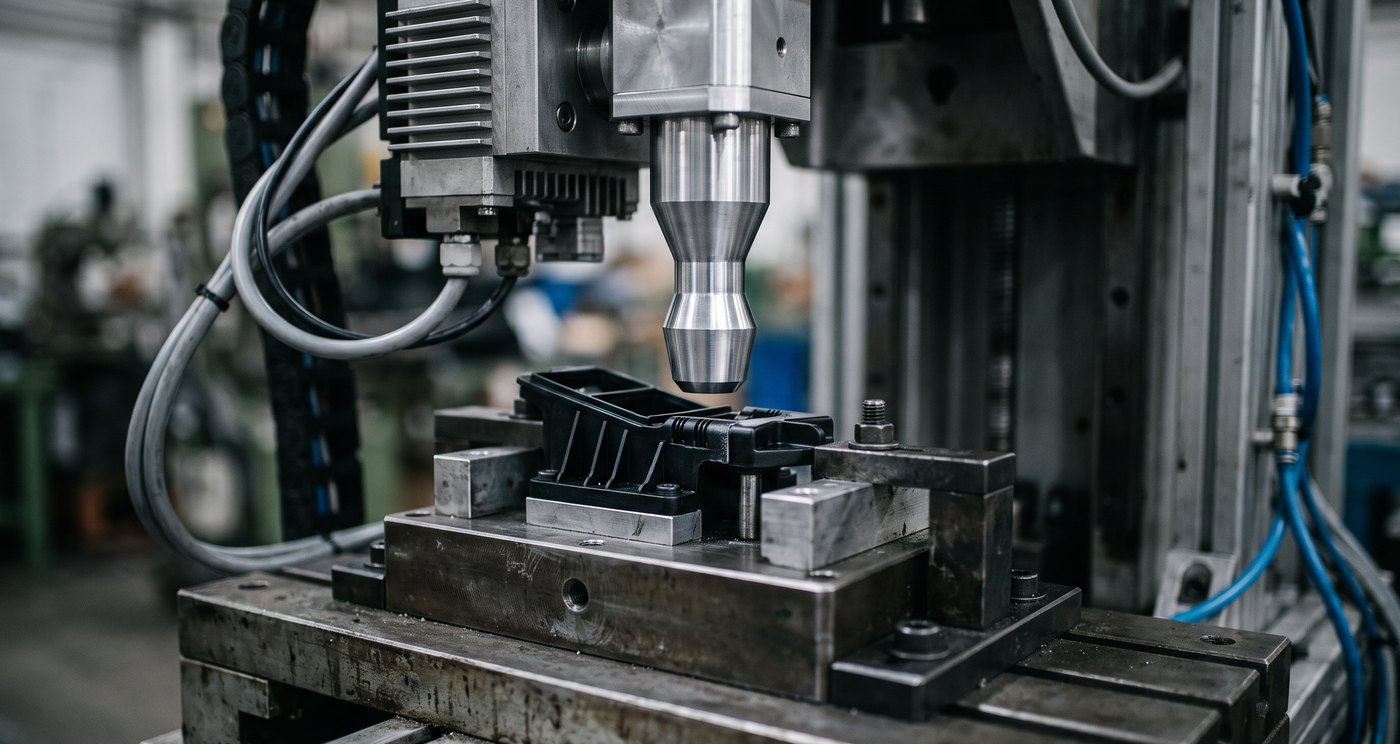
A sonotrode is designed, machined and frequency-tuned for your part, and the fixture is made alongside it. Allow several weeks from approved drawings. Current lead times are quoted with each application.
A hand welder and a full automated cell are two orders of magnitude apart, so any number quoted without seeing the part is meaningless. What drives it: press size and power, tooling complexity, number of cavities or fixtures, and the level of automation and data recording. Send the parts through the enquiry form and you get a real number.
Yes — non-ferrous only. Copper, aluminium, nickel, brass and their combinations, for wire splices, terminals, battery tabs, busbars and tube sealing. It is a solid-state process; the metal never melts. See metal welding.
Yes, and you should. Send the parts and we will have them welded and returned with the parameters recorded. A trial answers in days what a specification argument will not settle in months — including whether ultrasonic welding is the wrong process for your part, which we will tell you.
Misonics is your Australian point of contact for the enquiry, the order and ongoing consumables — sonotrodes, converters and spares. Application engineering and machine build come from our welding partner, who has run thousands of standard and custom applications. You deal with us; their engineers stand behind the application work.
Ultrasonic welding is decided by the parts — the resin, the wall, the joint and what the weld has to do. Send photos and drawings through the enquiry form and you get an engineered answer, not a price range.