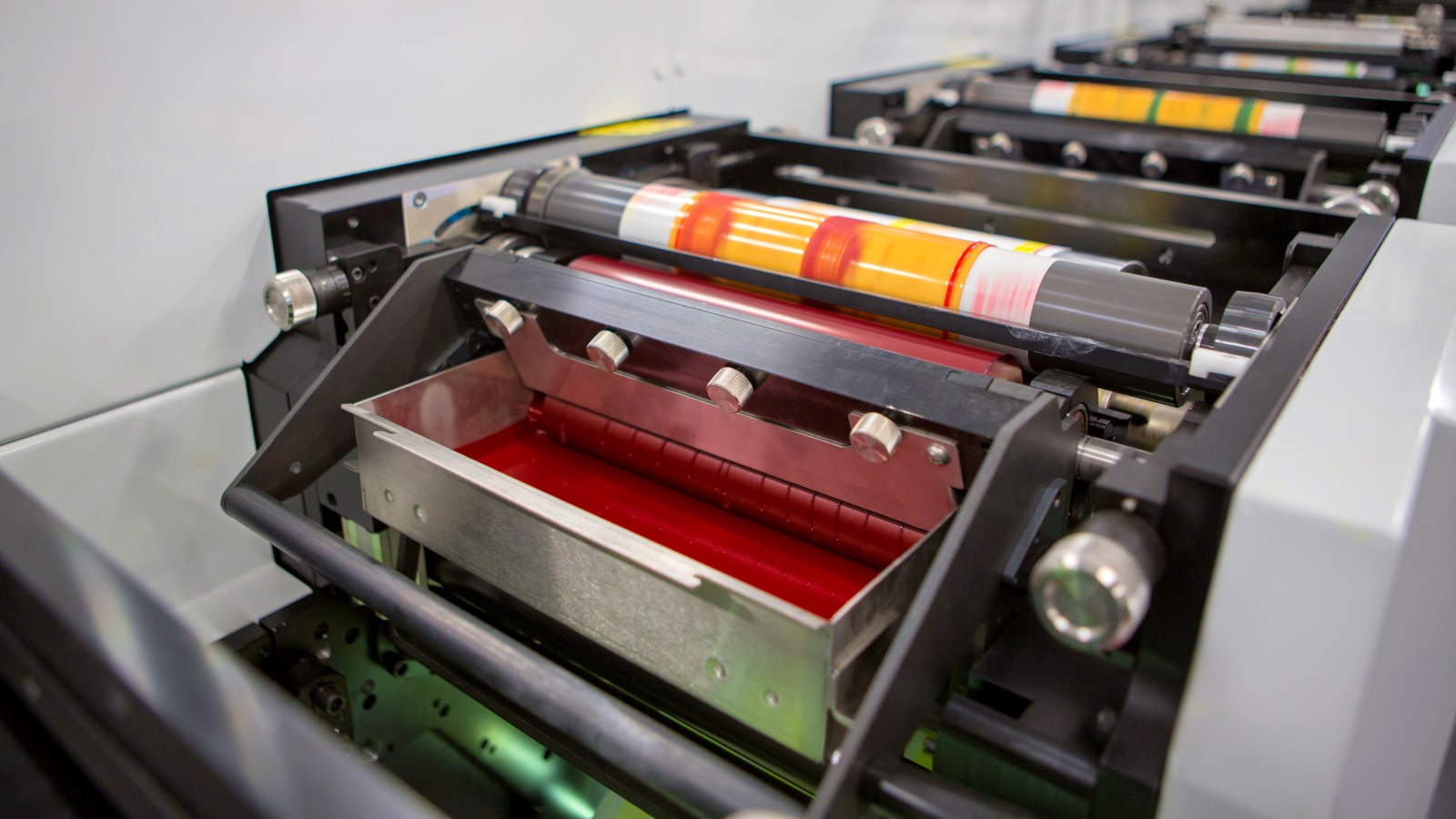
Anilox Roll Cleaning, Ultrasonic
An anilox roll is a precision metering instrument with millions of engraved cells — and every dried ink film in those cells changes the delivered volume. Blades and bicarb blasting shorten roll life; cavitation empties cells without touching the ceramic.
Misonics systems clean anilox rolls, sleeves, screens and press hardware back to volume, with cycle parameters set to engraving specification.
What we remove in printing
Dried UV & water-based inks
Cured films in anilox cells, progressively starving delivered volume.
Coatings & varnishes
Bonded residues in high-LPI engravings.
Adhesives
Laminating and cold-seal residues through applicator hardware.
Plate & blanket residues
Processing chemistry and image debris.
Press oils & dust
General contamination through press components.
Real parts, real materials
Anilox rolls & sleeves
Ceramic and chrome anilox to 1500+ LPI — cell volume restored, verified by volume measurement.
Screens & plates
Rotary and flat screens, flexo plates — image areas open without mesh damage.
Press hardware
Ink pumps, doctor blade holders, gluing and coating hardware.
Cavitation cleans geometry it cannot see
Bubble collapse at the liquid–metal boundary lifts contamination from passages, galleries and cavities without anything touching the surface. Nothing abrades, nothing embeds, no metal is removed.
The VarioSonic G4 tracks the transducer array as temperature and load shift — conversion efficiency up to 95%.
Eliminates standing-wave hot and cold zones across a loaded basket.
Stored recipes and logged cycles — audit evidence produced as a by-product of running.
Multi-stage filtration and weir oil capture hold results steady as the bath loads.
Most faults identified — many resolved — without a site visit.
Heavy 316 stainless tanks, tested before despatch, every wearing part replaceable.
The machine follows the process
From manually loaded single-tank units to automated lines — and engineered systems where the catalogue ends.
Matched to the soil and the substrate
Ink chemistry must dissolve the resin system without etching ceramic or corroding aluminium roll cores — formulation and frequency are matched to the engraving, not guessed.
Component coverage at a glance
| Component category | Specific parts / assemblies | Compatible materials |
|---|---|---|
| Anilox | Rolls, sleeves | Ceramic on steel, chrome |
| Screens | Rotary, flat screens | Nickel, polyester mesh |
| Plates | Flexo, letterpress | Photopolymer, metal-backed |
| Ink train | Pumps, hoses, chambers | Stainless, aluminium |
| Finishing | Gluing, coating hardware | Stainless, brass |
What are you cleaning?
Tell us what the part is, what comes off it, and what it has to pass. Technical sales will tell you whether ultrasonics is the right answer for that part and what it takes to run it on your own floor.
What printing engineers ask us
Is high-LPI engraving safe?
How much volume comes back?
Can roll cores corrode?
UV inks as well as water-based?
Also in this sector
Packaging
Hot melt and cold glue off applicator heads, nozzles, gluing modules and change parts.
Manufacturing
In-process degreasing and pre-treatment cleaning across general fabrication and machining.
Automation & Robotics
End-effectors, precision actuators and component cleaning integrated into automated lines.
Molds, Castings & Foundry
Die and mould cleaning without dimensional loss — release agents, resin and scale.