What is fixed
| Pairing | Matched to the rodSized to the resonator's power output — the two are quoted together |
|---|---|
| Frequency | Fixed25 kHz standard across the Solo 360 range |
| 40 kHz option | AvailableOn the two shortest rods, and to order — on application |
| Rod power range it covers | 800 to 1,500 WThe Solo 360 range, 340 to 1327 mm |
| Not interchangeable | Rods onlyThe multi-frequency VarioSonic G4 drives immersibles and plates, not rods |
Specification
| Frequency range | 20 – 170 kHzThe platform tracks the range; built as a Solo 360 drive it is set to the rod and holds it |
|---|---|
| Power output | To 1,500 WSized to the resonator it drives |
| Output stage | IGBTMicrocontroller managed, fully automatic |
| Frequency control | AutomaticHolds the resonant point as the bath and the load change |
| Cooling | IndirectThe cooling air never contacts the electronics — built for a dirty plant room |
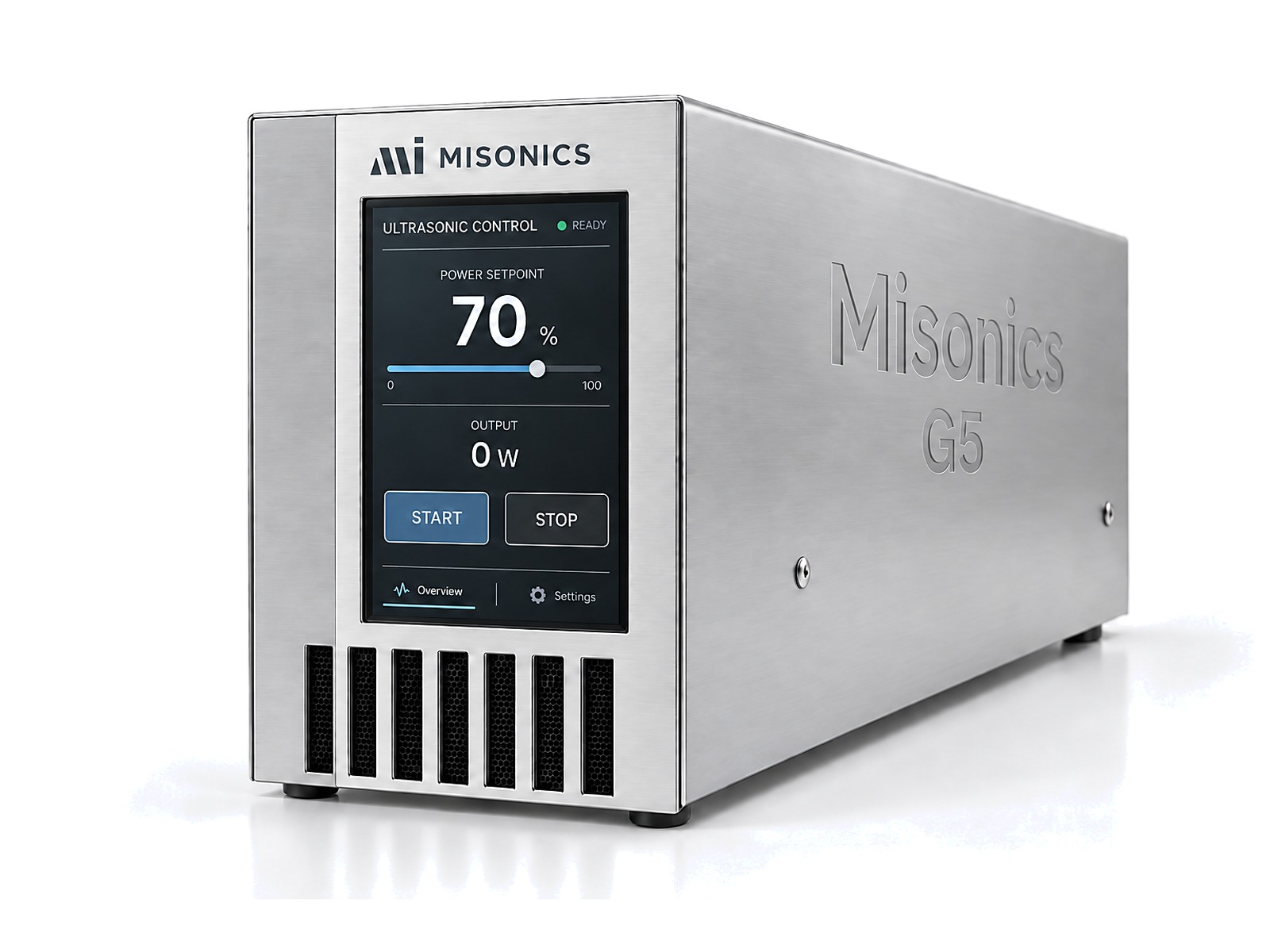
| Display | 4.3″ colour touchOr a blind version with no screen, on application |
| Communications | RS485 (Modbus RTU) |
| Digital I/O | DB-25Control and monitoring, plus five DC-isolated 24 V inputs so a PLC can set the power |
| Data | SD card, USB, EthernetOn-board logging |
| Protection | Over-temperature, over-current, short circuit, no-loadPlus the safety interlocks |
| Enclosure size | 105 × 155 × 390 mmW × H × D — bench, 19-inch rack, DIN rail or wall |
| Supply, IP rating, ambient | Confirmed at quotationStated against the build, with the rod it is matched to |
What the control actually does
| Sweep | Breaks up standing waves and evens out the energy distribution. |
|---|---|
| Pulse or continuous | Selectable, with on and off times set on the panel. |
| Wave shape | Triangular, saw-tooth or random, each with its own parameters. |
| Boost | Extra drive on demand for stubborn contamination. |
| Automatic degas | Drives dissolved air out of a fresh bath before the work goes in. |
| Timed start | Real-time clock with six time channels — the bath can degas before the shift. |
| Constant output | Holds the set power as temperature, liquid level and work load change. |
| Monitoring | Messages, warnings and faults on the screen; run data to SD, USB or Ethernet. |
| Integration | RS485 Modbus RTU to PLC and HMI, five isolated 24 V inputs, 19-inch cabinet mounting. |
SonoDrive G5
A rod resonator is not driven by a general-purpose generator. The SonoDrive G5 is specified against the rod it runs — its power output matched to the resonator, its frequency fixed rather than swept across bands.
Replacing transducers in a tank you already own? Read this firstOpen
Elements are sold on their own. Building a plate, specifying an OEM machine, or wanting elements and nothing else is a normal order, and there is no requirement to buy a generator with them.
Re-elementing an array you already own is the case that needs care. When an immersible box or a bonded array has gone deaf, replace the whole block rather than the one element that failed. Transducers age together — output falls away, the resonant point drifts and the impedance climbs. Put one new element into an aged set and the drive cannot tune to both: it hunts, the new element takes more than its share of the power, and it fails early. Where the generator is the same age as the block it was tuned for, budget for both. Tell us what is in the tank now and roughly when it went in, and we will tell you which half actually needs replacing before you spend anything.
Matching the drive to the array
A generator is tuned to the array it drives, not to a frequency on a label. What has to line up: the frequency the generator tracks, the total capacitance of the array wired to it, the impedance and phase that array presents once it is in the liquid, and the voltage across the group under load. Where we supply a complete system we specify those against each other and commission the two as one. Elements bought on their own are a different thing and a normal order — the matching is then yours or your builder’s to get right, and we will tell you what the elements need.
What goes wrong when they are not matched
A new generator will not rescue an old set. Transducers age — output falls away, the resonant point drifts and the impedance climbs — so an older array is no longer the load a new drive was tuned for. A set of mixed ages is worse again: the weakest element pulls the rest off tune and the drive spends its power hunting for a resonance that has moved. What you get is a generator running hot or dropping out, a bath cleaning unevenly, and transducers failing earlier than they should — and from the outside there is no way to tell which end is at fault, so you end up replacing both anyway.
What we can and cannot stand behind. Where we supply the generator and the transducers together, they are matched and commissioned as a system and warranted as one. Elements supplied on their own go onto a drive we have not characterised, so we cannot warrant what the tank will do with them. That is the limit of what we can know, not a refusal to sell. Tell us what the drive is and roughly when it went in, and we will say where you stand before you spend anything.
Ask about the SonoDrive G5
Tell us which rod you are running, or the tank you want to convert, and we will come back with the matched generator and the price for the pair.