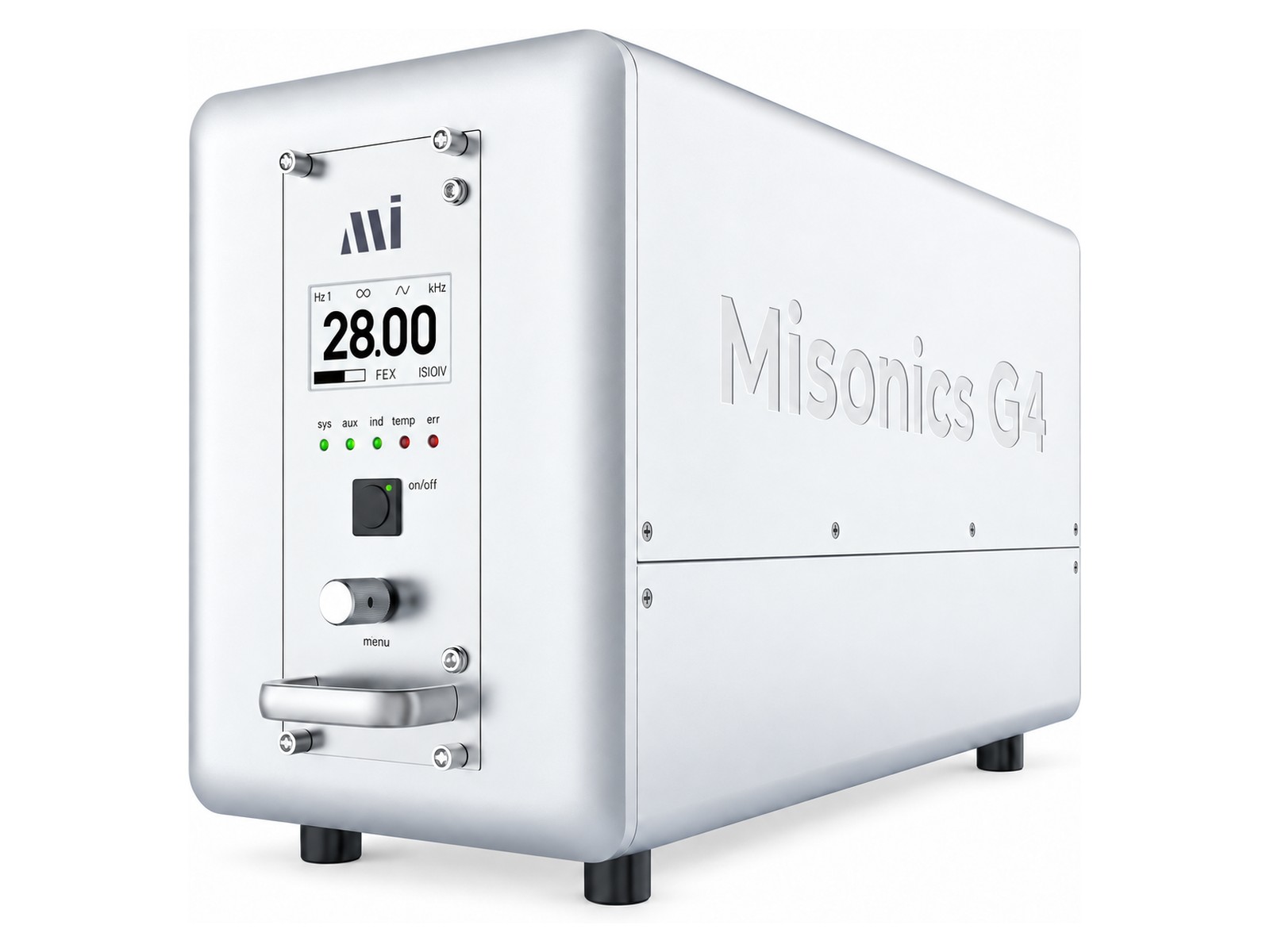
Specification
| Model | G4-1040/80 |
|---|---|
| Ultrasonic frequencies | 40 & 80 kHz |
| Rated power | 1,000 W |
| Power adjustment | 10–100 %Linear control across the range |
| Power supply | 220 VAC ±10 %, 50/60 Hz |
| Control topology | Full-bridge phase shift |
| Power regulation | Constant power control |
| Frequency control | Automatic trackingLoad self-adaptation |
| Frequency switching | 24 VDC ±10 %, 20 mA |
| Communications | RS485 (Modbus RTU) |
| Protection class | IP21 |
| Ambient conditions | 0–40 °C, 0–90 % RH |
| Enclosure size | 412 × 160 × 238 mmL × W × H — 19-inch cabinet integration supported |
| Conversion efficiency | Up to 95 % |
What the control actually does
| Full-bridge phase shift | Stable, efficient power conversion for industrial ultrasonic loads. |
|---|---|
| Constant power output | Holds controlled output as the load and the bath conditions change. |
| Automatic tracking | Follows the resonant frequency and adapts to impedance changes — no manual retuning visit. |
| Peak power | Available on demand for stubborn contamination — the figure is confirmed against the model. |
| Sweep | Breaks up standing waves and evens out the energy distribution. |
| Monitoring | Voltage, current, phase, status, temperature, run time and both frequencies on the front LCD. |
| Protection | Over-current, over-voltage and short circuit, internally. |
| Integration | Remote control to PLC and HMI, RS485 Modbus RTU, 19-inch cabinet mounting. |
VarioSonic G4-1040/80
One generator, two selected operating frequencies — aggressive soil removal and fine cleaning on the same platform. Pick the frequency pair your parts need, then the power your transducer set draws.
Which frequency should I choose? → How loud is each band? →
Replacing transducers in a tank you already own? Read this firstOpen
Elements are sold on their own. Building a plate, specifying an OEM machine, or wanting elements and nothing else is a normal order, and there is no requirement to buy a generator with them.
Re-elementing an array you already own is the case that needs care. When an immersible box or a bonded array has gone deaf, replace the whole block rather than the one element that failed. Transducers age together — output falls away, the resonant point drifts and the impedance climbs. Put one new element into an aged set and the drive cannot tune to both: it hunts, the new element takes more than its share of the power, and it fails early. Where the generator is the same age as the block it was tuned for, budget for both. Tell us what is in the tank now and roughly when it went in, and we will tell you which half actually needs replacing before you spend anything.
Nine dual-frequency models
Model codes read power then frequencies: G4‑10 40/80 is 1,000 W at 40 and 80 kHz. Tap a row to load that model into the configurator above.
| Model | Frequency | Rated power |
|---|
These nine are the dual-frequency range, and 1,500 W is the ceiling for running two bands from one generator. Built as a single-frequency unit the same platform drives higher power, because all of it goes into one band instead of being shared across two. Tell us the transducer set and we will confirm the generator, or the number of them, that drives it.
What the G4 is matched to
- Immersible transducers — built to your tank. Send length, width and height, the material (SS304 or SS316), the frequency you need and, above all, the fixing or spigot points.
- Transducer plates — where the geometry suits a plate rather than a box.
- Not rod resonators. Rods are fixed-frequency and run on the matched SonoDrive G5. The two are not interchangeable.
Matching the drive to the array
A generator is tuned to the array it drives, not to a frequency on a label. What has to line up: the frequency the generator tracks, the total capacitance of the array wired to it, the impedance and phase that array presents once it is in the liquid, and the voltage across the group under load. Where we supply a complete system we specify those against each other and commission the two as one. Elements bought on their own are a different thing and a normal order — the matching is then yours or your builder’s to get right, and we will tell you what the elements need.
What goes wrong when they are not matched
A new generator will not rescue an old set. Transducers age — output falls away, the resonant point drifts and the impedance climbs — so an older array is no longer the load a new drive was tuned for. A set of mixed ages is worse again: the weakest element pulls the rest off tune and the drive spends its power hunting for a resonance that has moved. What you get is a generator running hot or dropping out, a bath cleaning unevenly, and transducers failing earlier than they should — and from the outside there is no way to tell which end is at fault, so you end up replacing both anyway.
What we can and cannot stand behind. Where we supply the generator and the transducers together, they are matched and commissioned as a system and warranted as one. Elements supplied on their own go onto a drive we have not characterised, so we cannot warrant what the tank will do with them. That is the limit of what we can know, not a refusal to sell. Tell us what the drive is and roughly when it went in, and we will say where you stand before you spend anything.
Get a price on a VarioSonic G4
Tell us what it is driving — tank size, transducer count and the frequency your parts need — and we will confirm the model and quote it. If you already know the model you want, say so and we will just quote it.