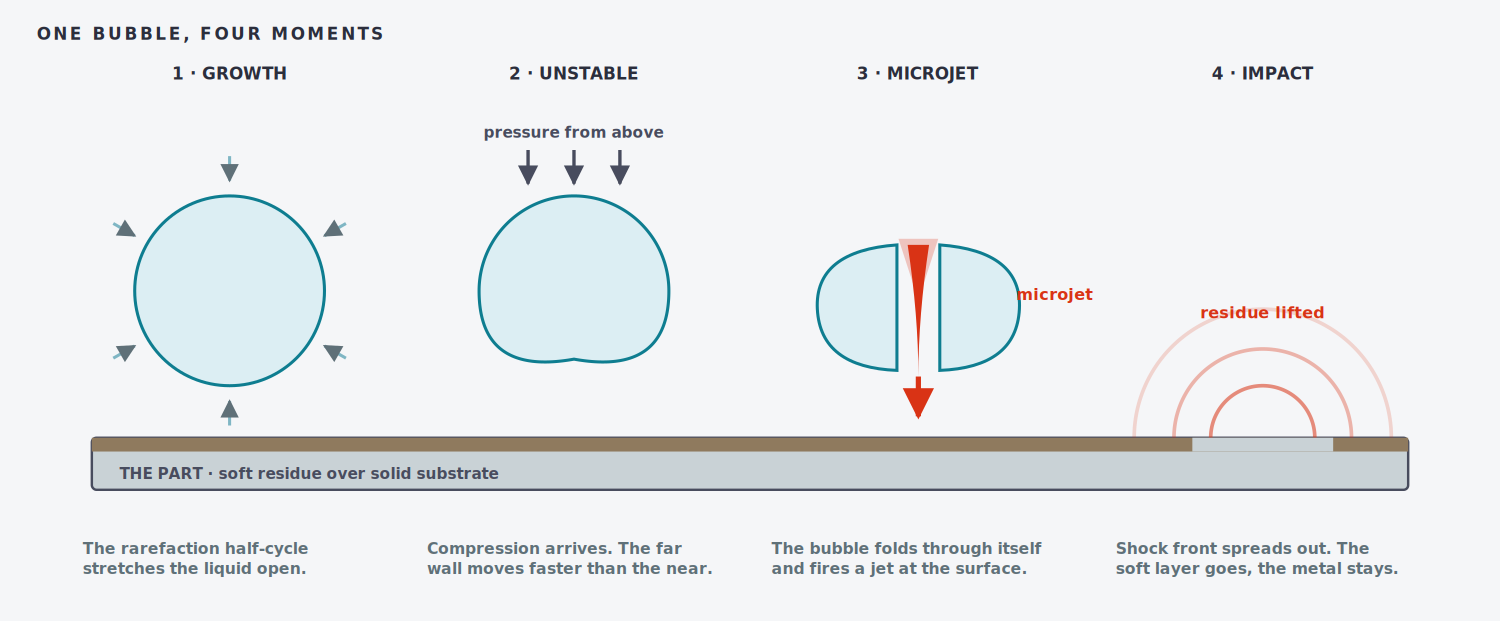
Cleaning is one application of cavitation. In a laboratory the same physics is a sample preparation tool, and often the fastest one available.
Cavitation delivers extreme local temperature and pressure, intense micro-mixing and shear, into a liquid, without heating the bulk. Cleaning exploits that at a surface. Ultrasonic processing exploits it in the liquid itself — and where it drives or alters chemical reactions, that part of the field is sonochemistry.
Bubbles form and implode. Inside a collapsing bubble, conditions are momentarily extreme; at its surface, liquid jets and shear forces are enormous. Nothing else gives you that combination at room temperature in an open vessel, which is why the technique keeps appearing in laboratory method development.
Ultrasound-assisted extraction disrupts cell walls and drives solvent into plant, food and tissue matrices, so recovery is higher and extraction time is shorter than maceration or Soxhlet — frequently at lower temperature, which matters for heat-sensitive compounds. Common in food, botanical, nutraceutical and analytical laboratories.
Cavitational shear ruptures cell walls and membranes to release intracellular contents. Standard sample preparation in microbiology and molecular biology.
Ultrasound produces very fine, stable emulsions and breaks up agglomerated particles — nanoparticle dispersion, suspension preparation, sample homogenisation before analysis.
The same effect that must be dealt with in a cleaning bath is useful on purpose. Ultrasound removes dissolved gas from solvents and samples — routine before HPLC and before any measurement that bubbles would corrupt. See degassing for the physics.
Accelerating dissolution of stubborn solids, and mixing where a stirrer bar cannot reach or would contaminate.
Sonochemistry in the strict sense — using cavitation to speed up or enable chemical reactions, and in some cases to open routes that do not proceed under conventional conditions. The applications above are ultrasonic processing; this is where the chemistry happens.
For extraction, degassing, dissolution and gentle dispersion, a bath is usually right and always simpler. For hard cell lysis, a probe usually wins.
For laboratory sonochemistry the relevant machines are the PowerSonic benchtop range — degas mode, timer, heater and stable control at bench scale — and, where a laboratory needs a repeatable, recordable cycle at higher duty, the MSX 15 and MSX 30 with stored recipes. In sonochemistry, equipment selection follows the process requirement. Frequency, power, amplitude, treatment time and system configuration must be matched to the required outcome.
Ultrasound can be applied to extraction, dispersion, degassing and cell disruption, but the operating parameters are specific to the application. Frequency, power, amplitude, treatment time and process conditions must be matched to the required outcome — and ultrasound is not the right tool for every process.
We assess each application. Where required, we validate the process through a controlled cleaning trial on the machine and chemistry we would specify, with the cycle and the result reported against your standard — ask us to scope it.