Two detergents can clean the same part equally well and give you completely different running costs. The difference is what happens to the oil afterwards.
This is the single biggest lever on consumable cost in an oily-parts operation, and it is almost never discussed at the point of sale.
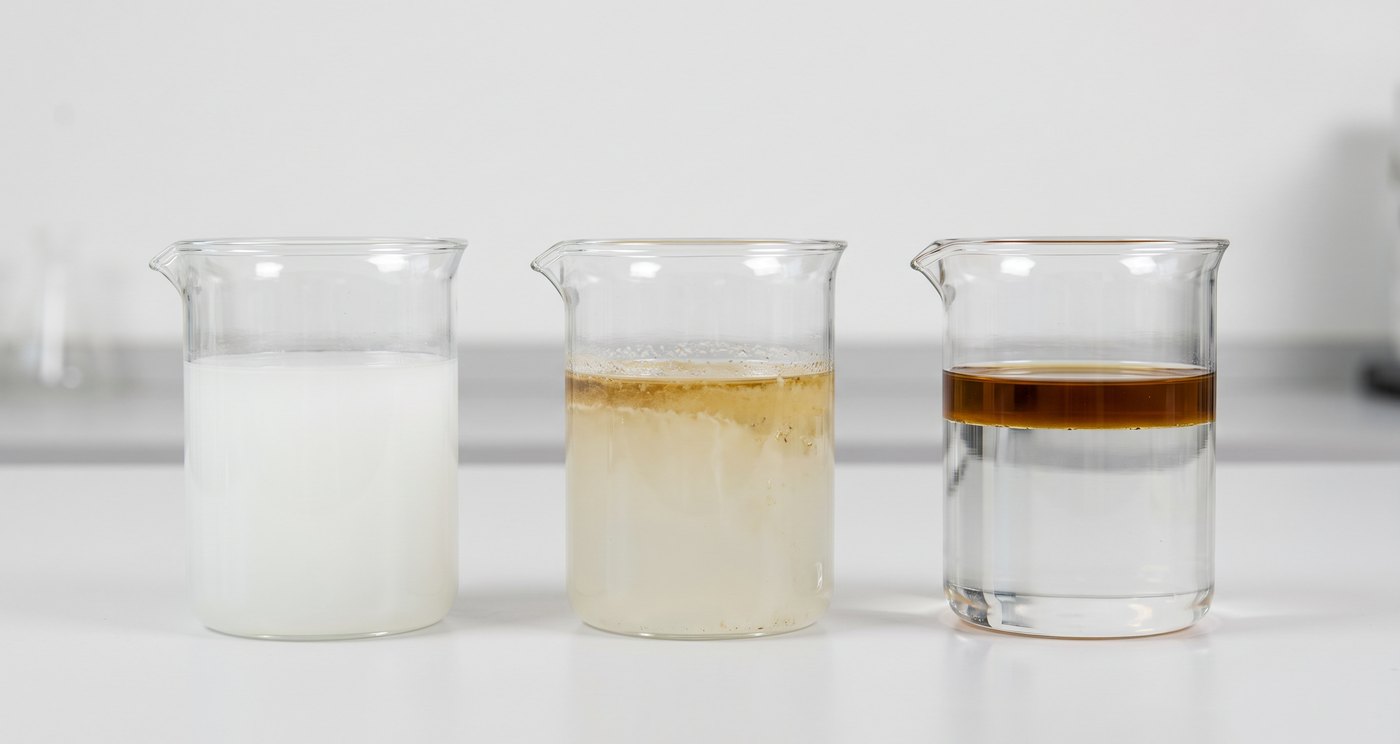
An emulsifying detergent lifts oil off the part and holds it dispersed in the bath as fine droplets. The bath looks uniformly milky. The oil is in there, suspended, and it stays there.
A demulsifying detergent lifts the oil off just as effectively, then deliberately releases it so it coalesces and floats. The bath separates into a clean working solution with an oil layer on top.
With an emulsifying bath, the oil accumulates. Cleaning performance falls as oil loading rises, because you are now washing parts in a solution that is partly oil. Eventually the only remedy is to dump the whole bath — chemistry, water and oil together — and start again. You pay twice: once for new chemistry, once to dispose of a large volume of oily wastewater that is classified accordingly.
With a demulsifying bath, the oil floats and you remove it — a weir, a skimmer, a coalescing separator, or a belt. The chemistry underneath is still working. Bath life extends dramatically, the removed oil is a much smaller and often more manageable waste stream, and cleaning stays consistent instead of degrading through the week.
This is not a rule with one side. Choose emulsifying when:
A jar test settles it in an hour. Take a sample of your working bath, shake it, and let it stand. If the oil rises and forms a distinct layer, you have a demulsifying system and you should be skimming it. If it stays uniformly cloudy, it is emulsifying and the oil is going nowhere until you dump the tank.
Then ask the harder question: how much oil is actually going in per day? If it is grams, ignore this page. If it is litres, this is the biggest cost decision in your process.
Demulsifying chemistry is only half of it; you need somewhere for the oil to go. Options range from a simple overflow weir to belt or disc skimmers to coalescing separators — covered properly in oil removal: weirs, interceptors and coalescers. On our multi-stage machines this is designed in, with a dedicated collection tank behind each wet stage.
Daily oil loading affects both chemistry selection and machine design. The system must not only remove oil from the parts, but effectively separate and remove it from the cleaning bath. Chemistry, filtration, oil separation and bath circulation therefore need to be designed together to maintain cleaning performance and extend bath life. If you are dumping baths weekly, there is usually a large saving sitting in this decision. See also the oil systems and flushing group.
We assess each application. Where required, we validate the process through a controlled cleaning trial on the machine and chemistry we would specify, with the cycle and the result reported against your standard — ask us to scope it.