Citric Acid Passivation of Stainless Steel
How citric acid passivation works, the ASTM A967 treatments, how the result is tested, and how to run it as a production line with ultrasonic assistance.
How do you passivate stainless steel with citric acid?
Clean and rinse the part first. Then immerse it in 4 to 10% citric acid by weight: at least 4 minutes at 60 to 71 °C, 10 minutes at 49 to 60 °C, or 20 minutes at 21 to 49 °C. These are ASTM A967 Citric 1, 2 and 3. Rinse twice in DI or RO water, dry, and test the part with the method your specification names.
Updated 21 October 2026
Passivation removes free iron so the stainless can protect itself
Stainless steel resists corrosion because of a thin chromium oxide layer on its surface. Machining, welding, grinding and handling leave free iron on that surface. The free iron rusts, stains and starts pitting. Passivation dissolves the free iron and lets the chromium oxide layer form again, evenly, across the whole part.
Passivation is not cleaning. Oil, coolant and shop soil stop the acid reaching the metal, so the part has to be cleaned first. That is why a passivation line always starts with a degreasing stage.
Why citric acid replaced nitric on most new lines
| Citric acid | Nitric acid | |
|---|---|---|
| Specifications | Recognised by ASTM A967 and AMS 2700 | Recognised by ASTM A967 and AMS 2700 |
| Handling | Not fuming, no NOx | Fuming acid, NOx risk, more PPE and extraction |
| Waste | Simpler neutralisation and disposal | Nitrate-bearing waste, harder to dispose of |
| Evidence | NASA comparative studies found citric equal to or better than nitric on the alloys tested | The long-standing reference method |
ASTM A967 citric acid treatments
ASTM A967 sets out citric treatments by temperature and time. The hotter the bath, the shorter the minimum immersion.
| Treatment | Citric acid | Temperature | Minimum time |
|---|---|---|---|
| Citric 1 | 4 to 10% by weight | 60 to 71 °C | 4 minutes |
| Citric 2 | 4 to 10% by weight | 49 to 60 °C | 10 minutes |
| Citric 3 | 4 to 10% by weight | 21 to 49 °C | 20 minutes |
| Citric 4 | Other combinations of concentration, temperature and time, with or without additives, that pass the specified test | ||
| Citric 5 | As Citric 4, with the bath held at pH 1.8 to 2.2 | ||
Summarised from ASTM A967. Your drawing or customer specification decides which treatment and test apply; read the current edition of the standard before you write a procedure.
Citric acid passivation procedure, stage by stage
- Degrease. Ultrasonic cleaning in an alkaline cleaner such as Brulin AquaVantage 815 GD takes off oil, coolant and soil. ASTM A380 covers the cleaning practice.
- Rinse. Stops the alkaline cleaner carrying into the acid bath.
- Passivate. Immersion in the citric bath at the treatment's temperature and time. Ultrasonics keeps fresh solution at the surface, inside bores and under weld spatter.
- Rinse twice. DI or RO water clears the acid. A final rinse in pure water avoids spotting.
- Dry. Hot-air drying, so the part leaves the line dry inside and out. See Rankine parts dryers.
- Verify. Test against the specification and record the result.
How passivation is checked
ASTM A967 lists the verification tests. The specification for the part says which one applies.
- Water immersion test
- High humidity test
- Salt spray test
- Copper sulphate test
- Potassium ferricyanide and nitric acid test, often called the ferroxyl test
- Damp cloth test
- Boiling water immersion test
What a trial on welded pipe showed
Before designing a passivation line for a pipe fabrication shop, we ran trials on the customer's own stainless, mild steel and cupronickel pipe, all carrying weld marks and carbon.
| Stage | Chemistry | Temperature | Time |
|---|---|---|---|
| Ultrasonic degrease | Brulin AquaVantage 815 GD at 10% | 60 °C | 30 minutes |
| Two rinses | DI water | 60 °C | 2 minutes each |
| Ultrasonic passivation | Citric passivation chemistry at 10% | 60 °C | 120 minutes for the stainless |
| Two rinses | DI water | 60 °C | 2 minutes each |
| Hot-air dry | — | 110 °C | 4 minutes |
The stainless pipe passed the ferroxyl test. The full line that came out of those trials, with renders and the general arrangement, is on the engineered cleaning systems page. The chemistry and the operating cost are in the citric passivation case study.
Brulin AquaVantage Passivation
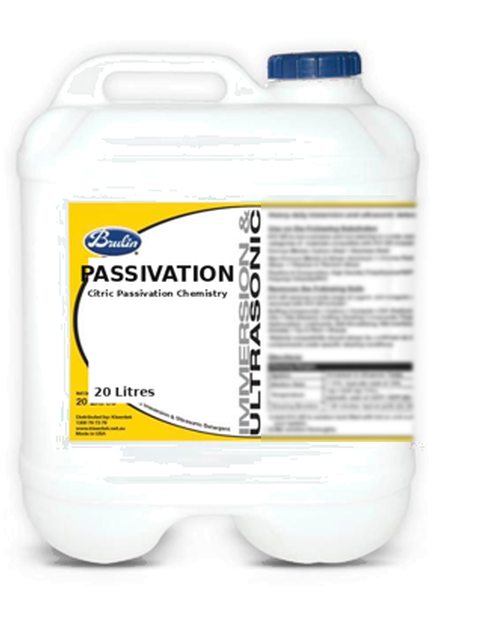
A dilutable citric acid formulation made for passivating stainless steel. It conforms to AMS 2700 Method 2 and to ASTM A380 and A967, and it is built to run alongside immersion and ultrasonic detergents in a multi-stage line.
It is not a detergent. Soil comes off in the degrease stage, in its own bath, before the part ever reaches the passivation tank — passivation on a dirty surface does not work and the data sheet says so plainly.
| From the data sheet | |
|---|---|
| System | Immersion or ultrasonic |
| Dilution | 4.0 – 10.0 % w/w (4.05 – 10.12 % v/v) |
| Bath temperature | 21 – 71 °C |
| Minimum time in solution | 4 minutes at 60 °C · 10 minutes at 49–60 °C · 20 minutes at 38–48 °C · 30 minutes below 38 °C |
| Rinse | Immediately on removal from the bath; final rinse in clean water, de-ionised preferred |
| Concentrate | Clear to slight yellow, water-thin, pH below 1, non-foaming |
Compatible across the corrosion-resistant steel families — austenitic, ferritic, free-machining, precipitation-hardened and martensitic — including 303, 304, 308, 311, 316, 17-4 and 420. The full list is table 4 of AMS 2700. Material compatibility should always be confirmed by testing with your own contaminants and conditions.
Running citric passivation as a production line
- Separate tanks. Degreasing and passivation never share a bath, and each gets its own rinse, so neither contaminates the other.
- Stainless tanks and heaters rated for the acid, with temperature held inside the treatment's band.
- Filtration and bath control. Concentration, pH and dissolved iron are checked on a schedule, and the bath is topped up or replaced before it drifts out of spec.
- Handling sized to the part. Baskets and racks for small parts, overhead carriages for spools and long assemblies.
- Bunding and drainage for the acid and the rinse water. See bunding, platforms and washbays.
For a bench-top or small batch job, a single heated ultrasonic tank per stage does the work. For production, see UltraKleen Pro and SonoLine multi-stage lines, or engineered systems for a line built into a new plant.
Citric acid passivation: common questions
What concentration of citric acid is used for passivation?
ASTM A967 Citric 1, 2 and 3 all use 4 to 10% citric acid by weight. The temperature sets the minimum time: 4 minutes at 60 to 71 °C, 10 minutes at 49 to 60 °C, or 20 minutes at 21 to 49 °C.
Is citric acid passivation as good as nitric?
Both are recognised by ASTM A967 and AMS 2700. NASA comparative studies found citric equal to or better than nitric on the alloys tested, without nitric's fuming acid and NOx handling.
Do parts need cleaning before passivation?
Yes. Oil and soil stop the acid reaching the metal. Degrease first, rinse, then passivate. Ultrasonic cleaning gets into bores, threads and weld areas that a dip alone misses.
How do you test that passivation worked?
With the test your specification names. ASTM A967 lists water immersion, high humidity, salt spray, copper sulphate, potassium ferricyanide and nitric acid (ferroxyl), damp cloth and boiling water tests.
Can Misonics build a citric passivation line?
Yes. We design and supply passivation lines from single tanks to multi-stage production lines with overhead handling, including the chemistry, trials on your parts, installation and commissioning.
Can you passivate stainless steel with citric acid at room temperature?
Yes. ASTM A967 Citric 3 runs at 21 to 49 °C with a minimum immersion of 20 minutes, in 4 to 10% citric acid by weight. A heated bath shortens the time: 10 minutes at 49 to 60 °C and 4 minutes at 60 to 71 °C.
What is the procedure for citric acid passivation?
Degrease, rinse, passivate in the citric bath at the treatment’s temperature and time, rinse twice in DI or RO water, dry, then verify with the test the specification names. Degreasing and passivation each get their own tank and rinse.
Why use ultrasonics for citric passivation?
Ultrasonics keeps fresh solution at the surface, inside bores and under weld spatter. The same applies at the degreasing stage, where ultrasonic cleaning reaches bores, threads and weld areas that a dip alone misses.
Passivating parts now, or planning a line?
Tell us the alloy, the part, how many and which specification it has to meet. Technical sales will come back with the process and the equipment to run it.