CoreKleen Plus
The performance additive for CoreKleen HX
Dosed at 1–2% v/v into the CoreKleen HX bath — the second part of the two-part rust, scale and red-dirt remover. Not a stand-alone cleaner.
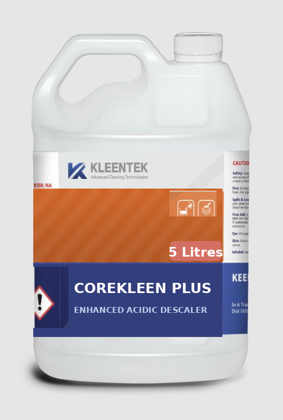
One bath, two parts
CoreKleen Plus is the second part of the CoreKleen HX system, not a cleaner in its own right. It is the performance additive the HX bath is formulated to run with, dosed at 1–2% v/v alongside HX at 20% v/v in the same ultrasonic or immersion tank.
Mildly alkaline (pH 8–10) and not classified as hazardous, it is supplied separately in 10, 20 and 200 L so the bath can be topped up as the additive is consumed. Run the bath at 50–60 °C and titrate it to keep it at working strength.
The solvent in CoreKleen Plus crazes acrylic, polycarbonate and ABS and softens PVC and nitrile, so fit EPDM or Viton seals in the tank. It goes wherever the HX bath goes — steel, cast iron, stainless, aluminium alloys, zinc and titanium — and never on magnesium.
Where it earns its keep
Rust, scale, red dirt and grime on industrial components — always dosed with CoreKleen HX, in ultrasonic and immersion tanks.
Dose: 1–2% v/v, dosed with CoreKleen HX at 20% v/v. The trial sets your exact process values; the TDS governs.
The working process
A freshly cleaned ferrous part is chemically active — protective films gone, surface warm and wet, rinse ions acting as electrolyte. Rust bloom can start within the hour. DI water rinsing slows it; protection stops it.
Inhibitor in the final rinse before hot-air drying, an Anti-Rust dip between processes, or a water-displacing film for storage — matched to the next process. Tell us what happens next and the protection specifies itself.
Right product, right job
Plus — the performance additive
Dosed at 1–2% v/v with HX; never on its own.
CoreKleen HX
The chelating descaler this one doses into
View →Descale
Phosphoric acid for general descaling duty
View →Delivered within Australia. Outside Australia, request a delivered price.
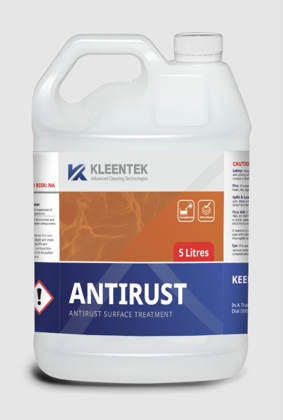 Anti-RustProtect the freshly bared metalView & buy →
| Mild & carbon steel | Carbon steel on the TDS list |
| Stainless steel | Safe in prescribed use |
| Cast iron | Cast iron on the TDS list |
| Aluminium & titanium | Aluminium alloys and titanium on the TDS list |
| Magnesium & soft alloys | Do not use |
| Zinc & galvanised | Zinc on the TDS list — removes white rust |
| Copper & brass | Chelated on prolonged contact — time-limit and test |
| Plated finishes (Cd·Cr·Ni) | Chrome plating and nickel listed; cadmium — test first |
| Plastics & rubbers | HDPE · PP · EPDM · Viton safe; PVC and nitrile soften; acrylic, polycarbonate and ABS craze |
| Painted / coated surfaces | Not on the TDS list — test first |
| Transport | Not classified as Dangerous Goods for road and rail |
This is not a single-use chemical
A common misconception treats industrial chemistry like dishwater — used once, tipped out. A defended bath of CoreKleen Plus works for weeks of production: weir oil separation and filtration defend the bath, solids leave through the filter, and the chemistry keeps working until genuine depletion.
Change out on evidence, not anxiety: when cycle times stretch or results fade at correct concentration, the bath has earned its retirement. Top-ups at specification carry it between changes.
- Skim or weir oils continuously — oil load is bath killer #1
- Filter solids; drain settled sludge from the sump
- Verify concentration on schedule per the TDS check method
- Log it — the trend predicts top-ups before cleaning fades
Drum and bath, both looked after
- Handling: Avoid eye contact and repeated or prolonged skin contact.
- Avoid inhalation of vapour, mist or aerosols.
- Storage: Store in a cool, dry, well-ventilated place and out of direct sunlight.
- Store away from foodstuffs.
- Store away from incompatible materials described in Section 10.
- Store away from sources of heat and/or ignition.
- Keep container standing upright.
- Keep containers closed when not in use - check regularly for leaks.
Lid the tank between shifts — holds temperature, limits evaporation, keeps dust out.
Idle periods: a warm, stagnant aqueous bath can support biological growth over extended stagnation. Circulate periodically, keep concentration at specification, never leave an open tank standing for weeks.
Extended shutdown: drain to sealed, labelled containers — or schedule changeover for restart day.
The paperwork, on the page
Hazard identification
PPE & exposure controls
- National Occupational Exposure Limits: TWA STEL NOTICES ppm mg/m3 ppm mg/m3 (2-Methoxymethylethoxy) propanol 50 308 Sk As published by Safe Work Australia.
- Product Name: Corekleen Plus Reference No: KT-CC-CKPS Issued: 2026-01-01 Version: 1.1 Safety Data Sheet TWA - The time-weighted average airborne concentration over an eight-hour working day, for a five-day working week over an entire working life.
- STEL (Short Term Exposure Limit) - the average airborne concentration over a 15 minute period which should not be exceeded at any time during a normal eight-hour workday. ‘Sk' Notice - absorption through the skin may be a significant source of exposure.
- The exposure standard is invalidated if such contact should occur.
- These Exposure Standards are guides to be used in the control of occupational health hazards.
- All atmospheric contamination should be kept to as low a level as is workable.
- These exposure standards should not be used as fine dividing lines between safe and dangerous concentrations of chemicals.
- They are not a measure of relative toxicity.
- If the directions for use on the product label are followed, exposure of individuals using the product should not exceed the above standard.
- The standard was created for workers who are routinely, potentially exposed during product manufacture.
First aid
- If poisoning occurs, contact a doctor or Poisons Information Centre (Phone Australia 131 126, New Zealand 0800 764 766).
- Inhalation: Remove victim from exposure - avoid becoming a casualty.
- Remove contaminated clothing and loosen remaining clothing.
- Allow patient to assume most comfortable position and keep warm.
- Keep at rest until fully recovered.
- Seek medical advice if effects persist.
- Skin Contact: If skin or hair contact occurs, remove contaminated clothing and flush skin and hair with running water.
- If swelling, redness, blistering or irritation occurs seek medical assistance.
- Eye Contact: If in eyes wash out immediately with water.
- In all cases of eye contamination it is a sensible precaution to seek medical advice.
Storage & handling
- Handling: Avoid eye contact and repeated or prolonged skin contact.
- Avoid inhalation of vapour, mist or aerosols.
- Storage: Store in a cool, dry, well-ventilated place and out of direct sunlight.
- Store away from foodstuffs.
- Store away from incompatible materials described in Section 10.
- Store away from sources of heat and/or ignition.
- Keep container standing upright.
- Keep containers closed when not in use - check regularly for leaks.
Disposal
- Persons conducting disposal, recycling or reclamation activities should ensure that appropriate personal protection equipment is used, see "Section 8.
- Exposure Controls and Personal Protection" of this SDS.
- If possible material and its container should be recycled.
- If material or container cannot be recycled, dispose in accordance with local, regional, national and international Regulations.
Transport & dangerous goods
- Not classified as Dangerous Goods by the criteria of the "Australian Code for the Transport of Dangerous Goods by Road & Rail" and the "New Zealand NZS5433:
- Transport of Dangerous Goods on Land".
- MARINE TRANSPORT Not classified as Dangerous Goods by the criteria of the International Maritime Dangerous Goods Code (IMDG Code) for transport by sea.
- AIR TRANSPORT Not classified as Dangerous Goods by the criteria of the International Air Transport Association (IATA) Dangerous Goods Regulations for transport by air.
Asked at the tank
What dilution and temperature do I run?
Why do my parts flash rust after cleaning?
When do I change the bath?
Will it attack my tank?
Can I get the SDS before buying?
Not sure which chemical? See which chemical for which metal and soil.
Prove it on your parts
The trial pairs CoreKleen Plus with your components — concentration, temperature and cycle documented before you order a drum. Wrong chemistry for your soil? The trial says so.
Filter bags for this bath
The bag is what keeps the bath working — it takes the soil out before it settles back onto the next load. This is a alkaline bath, and that rules the media in and out before micron rating comes into it.
Rated to pH 14. Start at 25 µm unless something downstream needs finer.