Article №4 ended on an honest problem: real baskets carry mixed reality — heavy soil beside delicate detail, castings beside finished faces — and a single frequency must compromise on one of them. Dual-frequency platforms refuse the compromise. Here is how they work, and the architecture question that separates the genuine article from the brochure version.
A dual-frequency machine runs two working bands through the same bath — typically an aggressive band (25–28 kHz) and a fine band (45–80 kHz, up to 130 on precision platforms). The process alternates: the low band breaks and bulk-lifts the heavy soil, the high band finishes detail and fine passages the big bubbles bridged over. Sequencing through the bands, sometimes repeatedly, cleans mixed loads to a standard neither band reaches alone — and shortens exposure at the aggressive end, which is exactly what soft substrates want.
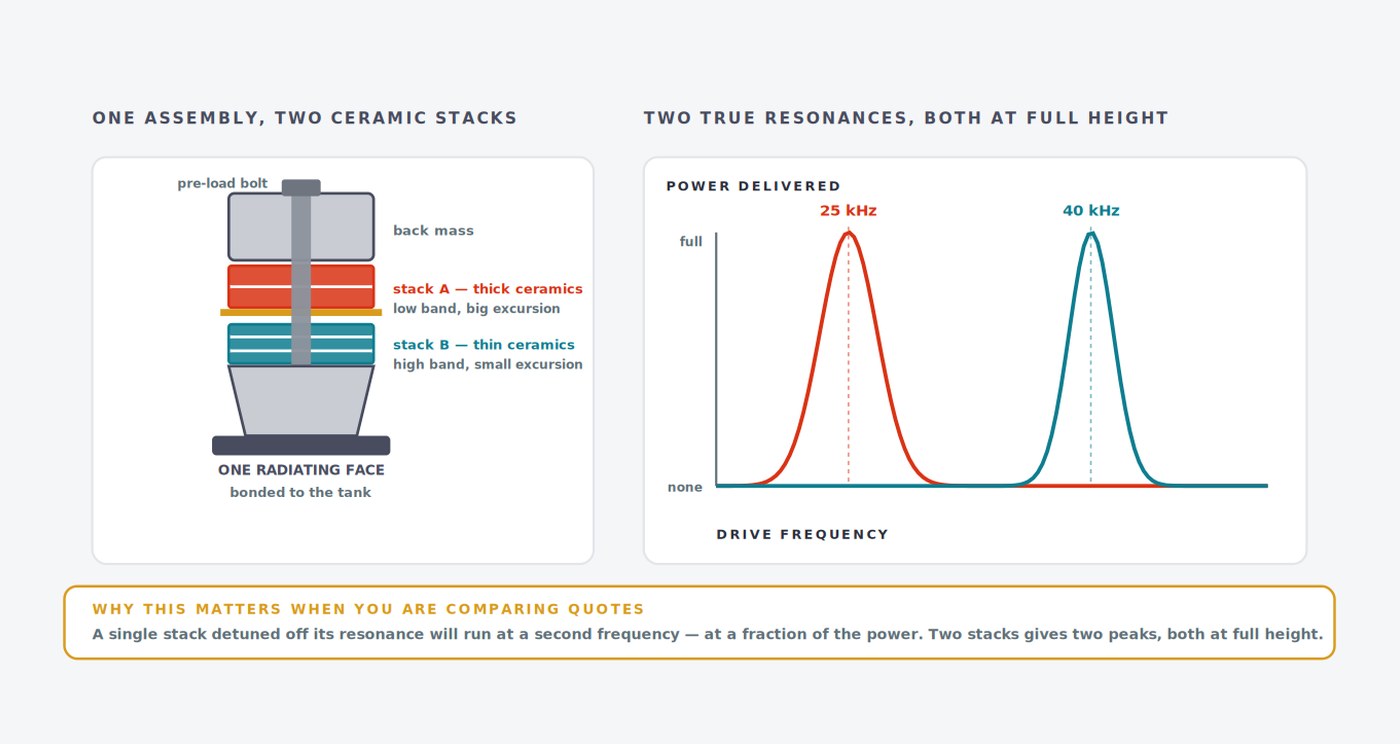
Here is where buyers get fooled. A transducer is a resonant system — it delivers full power at resonance and falls off a cliff away from it. Some "dual frequency" products take a single-resonance transducer and simply drive it at a second frequency it was never built for: the panel shows two numbers, the tank delivers one honest frequency and one weak impostor.
Our dual-frequency platforms use dual-piezo BLT transducers — two resonant stacks in one assembly, sharing one radiating face, each driven at its own true resonance. Both frequencies arrive at full, honest power. Ask any dual-frequency vendor which architecture they run; the pause tells you plenty.
The sequence case makes itself in a trial log: bulk contamination mass removed in the low-band pass, surface-finish and fine-passage results after the high band, exposure time per band recorded against substrate limits from №4. That log is also your process document when a customer asks how alloy parts survived aggressive cleaning — sequencing is damage control you can show an auditor.
Ring-groove carbon at low band, finished faces at high — dimensional results on file from our 70 °C QR-NF work.
Read the study: ring-groove carbon, dimensions untouched →Mixed soils on one part — carbon in the grooves, films on the finished faces. The classic rebuild profile.
Mixed parts in one shop — a jobbing workshop cleaning castings before lunch and instruments after. One tank, both duties.
Soft substrates with hard soils — aluminium and brass carrying baked deposits: short aggressive exposure, then finish gentle. Sequencing is the damage-control strategy from №4, automated.
And when you do not: single-soil production lines running one part family forever are better served by one perfectly chosen frequency — cheaper, simpler, nothing to misuse. Dual frequency is a flexibility purchase; buy it when your reality is mixed.
The cleanest demonstration of dual frequency is a single mixed-reality part: an alloy cylinder head carrying baked combustion carbon and machined sealing faces. Low band alone clears the carbon but spends long exposure near soft surfaces; high band alone polishes detail while the carbon laughs. Sequenced, the low band works in short bursts and the high band finishes — total aggressive exposure drops by half or more while the result improves at both ends of the part.
Genuine dual frequency runs two resonant piezo stacks in one transducer body — each driven at its own true resonance, sharing one radiating face.Dual-piezo BLT architecture; see the cutaway diagram above.
Consider the part that sells more dual-frequency platforms than any brochure: a basket of injector bodies carrying baked external carbon and micron-scale internal drillings. Single-band thinking fails in both directions — low frequency alone risks the lapped seats and cannot enter the drillings usefully; high frequency alone nibbles at heavy external coke for an hour. The sequenced cycle runs it in two movements: a short, deliberate low-band pass in hot alkaline chemistry to demolish the external carbon — minutes, not the whole cycle, exposure capped to protect the substrate — then the high-band finishing pass, where the finer cavitation works the drillings, galleries and seat areas that are the actual point of the part.
The process card records what an auditor and a warranty manager both want: band, time, temperature, chemistry and concentration per movement. The same pattern scales across the workload — heavy demolition then fine finish — for cylinder heads with polished cam bores, transmission valve bodies, pump internals. And where the workload does not have this two-nature character, the honest advice stands: skip the dual-frequency premium and buy the single band that fits, better specified.
The sequence trial shows low-band, high-band and combined results on your actual parts — the flexibility case, proven or dismissed.