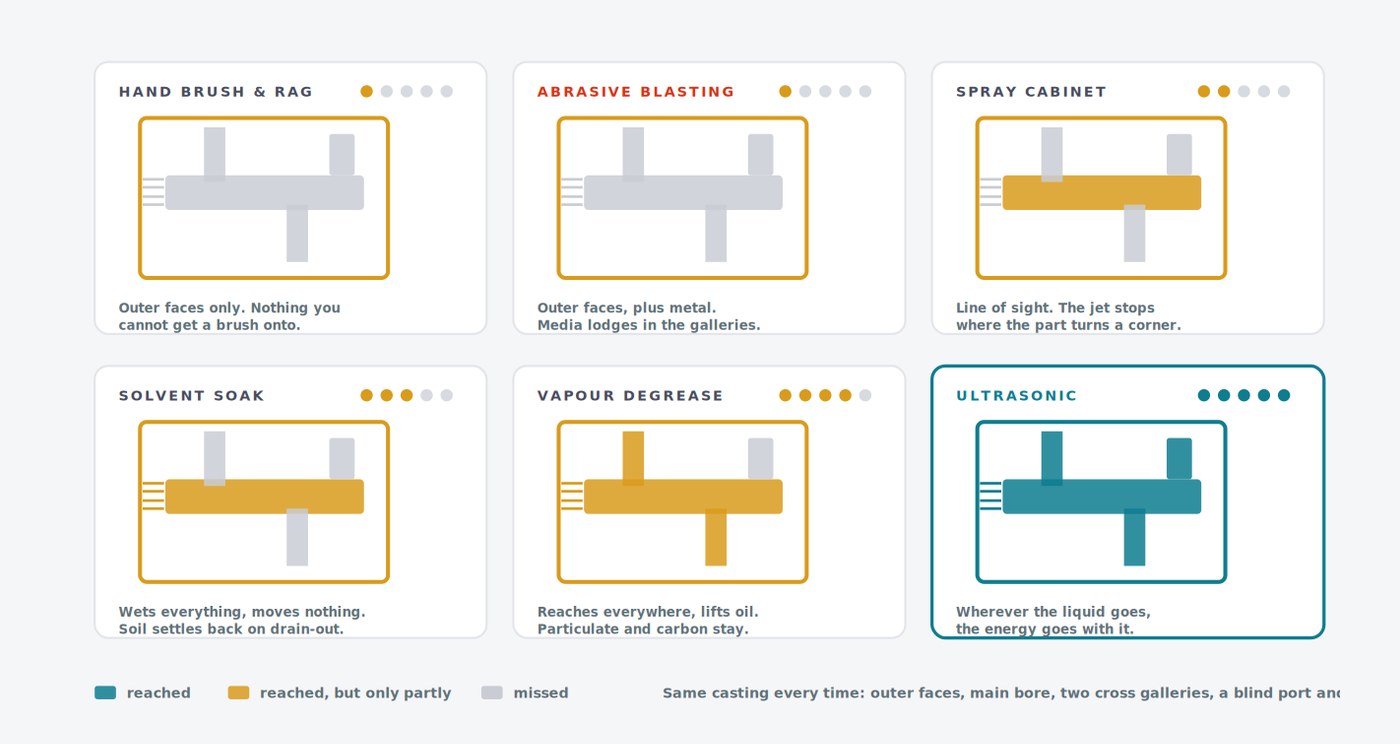
Six ways industry gets parts clean, compared without the sales gloss — including the jobs where ultrasonics is the wrong answer, because knowing those is how you trust us on the rest.
Every cleaning method is a way of delivering energy to contamination. Muscle, pressure, abrasive impact, solvency, heat, cavitation — the physics differs, and so do the side effects. The right question is never "which method is best?" It is "which method removes my soil from my part without costing me something I care about?" Here is the field, honestly.
Infinitely flexible, zero capital, and the most expensive method ever devised once you multiply minutes by wages. Its real costs hide in variability — every operator scrubs differently — and in damage: a scraper finds soft metal, a wire brush rounds edges, and neither reaches inside anything. As a pre-clean for gross soil, though, a thirty-second wipe still earns its keep — more on that in the process article.
Fast on large accessible surfaces and unbeatable for shifting mud off a loader. But spray needs line-of-sight: it cannot turn corners, cleans blind holes by hope, and at close range can drive contamination deeper into galleries and bearings. Water management and mist containment are its quiet operating costs. In multi-stage machines it earns a place as a bulk-removal stage — not a finisher.
Genuinely fast on heavy corrosion and coatings, and the right call on structural steel heading for paint. On precision components it is the most dangerous method on this list: it removes parent metal, rounds the edges that seal, and embeds media in soft alloys — media that later migrates out and circulates through the machine you just rebuilt. The part looks superb. The engine disagrees.
Excellent on fresh oils and greases — like dissolves like. But solvents stall completely on polymerised and inorganic soils: baked carbon, varnish and scale are no longer chemically similar to anything a solvent can grab. Add compliance and disposal load, plus flammability rules near heat, and the traditional solvent bath is shrinking to niches.
The gold standard for final-stage oil removal at volume: distilled solvent condensing on cool parts, in a sealed modern machine, delivers repeatable spotless results. It is capital-intensive, chemistry-restricted, and does nothing for particles or inorganic soils — a precision finisher, not a general cleaner. Where the specification demands it, we supply the fluid.
Cavitation delivers its energy through the liquid itself, so it works wherever liquid reaches — blind holes, galleries, threads, the inside of an exchanger — at full intensity, touching nothing. Paired with the right chemistry it removes both particles and films in the same cycle, to a repeatable, documentable endpoint. Its honest limits: parts too big for any tank, soils where no liquid contact is possible, and jobs so crude that a pressure washer's speed simply wins.
| Method | Reaches hidden geometry | Touches the part | Repeatable | Best at | Watch out for |
|---|---|---|---|---|---|
| Hand | No | Yes — hard | Operator-dependent | Gross pre-wipe, odd jobs | Labour cost, damage, variability |
| Pressure / spray | Line-of-sight only | Water impact | Fair | Bulk external soil | Drives soil deeper, mist, water handling |
| Blasting | Line-of-sight only | Yes — abrasive | Fair | Corrosion & coatings pre-paint | Metal loss, embedded media |
| Solvent soak | Wherever liquid sits | No | Fair | Fresh oils & greases | Stalls on carbon/scale, compliance |
| Vapour degrease | Yes (condensing) | No | Excellent | Final-stage oil removal at volume | Capital, solvent rules, no particles |
| Ultrasonic | Yes — full intensity | No | Excellent — logged | Complex parts, mixed soils, spec cleaning | Needs right chemistry & degassed bath |
Methods that reach hidden geometry without touching the part occupy exactly two rows — and only one of them also removes particles, runs aqueous, and scales from a benchtop to 42,000 litres. That overlap is why ultrasonics anchors modern industrial cleaning.
Internal and complex geometry. The only method delivering full cleaning energy inside galleries, drillings and bundles with no line of sight.
Dimension-critical parts. Nothing abrades, nothing embeds, no metal leaves. Ring grooves gauge the same after as before — the whole argument for rebuilders and MRO.
Mixed contamination. Particles and films go in one cycle — jobs that otherwise chain two or three methods.
Auditable repeatability. Time, temperature, chemistry, frequency — set, logged, identical for every basket. Try writing a hand-scrubbing SOP an auditor accepts.
Labour release. The tank cleans unattended while the operator does skilled work. The payback maths usually ends there.
Method comparisons usually stop at capability. Operating economics decide harder: hand cleaning bills every minute at labour rates; blasting consumes media and then bills you again in rework when embedded grit surfaces; solvent programs pay compliance rent forever. Ultrasonic lines invert the curve — capital up front, then chemistry-and-power operating costs that fall per part as volume rises, with labour released rather than consumed. On repeated part families the crossover typically arrives within the first year.
A cylinder head that takes forty minutes of hand scraping cleans in one unattended basket cycle — with the operator doing skilled work elsewhere.Misonics rebuild-shop application experience; trial data available per part family.
The methods table is not static — regulation keeps deleting rows. The US EPA finalised its ban on methylene chloride in 2024: consumer paint-stripping uses went first, and most remaining commercial uses are prohibited after April 2026, with other jurisdictions tracking the same direction. The drop-in solvent replacements (benzyl alcohol, dibasic esters) are honest but slower — literature and field experience agree they work one coating layer at a time, in hours where MC took minutes. The industrial answer that actually restores the speed is energy: heated chemistry plus cavitation, which is exactly the Alloy System pattern for strip work and the aqueous-ultrasonic pattern everywhere else. Every solvent that leaves the market makes the energy argument stronger.
Zinc diecast carburettors stripped and decarbonised aluminium-safe — the classic post-MC conversion.
Read the first study: brass lock components (trial T-3173) →Structural steel heading for paint wants blasting. Mud on a chassis wants a pressure washer. A one-off oddball with easy access may never justify a tank. And very-high-volume final oil removal to a solvent specification belongs in vapour plant. When your parts land in those categories, our trial says so — that honesty is cheaper for both of us than a machine you resent.
The strongest tell that ultrasonics fits your work: you are cleaning the same family of parts repeatedly, they carry mixed soil or internal geometry, and either dimensions or documentation matter. Two of those three, and the trial is worth a box of parts.
One trial, your worst components — and a documented recommendation, even when it isn't us.