Glassware clean enough to trust the next result
A film you cannot see is a variable you cannot control. Ultrasonic cleaning strips residues from glassware, frits and fittings without abrasion — and the same tank degasses solvents and disperses samples.
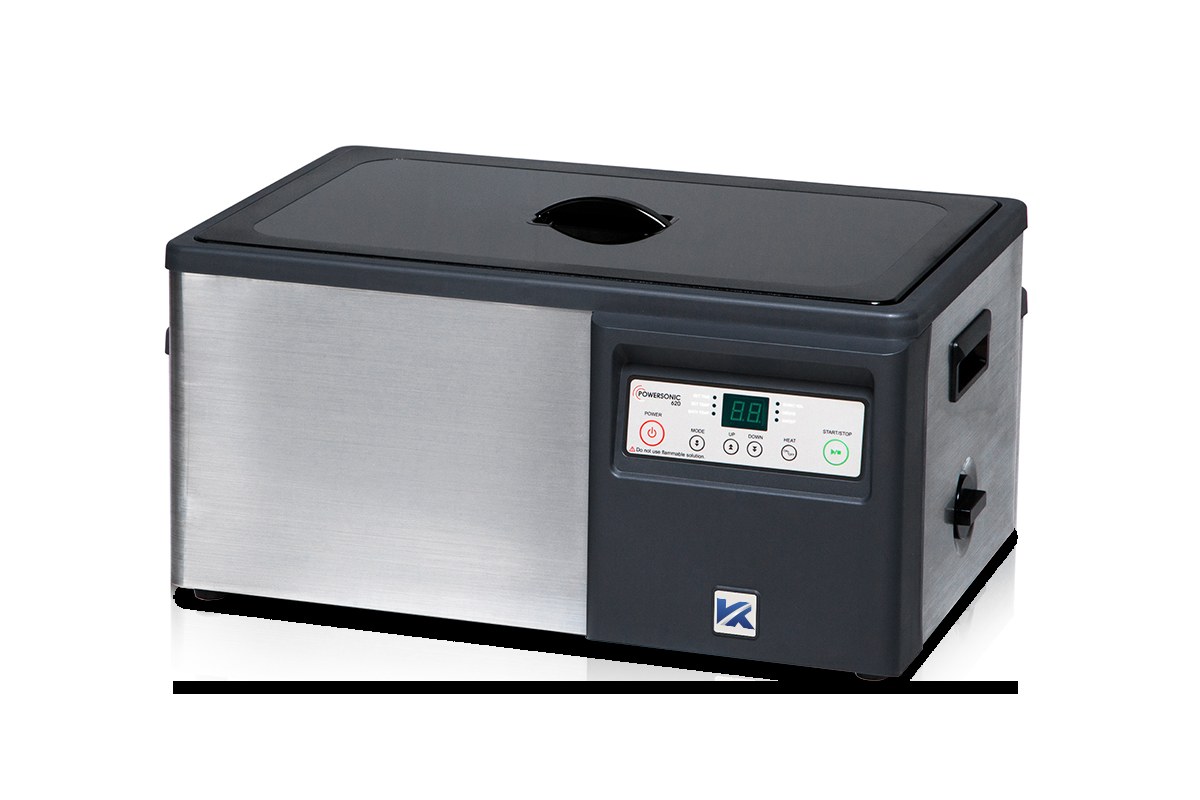
Three lab jobs, one bench machine
Pipettes, flasks, condensers, joints and frits — residue films and baked deposits removed without brushes that scratch graduations and wear ground joints.
Valves, fittings, filters, small mechanical parts from rigs and instruments — cleaned to assembly standard between runs.
Degas mode purges dissolved gases from solvents and buffers (HPLC mobile phases, dissolution media); short bursts disperse and dissolve stubborn samples.
What goes in the basket
Why labs standardise on it
Removes the invisible variable
Trace films from previous work are cross-contamination waiting to publish. Cavitation plus the right detergent removes them to a rinse-water-clean endpoint.
Gentle on the expensive stuff
No brush scratching on graduated, ground or optical surfaces — the non-contact clean is why labs trust it with the glassware that costs real money.
Two instruments in one
The cleaning tank doubles as the degasser and sample-prep bath — bench space and budget both approve.
The machines labs buy
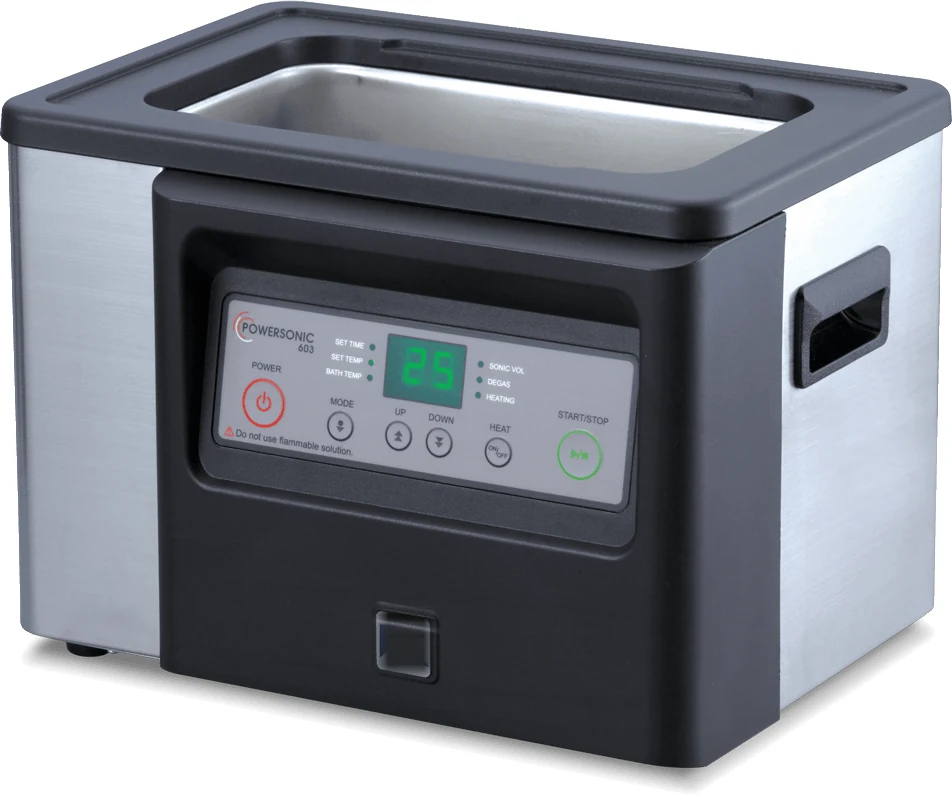
PS 603
Bench-side: daily glassware, small fittings, solvent degassing.
View or buy →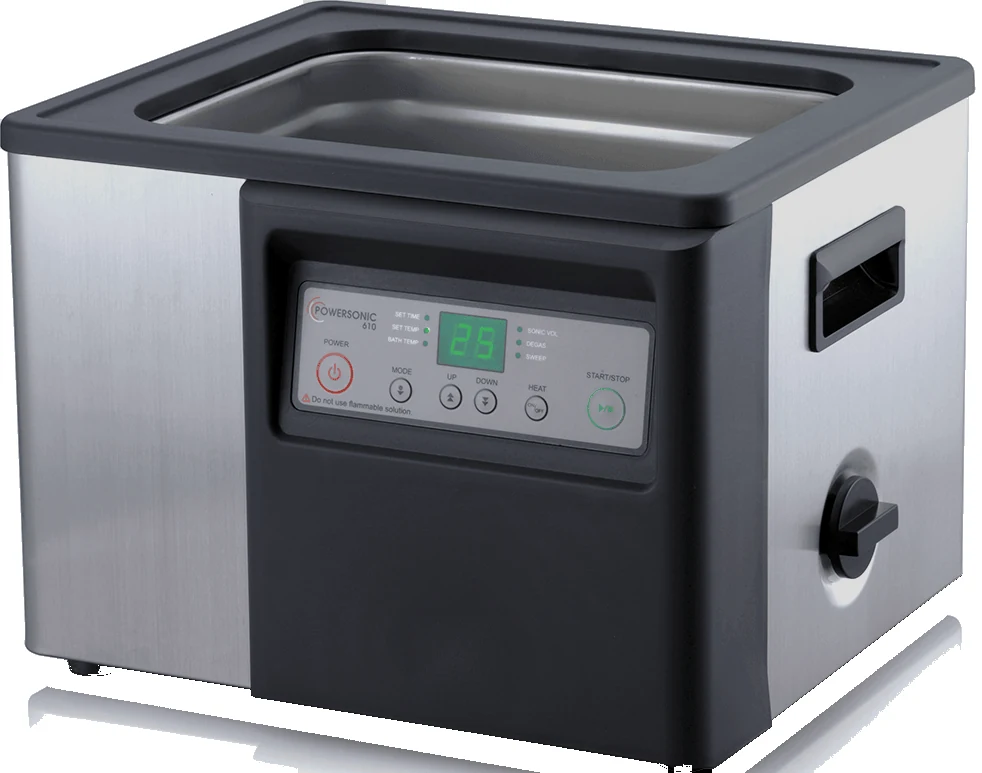
PS 610
Wash-up room: batch glassware and apparatus in the full-width basket.
View or buy →For dedicated critical cleaning at higher throughput, the MSX range adds capacity and duty cycle. PowerSonic units are also available through our laboratory equipment reseller network — ask us for your nearest stockist.
Typical starting cycle — refined in your first week
| Chemistry | Laboratory glassware detergent; DI-water final rinse |
| Temperature | 40–60 °C (per detergent) |
| Power | Low (optics/graduated) · Med (general) |
| Time | 3–10 minutes · degas 5 min after fresh fill |
| Then | DI rinse · dry · store covered |
Starting points only — part condition, chemistry and load set the final card. We help you dial it in.
Asked every week
Will it damage graduated or volumetric glassware?
Can it clean sintered glass frits?
Does degas mode replace vacuum degassing?
What about optics and sensors?
Water quality for rinsing?
Best ultrasonic cleaner for a laboratory: the shortlist
Bench-side or wash-up room, by throughput.
Daily glassware, small fittings and solvent degassing beside the bench.
Batch glassware and apparatus in the full-width basket.
SS316 tanks, stored recipes and the duty cycle for dedicated critical cleaning at higher throughput.
Run a laboratory glassware detergent at 40–60 °C with a DI-water final rinse, and degas a fresh fill for five minutes. Read how to choose the best industrial ultrasonic cleaner.
What are you cleaning?
Tell us what the part is, what comes off it, and what it has to pass. Technical sales will tell you whether ultrasonics is the right answer for that part and what it takes to run it on your own floor.