Two tanks, same size, same price. One says 1,000 W, the other 1,800 W. The bigger number wins the order — and quite possibly cleans worse. Ultrasonic power ratings are the most gamed number in this industry, and cutting through them takes ten minutes of physics and one rule of thumb. Both are below.
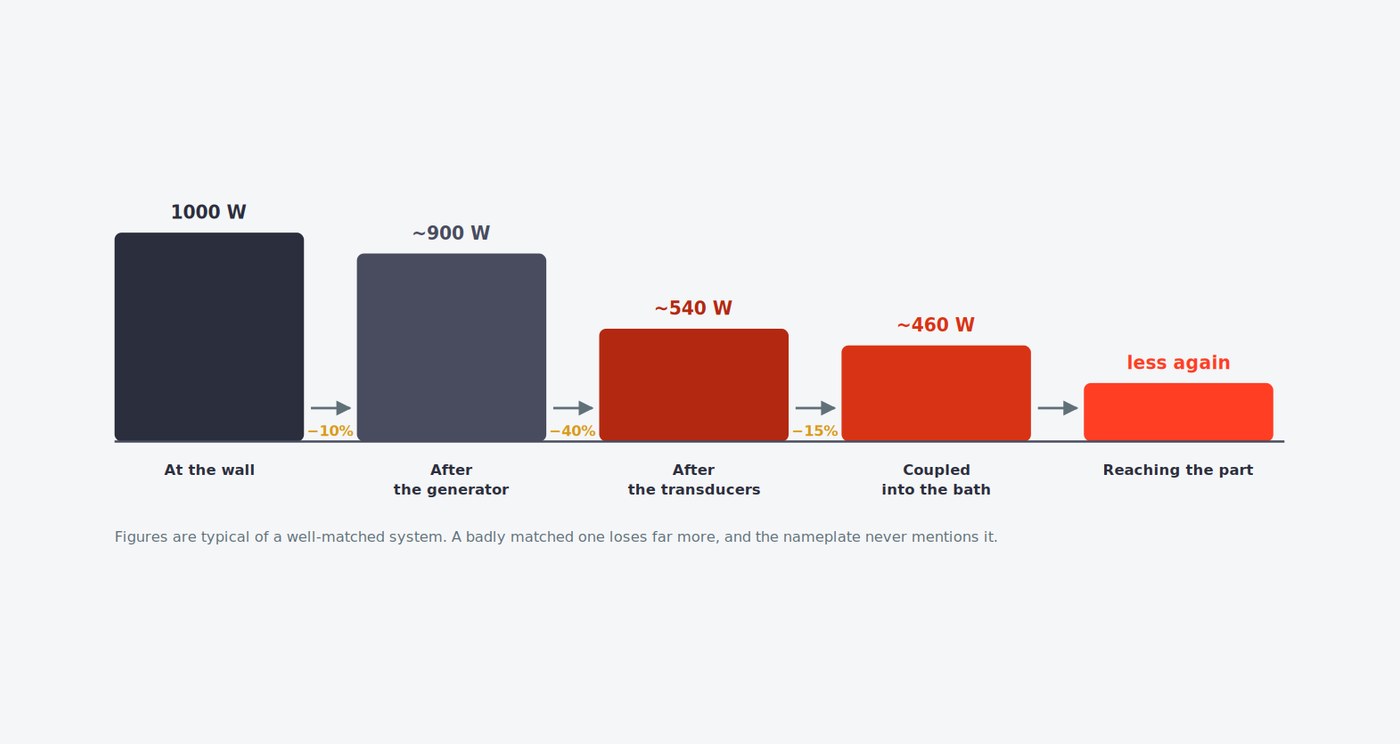
A watt is one joule per second — a rate of energy delivery, not a quantity of cleaning. What removes soil is accumulated energy actually converted into cavitation at your part, over the cycle. Between the nameplate and the part sit three taxes: how the number was measured, how efficiently it converts, and how it distributes through the bath. Vendors quote the number before tax.
Is that average RMS power or a peak figure? Is it electrical input or acoustic output (up to 95% conversion on a VarioSonic-class platform; far less on cheap drives)? And is it delivered at resonance under load — or on a bench into a matched dummy? Honest vendors answer in one breath. The pause is the datasheet.
Delivered power spread through bath volume — watts per litre — is the useful comparator, and our own range runs roughly 20–60 W/L depending on duty: small precision tanks at the dense end, large industrial volumes leaner. Two warnings before you weaponise it. First, the number scales non-linearly: a 40 L bench tank thrives at densities that would be absurd (and unnecessary) in a 4,000 L pit, because established fields in large volumes sustain cavitation more efficiently — lab W/L figures do not transplant to production tanks. Second, distribution beats density: 30 honest W/L spread evenly (sweep, sensible transducer layout, №9) outcleans 45 W/L concentrated in stripes.
Under-powered tanks never establish a working field — the cavitation threshold simply isn't crossed in parts of the bath, and no cycle time compensates. Over-powered tanks waste capital and, at the extreme, surface-etch delicate work and accelerate transducer erosion. Right-sized is soil- and load-dependent, which is why our quotes name delivered power, density and distribution for your basket — and why the trial, not the brochure, verifies it.
The measurement culture exists if you ask for it: calibrated cavitation meters read delivered intensity at position and depth, and a vendor confident in their nameplate will meter it in front of you. We do — it is five minutes, and it reprices most comparisons on the spot.
The BAE-pattern cost workbook — energy, chemistry and labour per cleaned part, ready to publish as a study.
Read the study: the cost-modelled passivation switch →Ask every vendor: average acoustic watts under load? W/L for my volume? conversion efficiency? distribution method? Then ask for foil-test results at depth. Five questions, and the gamed datasheets leave the room by themselves.
One worked example seals the method. Two 100-litre tanks: A claims 1,800 W peak input; B claims 1,000 W average acoustic at resonance under load. A converts at perhaps 60% and never states the measure; B states everything. B's honest 10 W/L of delivered field beats A's brochure 18 W/L of marketing — and the foil test settles it in a minute if anyone argues. The datasheet question is never "how many watts?"; it is "watts of what, measured where?"
Electrical-to-acoustic conversion efficiency on a VarioSonic-class generator at tracked resonance — the difference between input watts and watts that clean.VarioSonic G5 platform specification; efficiency claims per Technology Bible.
Put the lesson to work on the comparison that lands on every buyer's desk: Quote A, "2,400 W ultrasonic power, 100 L, $14,000." Quote B, "1,500 W, 100 L, $21,000." On a spreadsheet, A wins twice. Now apply the questions. Is A's figure peak or average RMS? Peak claims can flatter by a factor of two or more — brochure watts, not bath watts. What is the conversion efficiency of the generator and transducer chain? A premium chain converting up to 95% can put more real acoustic energy into the liquid from a smaller electrical number than a budget chain converting half of it. Does the power hold under load — full basket, hot bath, end of shift — or does it sag as an untracked generator drifts off resonance while the tank warms? And what is the power density in W/L at the working volume you will actually run? Ask all four in writing and the spreadsheet usually inverts: B delivers more cleaning energy to the parts, holds it all shift, and does it without the cheap-chain failure modes that turn a bargain into a transducer rebuild.
None of this requires taking anyone's word — including ours. Specify acceptance by measurement: a foil map at commissioning, or a metered cavitation reading at agreed positions and depth, written into the purchase. A vendor who resists measured acceptance of their own nameplate has answered the question already.
The trial measures the field your parts actually need — delivered watts, density and distribution, documented.